What Are the Key Differences in Nation Building in Latin America?
TL;DR
Nation building in Latin America differs from Europe due to a lack of prolonged international wars, colonial legacies, and internal conflicts. While European nation-states often emerged from military conflicts, Latin American states have frequently mobilized their militaries against internal threats, which has impacted their political and economic development.
Transcript
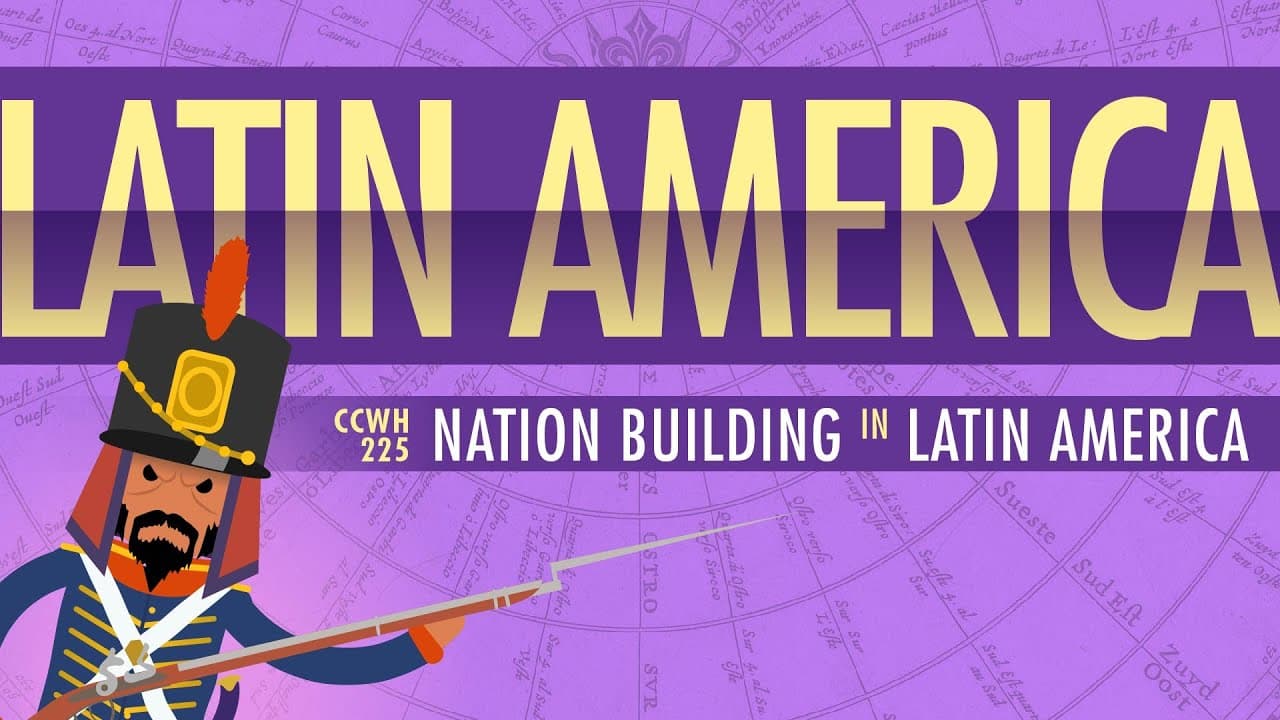
Hi, I'm John Green. This is Crash Course World History, and today we're gonna return to two of our favorite themes: the creation of nation-states and the role of war. And we're gonna focus on a region that often gets overlooked in world history, Latin America. Wait, Mr. Green, Mr. Green--there's another America? Where they speak Latin? Well, yes an... Read More
Key Insights
- The theory by Charles Tilly suggests that European nation-states emerged through coercive institutions and international wars, a model not directly applicable to Latin America.
- Latin American states are often perceived as ruled by military strongmen, but this is a reflection of state weakness rather than strength.
- The absence of prolonged international wars in Latin America is a factor in the region's different political and economic development compared to Europe.
- Geographic diversity and inhospitable borders in Latin America have limited opportunities for international conflicts, affecting state formation.
- Latin American countries often mobilize their military against internal threats rather than external, with civil wars being more common than international wars.
- Colonial legacies and racial and class divisions have hindered the development of strong nation-states in Latin America.
- European states benefited economically from colonialism, which contrasts with Latin America's destructive wars for independence.
- The historical success of European nation-states is specific to their context and should not be universalized as a model for Latin America.
Install to Summarize YouTube Videos and Get Transcripts
Explore YouTube Video Summarizer or Get YouTube Transcript Extractor
Questions & Answers
Q: How does Charles Tilly's theory of state formation apply to Latin America?
Charles Tilly's theory suggests that states form through coercive institutions and international wars, which strengthen state power. However, in Latin America, this model is less applicable due to the region's unique historical context, including limited international wars and colonial legacies that shaped different political and economic trajectories.
Q: What role did military regimes play in Latin American state formation?
Military regimes in Latin America often reflect state weakness rather than strength. While the stereotype of military strongmen exists, many Latin American states lacked the capacity to raise large armies or sustain prolonged wars, leading to internal conflicts and military mobilization against their own citizens rather than external threats.
Q: Why have international wars been less common in Latin America?
International wars have been less common in Latin America due to geographic diversity and inhospitable borders, which reduce opportunities for conflict. Additionally, many Latin American countries view themselves as part of a larger community, reducing the likelihood of prolonged international wars compared to Europe.
Q: How have colonial legacies affected nation-building in Latin America?
Colonial legacies in Latin America have left deep racial and class divisions, hindering the development of cohesive nation-states. The ruling Creole class feared losing power to lower classes, and these divisions prevented the armed forces from uniting people across different social and economic backgrounds, unlike in European states.
Q: What economic factors differentiate European and Latin American nation-states?
European nation-states benefited from colonialism, extracting wealth from colonies, while Latin American states began with destructive wars for independence. This economic advantage allowed European states to focus on citizen welfare and internal peace, contrasting with Latin America's struggles with economic and political stability.
Q: How does the absence of external enemies affect nationalism in Latin America?
The absence of external enemies in Latin America has limited the development of strong nationalist sentiments. Unlike Europe, where external threats fostered nationalism, Latin American countries often faced internal divisions and lacked a unified national identity, with Creoles seeing themselves as different from indigenous populations but similar to elites in neighboring nations.
Q: What lessons can be drawn from the comparison between European and Latin American states?
The comparison highlights that the success of European nation-states is specific to their historical context and should not be seen as a universal model. Latin America's distinct path, shaped by colonial legacies and internal conflicts, demonstrates the complexity of nation-building and the need to consider unique regional factors.
Q: How have recent developments in Latin America challenged historical narratives?
Recent economic growth in many Latin American countries challenges historical narratives of failure and instability. These developments remind us that history is ongoing, and past comparisons with European states should not overshadow the potential for positive change and development in Latin America.
Summary & Key Takeaways
-
John Green explores the differences in nation-building between Latin America and Europe, emphasizing the unique historical contexts of each region. He challenges the notion that Latin America's lack of international wars impeded its growth, suggesting instead that colonial legacies and internal conflicts played significant roles.
-
The video discusses Charles Tilly's theory that war creates states, noting its limited applicability to Latin America due to the region's distinct historical and geographic factors. It highlights how internal conflicts and the absence of strong external threats shaped Latin American state formation differently from Europe.
-
Green examines the impact of colonial legacies, racial and class divisions, and the lack of prolonged international wars on Latin America's political and economic development. He argues that these factors, rather than a simple lack of war, explain the region's divergent path from European nation-states.
Read in Other Languages (beta)
Share This Summary 📚
Summarize YouTube Videos and Get Video Transcripts with 1-Click
Try YouTube Summary with ChatGPT & Claude or YouTube Transcript Generator
Explore More Summaries from CrashCourse 📚




Summarize YouTube Videos and Get Video Transcripts with 1-Click
Try YouTube Summary with ChatGPT & Claude or YouTube Transcript Generator