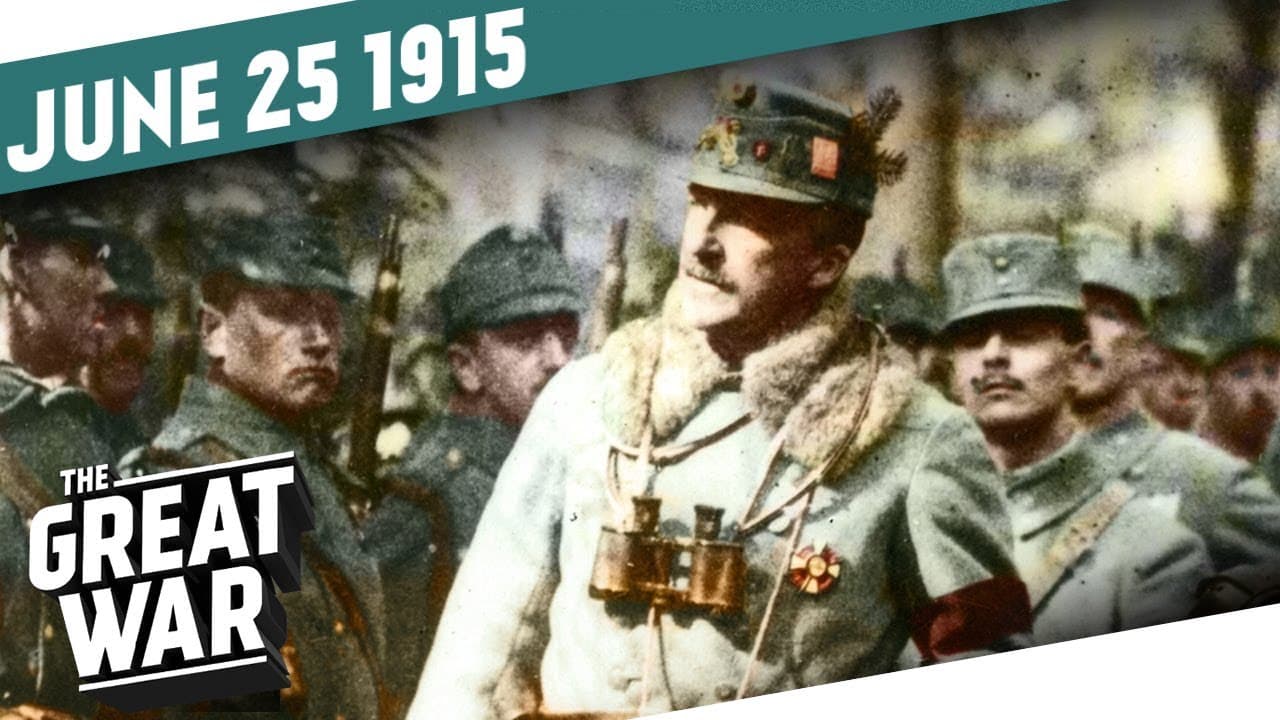
The Austro-Hungarian Empire Strikes Back I THE GREAT WAR Week 48
TL;DR
Austro-Hungarian forces reclaim Lemberg, reversing Russian gains.
Transcript
The Austro-Hungarian Imperial army had fought so badly during the early months of the war that by the spring of 1915 it had seemed on the verge of collapse. It had not only been humiliated, it had lost huge amounts of land and even one of the great cities of the Empire, Lemberg, but this week, after six weeks of triumphant advance, the Empire took ... Read More
Key Insights
- The Austro-Hungarian army, previously on the brink of collapse, regained momentum with German support, reclaiming lost territories including Lemberg.
- The Second Battle of Artois ended with significant French casualties, as the French aimed to prevent German troop movements eastward.
- Despite victories, the Austro-German forces suffered heavy casualties, with 600,000 troops put out of action between April and June.
- The Russian front shrank dramatically, with the Austro-German advance pushing the Russians back over a significantly reduced battle line.
- Internal Russian political turmoil included the resignation request of Ivan Goremykin and the dismissal of War Minister Vladimir Sukhomlinov.
- Italy's entry into the war opened a new front against Austria-Hungary, but the Italian army faced challenges due to undertraining and lack of artillery.
- The Italian Chief of Staff Luigi Cadorna's aggressive strategy faced difficulties due to the challenging terrain and strong Austrian defenses.
- The Austro-German success in reclaiming Lemberg marked a significant shift in the Eastern Front, with Russia in retreat and facing internal chaos.
Install to Summarize YouTube Videos and Get Transcripts
Explore YouTube Video Summarizer or Get YouTube Transcript Extractor
Questions & Answers
Q: What was the significance of reclaiming Lemberg for the Austro-Hungarian Empire?
Reclaiming Lemberg was a major victory for the Austro-Hungarian Empire, reversing the losses they had suffered earlier in the war. It symbolized a resurgence of their military capabilities and morale, as they managed to regain a strategically important city that had been under Russian control since September. This success, achieved with German support, marked a turning point on the Eastern Front, showcasing the effectiveness of the Austro-German alliance.
Q: How did the Second Battle of Artois impact French military strategy?
The Second Battle of Artois had a significant impact on French military strategy, as it resulted in 100,000 French casualties. The battle was part of a series of attacks intended to prevent the Germans from transferring troops to the Eastern Front to fight Russia. Although the French aimed to relieve pressure on their Russian allies, the high casualty rate highlighted the challenges of their offensive strategy and the formidable German defenses, prompting a reevaluation of their approach on the Western Front.
Q: What were the challenges faced by the Italian army after entering the war?
After Italy entered the war, its army faced several challenges on the new front against Austria-Hungary. The Italian forces were largely undertrained compared to other warring nations, and they suffered from a lack of modern artillery, with only 120 heavy guns available. The terrain was particularly challenging, as the front was located in the highest mountains in Europe. Additionally, the Italian Chief of Staff Luigi Cadorna's aggressive strategy was hampered by the strong Austrian defenses and the difficult mountainous terrain.
Q: What internal political issues did Russia face during this period?
During this period, Russia faced significant internal political turmoil. Ivan Goremykin, the President of the Council of Ministers, experienced a breakdown and requested to be replaced, but the Tsar did not grant this request. Additionally, several ministers advised the Tsar against convening the Duma and expressed concerns about Russia's ability to continue the war. The dismissal of War Minister Vladimir Sukhomlinov on charges of negligence further highlighted the political instability, as did the demands for a new government acceptable to liberals, set to be addressed by recalling the Fourth Duma on August 1st.
Q: How did the Austro-German forces manage to push back the Russians?
The Austro-German forces managed to push back the Russians through a well-coordinated campaign that combined the strengths of both armies. The Gorlice-Tarnow Offensive, which began in May 1915, played a crucial role in erasing eight months of Russian gains within weeks. The Austro-German force, numbering over 500,000 men, utilized superior artillery and strategic planning to outmaneuver and overwhelm the Russian forces, who were in retreat and suffering from logistical and supply issues. Despite their victories, the Austro-German forces incurred significant casualties, demonstrating the high cost of their advance.
Q: What role did German General Mackensen play in the Austro-Hungarian victories?
German General August von Mackensen played a pivotal role in the Austro-Hungarian victories on the Eastern Front. He led the central force of the German offensive, which was instrumental in the successful recapture of Lemberg. Mackensen's strategic acumen and effective use of artillery, with 2,500 big guns at his disposal, allowed his forces to outmatch the Russians. His leadership was recognized with a promotion to Field Marshall, underscoring his significant contribution to the Austro-German campaign and the reversal of Russian gains.
Q: What were the consequences of the Austro-German victories for Russia?
The Austro-German victories had severe consequences for Russia, both militarily and politically. The recapture of Lemberg and the Russian retreat highlighted the weaknesses in Russia's military capabilities, such as being outgunned and underequipped. The loss of territory and strategic positions further demoralized Russian forces. Politically, the defeats exacerbated internal strife, leading to leadership changes and calls for government reform. The chaos on the battlefield mirrored the instability at home, as Russia struggled to maintain its war effort amidst growing discontent and political pressure.
Q: How did the Italian Chief of Staff Luigi Cadorna's strategy compare to Russian military plans?
Luigi Cadorna's strategy for the Italian army involved a rapid breakthrough on the Isonzo front, aiming to penetrate deep into Austro-Hungarian territory. His plan was ambitious, envisioning an advance through the Julian Alps into the heart of the Austro-Hungarian Empire. In comparison, Russian military plans in April focused on pushing through the Carpathians into the Hungarian plains. While both strategies aimed at significant territorial gains, the Russian plans were considered more realistic given the terrain and logistical challenges. Cadorna's strategy faced difficulties due to the rugged mountain terrain and strong Austrian defenses, highlighting the challenges of executing such ambitious plans.
Summary & Key Takeaways
-
The Austro-Hungarian army, with German assistance, managed to reclaim Lemberg, reversing months of Russian territorial gains. This marked a significant shift in momentum on the Eastern Front, demonstrating the effectiveness of the Austro-German alliance.
-
Despite the Austro-German victories, the campaign came at a high cost, with hundreds of thousands of troops lost. Meanwhile, internal political strife in Russia compounded their military setbacks, leading to leadership changes and calls for government reform.
-
Italy's entry into the war opened a challenging new front against Austria-Hungary. The Italian army, under the command of Chief of Staff Luigi Cadorna, faced difficulties due to the mountainous terrain and strong Austrian defenses, resulting in heavy casualties.
Read in Other Languages (beta)
Share This Summary 📚
Summarize YouTube Videos and Get Video Transcripts with 1-Click
Try YouTube Summary with ChatGPT & Claude or YouTube Transcript Generator
Explore More Summaries from The Great War 📚
Summarize YouTube Videos and Get Video Transcripts with 1-Click
Try YouTube Summary with ChatGPT & Claude or YouTube Transcript Generator