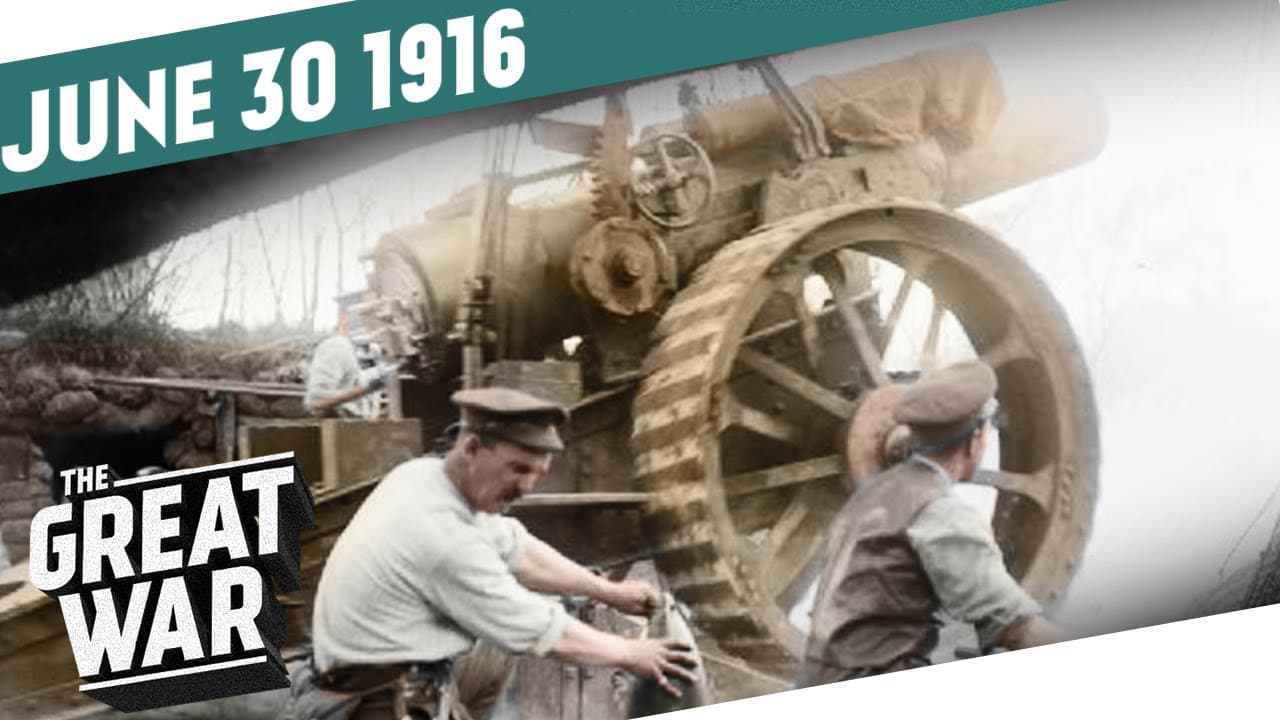
British Artillery At The Somme - Brusilov Offensive Implodes I THE GREAT WAR Week 101
TL;DR
Brusilov Offensive stalls as Somme artillery barrage begins.
Transcript
You’re at war. You’re a general. You launch an offensive that does serious damage to the enemy and reaches the point where it may decide the war; all you need is for your army’s other generals to attack your other enemy and prevent him from reinforcing the enemy you’re crushing. But what happens when that diversion doesn’t divert? Let’s find out. I... Read More
Key Insights
- The Brusilov Offensive, led by General Alexei Brusilov, initially gained significant ground against Austro-Hungarian forces but faced challenges due to lack of support from other Russian generals.
- German Chief of Staff Erich von Falkenhayn sought to take control of the Eastern Front, frustrated by Austrian failures and the need to reinforce the Austrians against the Russians.
- The British began a massive artillery barrage at the Somme, which, despite firing over 1.7 million shells, failed to significantly damage deep German defenses.
- The Italian front saw the Austrians use poison gas against Italian forces, but the Italians eventually regained lost ground, boosting morale and public support for General Luigi Cadorna.
- Internal dissent in Germany was rising, exemplified by a large protest involving 55,000 workers and the sentencing of anti-war politician Karl Liebknecht.
- The Somme offensive was delayed due to heavy rains and concerns over the effectiveness of the artillery barrage, highlighting the challenges of coordinating large-scale military operations.
- The Austro-Hungarian Chief of Staff Conrad von Hotzendorf faced criticism for his strategic decisions, which resulted in significant losses against both Russian and Italian forces.
- The personal impact of war was poignantly illustrated by a letter from Captain Charles May, who expressed his fears and hopes before being killed at the Somme.
Install to Summarize YouTube Videos and Get Transcripts
Explore YouTube Video Summarizer or Get YouTube Transcript Extractor
Questions & Answers
Q: What was the main goal of the Brusilov Offensive?
The main goal of the Brusilov Offensive was to break through Austro-Hungarian lines and force a decisive victory against them. General Alexei Brusilov aimed to exploit the weaknesses in the Austro-Hungarian defenses and capture significant territory, which would potentially lead to a collapse of the Austro-Hungarian front and relieve pressure on other Allied fronts.
Q: Why was the British artillery barrage at the Somme considered ineffective?
The British artillery barrage at the Somme was considered ineffective because, despite the massive number of shells fired, many were duds or failed to penetrate the deep German dugouts. This limited the damage to German defenses and did not significantly weaken their positions, leading to concerns about the success of the upcoming infantry assault and necessitating a delay in the offensive.
Q: How did the Austrians use poison gas in the Trentino?
In the Trentino, the Austrians used hydrocyanide gas to attack Italian positions, causing significant casualties among the Italian troops. However, the gas later blew back onto the Austrian lines, resulting in casualties on their side as well. This incident highlighted the unpredictable and dangerous nature of chemical warfare during World War I.
Q: What were the consequences of the protests in Germany?
The protests in Germany, involving 55,000 workers, demonstrated significant public discontent with the ongoing war and the hardships it caused. The government's response included expelling Karl Liebknecht from the Reichstag and sentencing him to hard labor for his anti-war stance. These actions reflected the growing internal pressures and challenges faced by the German government in maintaining support for the war effort.
Q: Why did the Brusilov Offensive stall?
The Brusilov Offensive stalled due to a combination of factors, including the lack of support from other Russian generals who failed to launch coordinated attacks against the Germans. This allowed German reinforcements to stabilize the front. Additionally, the Russians faced logistical challenges and were nearing their operational limits, which hindered their ability to maintain momentum and achieve a decisive breakthrough.
Q: What role did Erich von Falkenhayn play on the Eastern Front?
Erich von Falkenhayn, the German Chief of Staff, played a crucial role in stabilizing the Eastern Front by sending German divisions to reinforce the Austro-Hungarian army against the Russian Brusilov Offensive. Frustrated by Austrian failures, he sought to take control of the Eastern Front by proposing German leadership over Austrian forces, aiming to prevent further Russian advances and maintain the integrity of the Central Powers' positions.
Q: How did the Italian public perceive General Luigi Cadorna's leadership?
The Italian public, desperate for positive news, largely supported General Luigi Cadorna's leadership after the Italians regained lost territory against the Austrians. The press portrayed him as a strategic genius, despite earlier failures and significant Italian casualties. This public perception was influenced by the need for national morale and the desire to see Italian forces succeed on the battlefield.
Q: What personal impact did the Battle of the Somme have on soldiers?
The Battle of the Somme had a profound personal impact on soldiers, as illustrated by the poignant letter from Captain Charles May. He expressed his fears of dying and leaving his family behind, highlighting the emotional toll and the personal sacrifices made by soldiers. His letter, written just before he was killed, underscores the human cost of war and the deep personal connections that were threatened by the conflict.
Summary & Key Takeaways
-
The Brusilov Offensive, initially successful against Austro-Hungarian forces, faced setbacks due to lack of support from other Russian generals, allowing German reinforcements to stabilize the front.
-
The British launched a massive artillery barrage at the Somme, firing over 1.7 million shells, but the effectiveness was limited, leading to a delay in the planned offensive.
-
Internal dissent in Germany was highlighted by large-scale protests and the imprisonment of anti-war politician Karl Liebknecht, reflecting growing public discontent with the war.
Read in Other Languages (beta)
Share This Summary 📚
Summarize YouTube Videos and Get Video Transcripts with 1-Click
Try YouTube Summary with ChatGPT & Claude or YouTube Transcript Generator
Explore More Summaries from The Great War 📚
Summarize YouTube Videos and Get Video Transcripts with 1-Click
Try YouTube Summary with ChatGPT & Claude or YouTube Transcript Generator