What Is the History of the Portuguese Language?

TL;DR
The Portuguese language evolved from Vulgar Latin and is the sixth most spoken language in the world. Its history includes significant Arabic influence, the development of Galician-Portuguese, and widespread global use due to colonial expansion. Today, Brazilian Portuguese differs notably from European Portuguese, reflecting diverse regional influences.
Transcript
The Portuguese language! The sixth most spoken language in the world by number of native speakers, spread across Europe, Africa, Asia and of course South America! A Romance language with complex phonetics, influenced by languages from all continents, and with a sound often defined as… a drunk Russian trying to speak Spanish. Pffff! Вы ничего не ... Read More
Key Insights
- Portuguese is the sixth most spoken language globally, with influences from various continents, showcasing its rich phonetic diversity.
- The language originates from Vulgar Latin, evolving through the Roman Empire's expansion, leading to the birth of Romance languages.
- Galician-Portuguese, the precursor to modern Portuguese, developed in the Iberian Peninsula, highlighting the complex linguistic evolution in the region.
- Portuguese has significant Arabic influences due to historical interactions, evident in words starting with 'al-' and others like 'oxalá'.
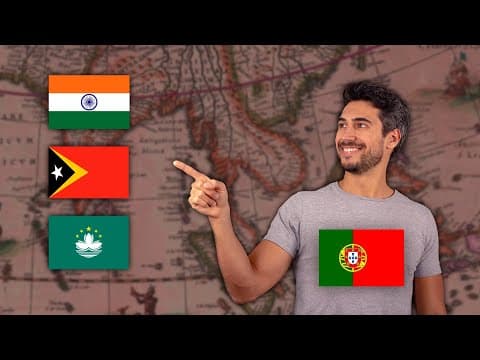
- The Portuguese language spread through colonial expansion, adapting and integrating local languages' influences in Asia, Africa, and South America.
- Brazilian Portuguese differs significantly from European Portuguese due to historical, cultural, and media influences post-independence.
- Regional dialects within Portuguese-speaking countries have influenced each other, contributing to the language's dynamic evolution.
- A new European Portuguese pronunciation course is being developed to address the lack of online resources for learning this language variant.
Install to Summarize YouTube Videos and Get Transcripts
Explore YouTube Video Summarizer or Get YouTube Transcript Extractor
Questions & Answers
Q: What is the origin of the Portuguese language?
The Portuguese language originates from Vulgar Latin, which evolved during the Roman Empire's expansion. It developed into Galician-Portuguese in the Iberian Peninsula, a precursor to modern Portuguese. This evolution was influenced by various historical and geographical factors, including the spread of the Roman Empire and subsequent regional developments.
Q: How did Arabic influence the Portuguese language?
Arabic influenced the Portuguese language significantly during the Muslim presence in the Iberian Peninsula. This influence is evident in the vocabulary, with many Portuguese words starting with 'al-' derived from Arabic. Additionally, the word 'oxalá' reflects this historical linguistic interaction, showcasing the deep-rooted Arabic impact on Portuguese.
Q: What role did colonial expansion play in the spread of Portuguese?
Colonial expansion played a crucial role in spreading the Portuguese language globally. As Portugal established colonies in Asia, Africa, and South America, the language adapted to local contexts, integrating elements from native languages. This interaction enriched Portuguese, contributing to its global presence and diverse dialects across different continents.
Q: Why is Brazilian Portuguese different from European Portuguese?
Brazilian Portuguese differs from European Portuguese due to historical, cultural, and media influences. Brazil's independence in 1822 and subsequent development during the radio and television era led to distinct linguistic evolution. These factors, combined with regional interactions, resulted in notable differences in pronunciation, vocabulary, and grammar between the two variants.
Q: How have regional dialects influenced the Portuguese language?
Regional dialects have significantly influenced the Portuguese language by integrating local linguistic elements. This dynamic interaction has led to diverse dialects within Portuguese-speaking countries. For example, African Bantu languages, Asian languages, and indigenous South American languages have all contributed to the enrichment and evolution of Portuguese vocabulary and phonetics.
Q: What is the significance of the 'Liga Romanica' project?
The 'Liga Romanica' project is significant as it promotes the understanding and appreciation of Romance languages, including Portuguese. Through livestreams and discussions in various Romance languages, the project fosters linguistic diversity and cross-cultural exchange. It serves as a platform for language enthusiasts to explore and celebrate the richness of Romance languages globally.
Q: What resources are available for learning European Portuguese?
Several resources are available for learning European Portuguese, including online courses, podcasts, and free downloadable materials. The upcoming European Portuguese pronunciation course aims to fill the gap in online resources, providing learners with structured guidance on mastering the unique phonetic aspects of this language variant. Additionally, platforms like Patreon offer exclusive content for dedicated learners.
Q: What is the historical significance of the 'Will of King Afonso II'?
The 'Will of King Afonso II,' dated 1214, holds historical significance as it is considered the oldest document written in Portuguese. This document marks a pivotal moment in the linguistic evolution from Galician-Portuguese to modern Portuguese. It symbolizes the formal recognition and establishment of Portuguese as a distinct language, reflecting its cultural and historical importance.
Summary & Key Takeaways
-
The Portuguese language, a Romance language, ranks as the sixth most spoken globally. It evolved from Vulgar Latin during the Roman Empire's expansion, leading to the development of Galician-Portuguese in the Iberian Peninsula. The language's history is marked by significant Arabic influence and global spread through colonial expansion.
-
Portuguese has adapted to various regional influences, integrating elements from Cantonese, Malay, Bantu languages, and indigenous Tupi-Guarani languages. These interactions have enriched its vocabulary and phonetics, resulting in diverse dialects across continents, with Brazilian Portuguese notably differing from European Portuguese.
-
A new European Portuguese pronunciation course is in development to fill the gap in online resources for this language variant. The initiative aims to support learners in mastering the unique phonetic aspects of European Portuguese, with the course expected to launch in early 2023.
Read in Other Languages (beta)
Share This Summary 📚
Summarize YouTube Videos and Get Video Transcripts with 1-Click
Try YouTube Summary with ChatGPT & Claude or YouTube Transcript Generator
Explore More Summaries from Portuguese With Leo 📚



Summarize YouTube Videos and Get Video Transcripts with 1-Click
Try YouTube Summary with ChatGPT & Claude or YouTube Transcript Generator