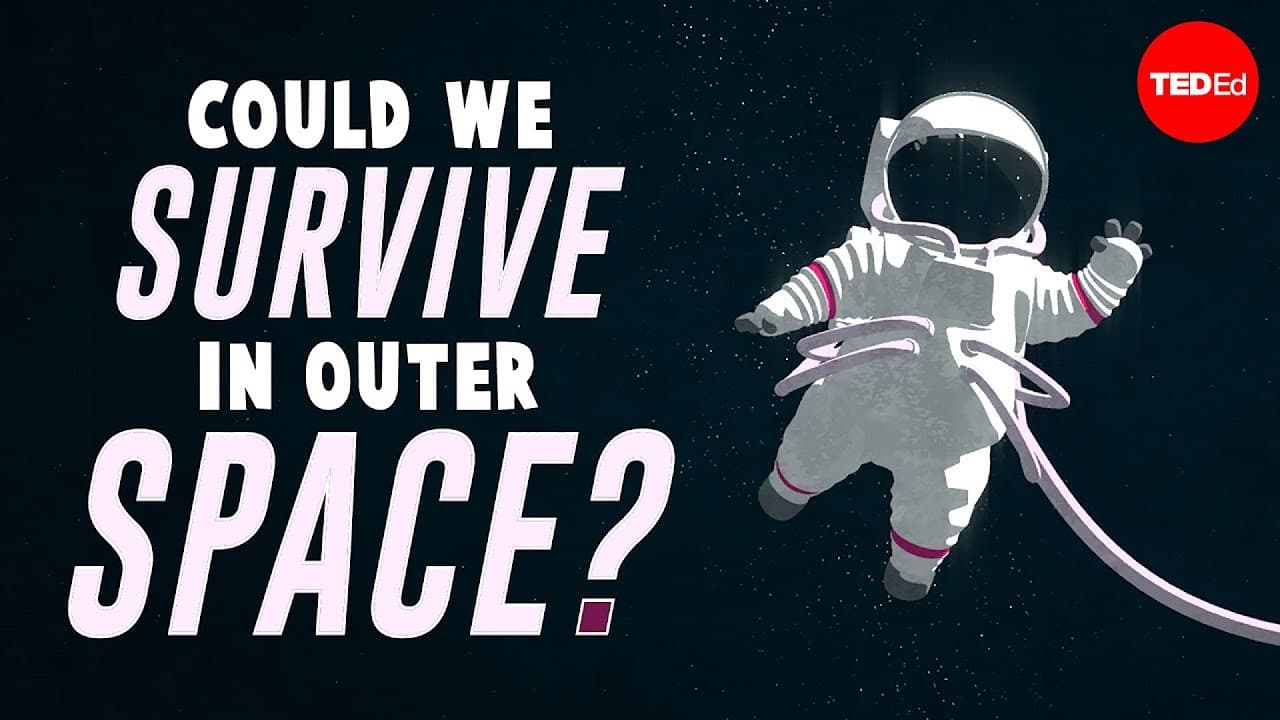
Could we survive prolonged space travel? - Lisa Nip
TL;DR
Space travel presents challenges like radiation and microgravity, but humans might evolve using gene editing and microbial engineering.
Transcript
Prolonged space travel takes a severe toll on the human body. Microgravity impairs muscle and bone growth, and high doses of radiation cause irreversible mutations. As we seriously consider the human species becoming space-faring, a big question stands. Even if we break free from Earth's orbit and embark on long-duration journeys among the stars, ... Read More
Key Insights
- 🛀 Humans have adapted to harsh environments in the past, showing the potential for evolution in response to challenges.
- 👾 Gene editing technology could be leveraged to protect against radiation exposure in space.
- ☠️ Microbial engineering inside the human body could signal bone and muscle cells to counteract the effects of microgravity.
- 👾 Ethical considerations are essential when considering radical alterations to human genetics for space travel.
Install to Summarize YouTube Videos and Get Transcripts
Explore YouTube Video Summarizer or Get YouTube Transcript Extractor
Questions & Answers
Q: What challenges does microgravity pose for human bone and muscle health in space travel?
Microgravity in space inhibits the cues that keep human bone and muscle cells healthy on Earth, leading to conditions like osteoporosis and muscle atrophy.
Q: How might gene editing technology be used to combat radiation exposure in space?
Gene editing could potentially be used to engineer humans to express energy-harvesting systems found in fungi that convert radiation into useful energy and protect DNA.
Q: How could humans potentially adapt physiologically to survive in harsh space environments?
Through gene therapy and microbial engineering, humans could potentially develop protective abilities against radiation and microgravity to thrive in space conditions.
Q: What ethical considerations surround using gene editing and microbial engineering for space travel?
The ethical implications of altering human genetics for space travel, including potential consequences and long-term effects, need to be carefully considered before implementation.
Summary & Key Takeaways
-
Prolonged space travel poses challenges to the human body, such as muscle and bone growth impairment in microgravity and mutations from radiation.
-
Humans have adapted to extreme environments in the past, showing the potential for physiological adaptations for survival.
-
Gene editing and microbial engineering could potentially help humans develop protective abilities for space travel.
Read in Other Languages (beta)
Share This Summary 📚
Summarize YouTube Videos and Get Video Transcripts with 1-Click
Try YouTube Summary with ChatGPT & Claude or YouTube Transcript Generator
Explore More Summaries from TED-Ed 📚




Summarize YouTube Videos and Get Video Transcripts with 1-Click
Try YouTube Summary with ChatGPT & Claude or YouTube Transcript Generator