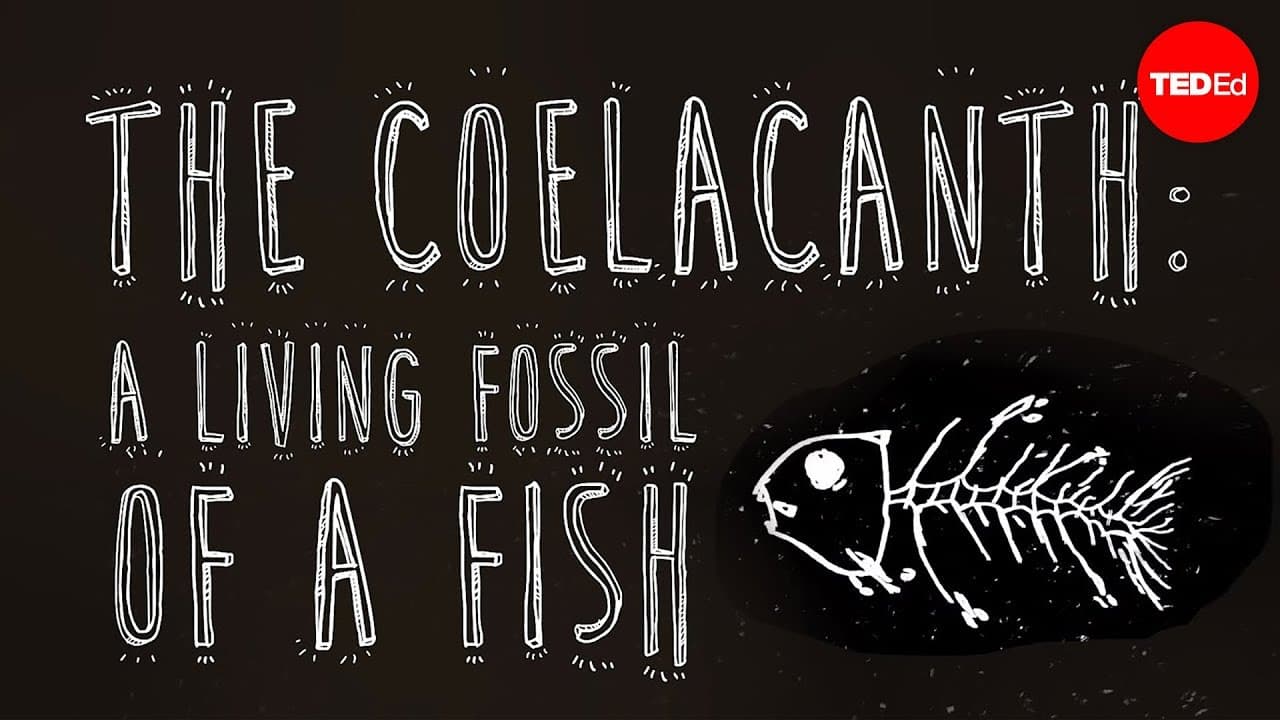
The coelacanth: A living fossil of a fish - Erin Eastwood
TL;DR
The coelacanth, a prehistoric fish thought extinct, reappeared and holds key insights into vertebrate evolution and land transition.
Transcript
The dead coming back to life sounds scary. But for scientists, it can be a wonderful opportunity. Of course, we're not talking about zombies. Rather, this particular opportunity came in the unlikely form of large, slow-moving fish called the coelacanth. This oddity dates back 360 million years, and was believed to have died out during the same mass... Read More
Key Insights
- 📣 The rediscovery of the coelacanth challenges assumptions about extinction and highlights gaps in scientific knowledge.
- 🫒 Genetic and morphological similarities to land vertebrates make the coelacanth a living record of vertebrate evolution.
- 🇫🇮 The coelacanth's fins, resembling limbs, provide crucial insights into the movement of vertebrates from water to land.
- 🍻 The reproduction method of the coelacanth hints at its evolutionary history and its link to mammalian ancestors.
- 🌊 The coelacanth symbolizes the mysteries of evolution and the vast knowledge still to uncover in the study of vertebrates and ocean depths.
- 💦 The coelacanth's existence offers a unique window into the migration of vertebrates from water to land over millions of years and its impact on human evolution.
- 🇫🇮 The fins of the coelacanth act as an evolutionary bridge between fish and land vertebrates, offering clues to the transition from water to land.
Install to Summarize YouTube Videos and Get Transcripts
Explore YouTube Video Summarizer or Get YouTube Transcript Extractor
Questions & Answers
Q: How did the discovery of the coelacanth challenge scientific understanding of extinct species?
The coelacanth's rediscovery in 1938 proved that not all species believed extinct actually are, highlighting the gaps in scientific knowledge about the survival of ancient organisms.
Q: What makes the coelacanth a critical species for understanding vertebrate evolution?
The coelacanth's genetic and morphological similarities to land vertebrates provide valuable insights into the transition of vertebrates from water to land over millions of years.
Q: Why are the coelacanth's fins significant in the study of evolution?
The coelacanth's lobe-finned structure, similar to limbs, and shared genetic sequences with land vertebrates offer important clues about how vertebrates evolved from water to land.
Q: How does the unique reproduction method of the coelacanth hint at its evolutionary history?
The fact that coelacanths give birth to live young, unlike most fish, aligns them more closely with mammals and adds to the understanding of vertebrate evolution over time.
Summary & Key Takeaways
-
The coelacanth, a large fish thought extinct for millions of years, resurfaced in 1938, revealing a living fossil.
-
Its genetic and morphological similarities to four-limbed vertebrates make it a crucial link in understanding vertebrate evolution.
-
The coelacanth's unique fins offer insights into the transition of vertebrates from water to land.
Read in Other Languages (beta)
Share This Summary 📚
Summarize YouTube Videos and Get Video Transcripts with 1-Click
Try YouTube Summary with ChatGPT & Claude or YouTube Transcript Generator
Explore More Summaries from TED-Ed 📚






Summarize YouTube Videos and Get Video Transcripts with 1-Click
Try YouTube Summary with ChatGPT & Claude or YouTube Transcript Generator