LISA | The Biggest Space Mission Ever
TL;DR
Lisa, a spacecraft launching in 2034, will revolutionize gravitational wave detection by exploring supermassive black hole mergers and early universe physics.
Transcript
In the center of every galaxy is a supermassive black hole a black hole that can be millions or billions of times the mass of our Sun that a kind of the most extreme object in the universe and Sometimes they collide with each other this is something unfortunately you'll never be able to see directly because they don't give out light that black hole... Read More
Key Insights
- 👋 Lisa, launching in 2034, is a spacecraft aimed at revolutionizing gravitational wave detection.
- 🖤 Supermassive black hole mergers can be detected by Lisa, providing unique insights into galaxy formation.
- ❓ The spacecraft will measure the Hubble constant accurately, crucial for understanding the universe's expansion.
- 🤩 Lisa's ability to see orbiting white dwarf stars and early universe phenomena makes it a groundbreaking mission.
- 👶 The spacecraft will explore new physics, potentially uncovering signals of new forces or testing theories like cosmic super strings.
- 👾 Lisa's technology, tested in earlier missions like Lisa Pathfinder, promises revolutionary advancements in space exploration.
- 👋 The spacecraft's capability to probe the early universe and study gravitational waves makes it a crucial tool for scientific discovery.
Install to Summarize YouTube Videos and Get Transcripts
Explore YouTube Video Summarizer or Get YouTube Transcript Extractor
Questions & Answers
Q: What makes Lisa different from ground-based gravitational wave detectors?
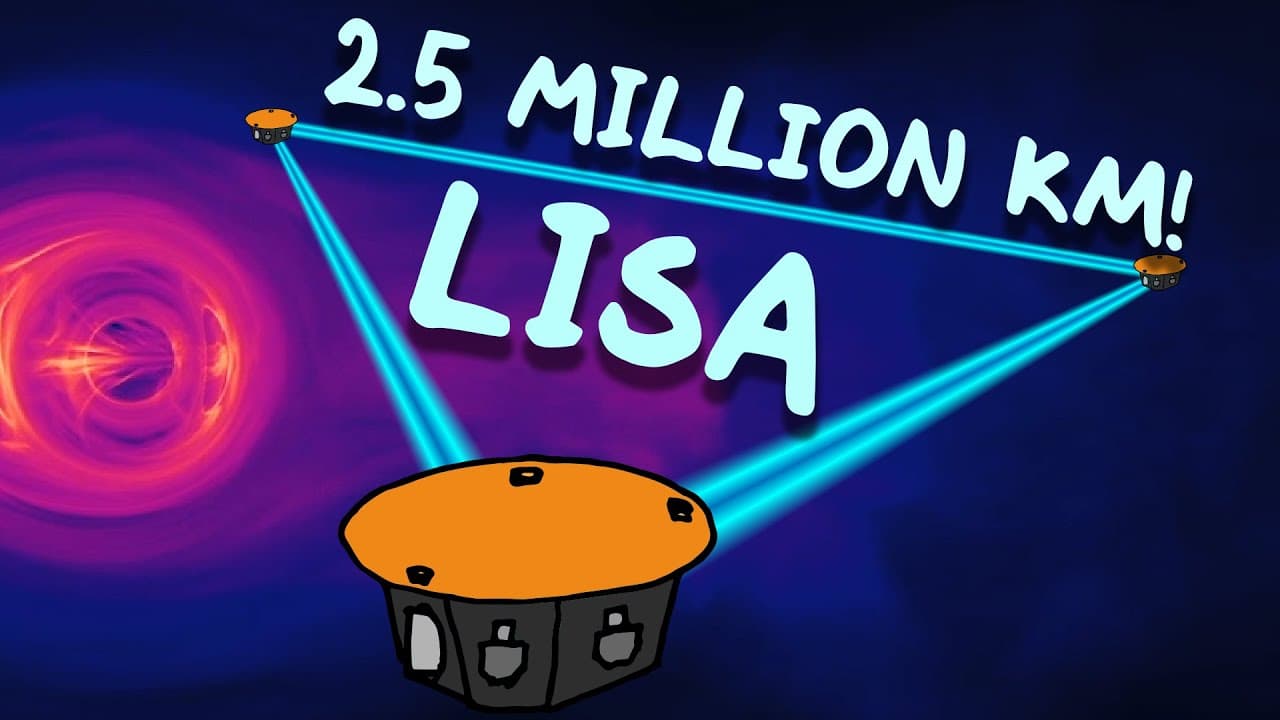
Lisa, being in space, will have a 2.5 million kilometer arm length and can detect events like supermassive black hole mergers that ground-based detectors cannot.
Q: How accurately can Lisa measure the Hubble constant?
Lisa will be able to measure the Hubble constant more accurately than current techniques, providing important insights into the universe's expansion.
Q: What potential new physics can Lisa uncover?
Lisa could potentially detect signals of new forces of nature or test theories like cosmic super strings, leading to groundbreaking discoveries in physics.
Q: How will Lisa contribute to understanding the early universe?
Lisa will allow scientists to probe back in time to a billionth of a second after the Big Bang, potentially shedding light on the emergence of the forces of nature.
Summary & Key Takeaways
-
Lisa, a spacecraft launching in 2034, will be a giant gravitational wave detector in space, detecting events like supermassive black hole mergers, which ground-based detectors can't.
-
Lisa's technology will allow for the exploration of the early universe, probing into physics previously inaccessible.
-
The spacecraft will provide insights into the history of galaxies, potential new physics, and accurate measurements of the Hubble constant.
Read in Other Languages (beta)
Share This Summary 📚
Summarize YouTube Videos and Get Video Transcripts with 1-Click
Try YouTube Summary with ChatGPT & Claude or YouTube Transcript Generator
Explore More Summaries from Domain of Science 📚


Summarize YouTube Videos and Get Video Transcripts with 1-Click
Try YouTube Summary with ChatGPT & Claude or YouTube Transcript Generator