Products
Features
YouTube Video Summarizer
Summarize YouTube videos
Web & PDF Highlighter
Highlight web pages & PDFs
Chat with PDF
Ask any PDF questions with AI
Ask AI Clone
Chat with your highlights & memories
Audio Transcriber
Transcribe audio files to text
Glasp Reader
Read and highlight articles
Kindle Highlight Export
Export your Kindle highlights
Idea Hatch
Hatch ideas from your highlights
Integrations
Obsidian Plugin
Notion Integration
Pocket Integration
Instapaper Integration
Medium Integration
Readwise Integration
Snipd Integration
Hypothesis Integration
Apps & Extensions
Chrome Extension
Safari Extension
Edge Add-ons
Firefox Add-ons
iOS App
Android App
Discover
Discover
Ideas
Discover new ideas and insights
Articles
Curated articles and insights
Books
Book recommendations by great minds
Posts
Essays and notes from readers
Quotes
Inspiring quotes collection
Videos
Curated videos and summaries
Explore Glasp
Glasp Newsletter
Weekly insights and updates
Glasp Talk
Interview series with great minds
Glasp Blog
Latest news and articles
Glasp Use Cases
Learn how others use Glasp
Build & Support
Glasp API
Access Glasp's API for developers
MCP Connector
Connect Glasp to Claude & ChatGPT
Community
Glasp Reddit Community
Students
Student discount and benefits
FAQs
Frequently Asked Questions
AboutPricing
DashboardLog inSign up

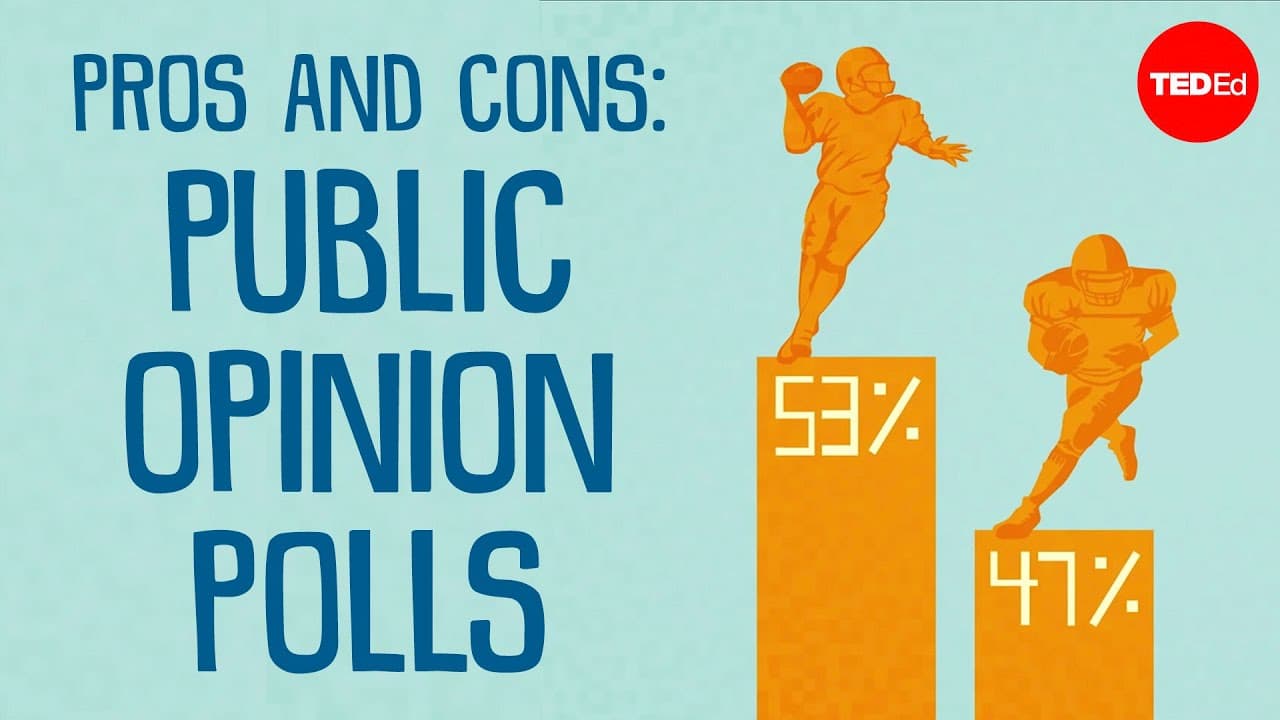
Pros and cons of public opinion polls - Jason Robert Jaffe
300.4K views
•
May 17, 2013
by
TED-Ed
YouTube video player
Pros and cons of public opinion polls - Jason Robert Jaffe

TL;DR

Public opinion polls are often inaccurate due to sample size, bias, and wording.

Transcript

Transcriber: Andrea McDonough Reviewer: Jessica Ruby We are constantly asked for our opinions. Which team do you think will win the Super Bowl? Who wore it better on the red carpet? Who are you going to vote for for mayor? Public opinion polls are everywhere. Important decision makers in American government have long relied on public opinion polls ... Read More

Key Insights

  • 🇨🇫 Sample size, diversity, and difficulty impact the accuracy of public opinion polls.
  • 🥺 Interviewer bias and push polls can lead to unreliable results.
  • 🔉 Despite flaws, polls offer insights into public sentiment for decision-makers and media.
  • 🇨🇫 Polls can provide a sense of public participation and validation.
  • ⁉️ The wording of poll questions can influence responses and outcomes.
  • 🏈 Public opinion polls have long been used in American government and media.
  • 🖐️ Polls play a role in shaping legislation, media content, and public perception.

Install to Summarize YouTube Videos and Get Transcripts

Explore YouTube Video Summarizer or Get YouTube Transcript Extractor

Questions & Answers

Q: Why are public opinion polls often inaccurate?

Public opinion polls can be inaccurate due to issues with sample size, narrowness, and difficulty. A small or biased sample group can skew results, as can questions that are too complex for respondents.

Q: How does interviewer bias affect poll results?

Interviewer bias occurs when the person asking the questions influences responses. Respondents may provide socially desirable answers or be swayed by the wording of questions, leading to inaccurate results.

Q: What is a push poll?

A push poll is a type of poll that aims to influence respondents by phrasing questions in a way that sways their answers. This manipulation can lead to biased or unreliable results.

Q: Why are public opinion polls still prevalent despite their flaws?

Public opinion polls provide insight into the thoughts and moods of large groups of people, helping decision-makers pass legislation and informing media and fashion. Despite their limitations, polls offer a sense of public voice and participation.

Summary & Key Takeaways

  • Public opinion polls are widely used in American government and media.

  • Polls can be inaccurate or misleading due to issues with sample size, narrowness, and difficulty.

  • Interviewer bias and poorly worded questions can also impact poll results.


Read in Other Languages (beta)

English

Share This Summary 📚

Summarize YouTube Videos and Get Video Transcripts with 1-Click

Download browser extensions on:

Try YouTube Summary with ChatGPT & Claude or YouTube Transcript Generator

Explore More Summaries from TED-Ed 📚
The myth of Cupid and Psyche - Brendan Pelsue thumbnail
The myth of Cupid and Psyche - Brendan Pelsue
TED-Ed
How to build a fictional world - Kate Messner thumbnail
How to build a fictional world - Kate Messner
TED-Ed
What is the History of Electric Cars and Their Comeback? thumbnail
What is the History of Electric Cars and Their Comeback?
TED-Ed
The rise and fall of the Byzantine Empire - Leonora Neville thumbnail
The rise and fall of the Byzantine Empire - Leonora Neville
TED-Ed
How does the Rorschach inkblot test work? - Damion Searls thumbnail
How does the Rorschach inkblot test work? - Damion Searls
TED-Ed
Why is it so hard to cure cancer? - Kyuson Yun thumbnail
Why is it so hard to cure cancer? - Kyuson Yun
TED-Ed

Summarize YouTube Videos and Get Video Transcripts with 1-Click

Download browser extensions on:

Try YouTube Summary with ChatGPT & Claude or YouTube Transcript Generator

Apps & Extensions

  • Chrome Extension
  • Safari Extension
  • Edge Add-ons
  • Firefox Add-ons
  • iOS App
  • Android App

Key Features

  • YouTube Video Summarizer
  • Web & PDF Summarizer
  • Web & PDF Highlighter
  • Chat with PDF
  • Ask AI Clone
  • Audio Transcriber
  • Glasp Reader
  • Kindle Highlight Export
  • Idea Hatch

Integrations

  • Obsidian Plugin
  • Notion Integration
  • Pocket Integration
  • Instapaper Integration
  • Medium Integration
  • Readwise Integration
  • Snipd Integration
  • Hypothesis Integration

More Features

  • APIs
  • MCP Connector
  • Blog & Post
  • Embed Links
  • Image Highlight
  • Personality Test
  • Quote Shots

Company

  • About us
  • Blog
  • Community
  • FAQs
  • Job Board
  • Newsletter
  • Pricing
Terms

•

Privacy

•

Guidelines

© 2026 Glasp Inc. All rights reserved.