Breaking The Heisenberg Uncertainty Principle
TL;DR
Exploring methods to surpass the Heisenberg uncertainty principle in quantum measurements.
Transcript
Quantum mechanics forbids us from measuringthe universe beyond a certain level of precision. But that doesn’t stop us from trying. And in some cases succeeding, by squeezing the Heisenberg uncertainty principle to its breaking point. Engineers have gifted physicists with some pretty incredible machines for measuring the universe. For example, the r... Read More
Key Insights
- The Heisenberg uncertainty principle limits the precision of measuring complementary quantum properties, such as position and momentum, or phase and amplitude.
- Recent advancements in engineering have allowed scientists to challenge this principle, achieving unprecedented measurement precision.
- The LIGO observatory exemplifies how squeezed light can enhance the detection of gravitational waves by manipulating quantum uncertainties.
- Squeezed light involves reducing phase uncertainty at the expense of amplitude uncertainty, allowing for more precise measurements.
- Quantum entanglement is used to correlate photon phases, reducing noise and enhancing the sensitivity of measurements like those in LIGO.
- The uncertainty principle suggests a fundamental unknowability in nature, but targeted manipulation can focus precision where it is most needed.
- Niels Bohr's complementarity principle highlights the dual nature of quantum objects, influencing how they are measured and understood.
- Advanced quantum techniques, such as those used in atomic clocks, could significantly improve technologies like GPS by enhancing measurement precision.
Install to Summarize YouTube Videos and Get Transcripts
Explore YouTube Video Summarizer or Get YouTube Transcript Extractor
Questions & Answers
Q: What is the Heisenberg uncertainty principle?
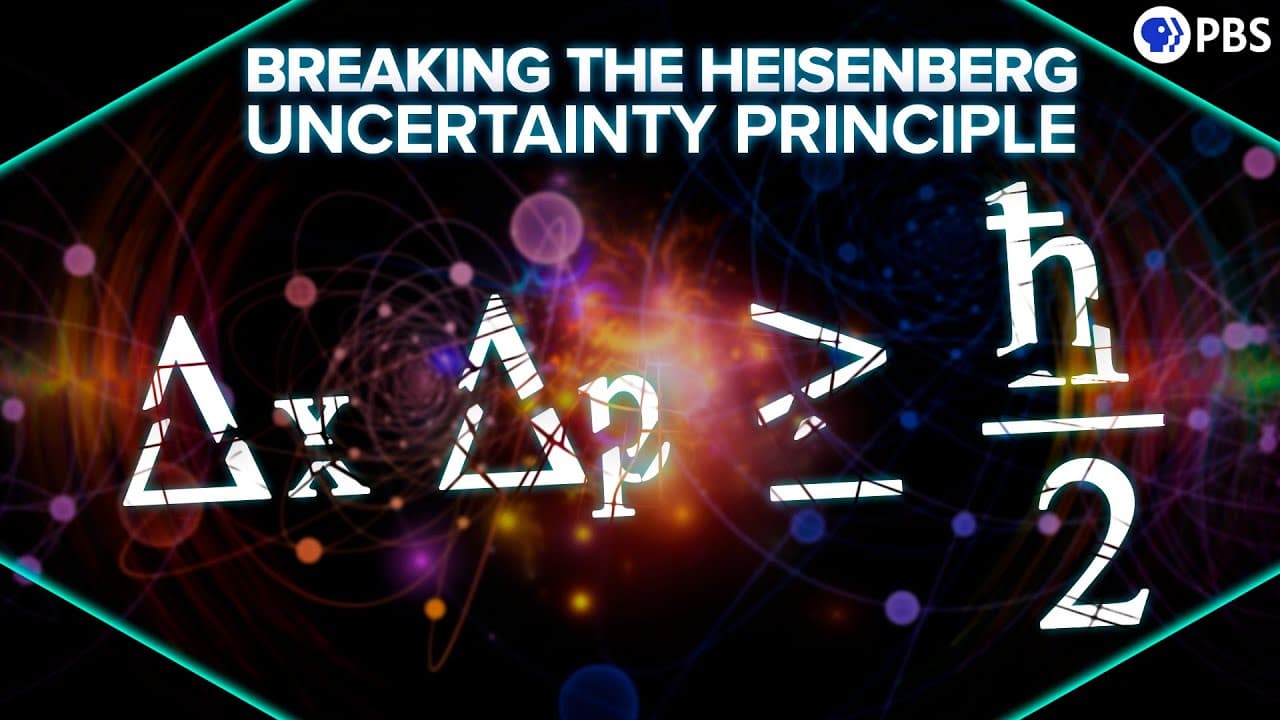
The Heisenberg uncertainty principle is a fundamental concept in quantum mechanics that states there is an inherent limit to the precision with which certain pairs of complementary properties, such as position and momentum or phase and amplitude, can be simultaneously known. This principle highlights the intrinsic uncertainty and unknowability in the measurement of quantum states.
Q: How does LIGO utilize squeezed light?
LIGO uses squeezed light to improve its sensitivity in detecting gravitational waves. By reducing the uncertainty in the phase of laser beams, while allowing greater uncertainty in amplitude, LIGO can more precisely measure the tiny changes in path lengths caused by gravitational waves. This manipulation of quantum uncertainties enhances LIGO's ability to observe weaker and more distant gravitational wave events.
Q: What role does quantum entanglement play in measuring precision?
Quantum entanglement plays a crucial role in improving measurement precision by correlating the phases of entangled photons. In systems like LIGO, entangled photons are used to reduce phase noise, allowing for more accurate measurements. By manipulating these correlations, scientists can effectively 'squeeze' uncertainties, focusing precision on desired properties and enhancing the sensitivity of quantum measurements.
Q: What is the principle of complementarity?
The principle of complementarity, developed by Niels Bohr, is a fundamental concept in quantum mechanics that describes the dual nature of quantum objects. It posits that quantum entities can exhibit both wave-like and particle-like behavior, but not simultaneously. The observed behavior depends on the measurement context, highlighting the limitations and choices involved in observing quantum systems.
Q: Why is manipulating quantum uncertainties important?
Manipulating quantum uncertainties is important because it allows scientists to enhance measurement precision beyond traditional limits set by the Heisenberg uncertainty principle. By focusing precision on specific properties, researchers can achieve more accurate and sensitive measurements, opening new possibilities in quantum research, technology, and applications such as gravitational wave detection and atomic clocks.
Q: What are the potential applications of improved quantum measurement techniques?
Improved quantum measurement techniques have potential applications in various fields, including gravitational wave astronomy, quantum computing, and precision timekeeping. For example, enhanced atomic clocks could significantly improve the accuracy of GPS systems. These techniques also offer new insights into fundamental physics, potentially leading to breakthroughs in understanding quantum mechanics and the nature of the universe.
Q: How does the uncertainty principle affect classical and quantum measurements?
The uncertainty principle primarily affects quantum measurements by imposing limits on the precision of complementary properties. In classical measurements, uncertainties are often due to technical limitations, while in quantum measurements, they arise from intrinsic properties of quantum states. Understanding and manipulating these uncertainties is crucial for advancing precision in both classical and quantum measurements.
Q: What challenges do scientists face when trying to surpass the uncertainty principle?
Scientists face several challenges when trying to surpass the uncertainty principle, including the need for advanced technology and understanding of quantum mechanics. Manipulating quantum uncertainties requires precise control and measurement techniques, often involving complex systems like entangled photons and squeezed light. Additionally, there are trade-offs, such as increased uncertainty in one property to reduce it in another, which must be carefully managed to achieve desired outcomes.
Summary & Key Takeaways
-
The Heisenberg uncertainty principle imposes a fundamental limit on how precisely we can measure pairs of complementary quantum properties. However, advancements in technology and quantum manipulation techniques are allowing scientists to push these boundaries and achieve unprecedented precision.
-
LIGO's use of squeezed light demonstrates how manipulating quantum uncertainties can enhance the detection of gravitational waves. By reducing phase uncertainty and accepting greater amplitude uncertainty, LIGO can detect weaker signals, increasing its sensitivity and range.
-
Quantum entanglement and the principle of complementarity play crucial roles in understanding and manipulating quantum measurements. By focusing precision on desired properties, scientists can bend fundamental laws to achieve more accurate measurements, opening new possibilities in quantum research and technology.
Read in Other Languages (beta)
Share This Summary 📚
Summarize YouTube Videos and Get Video Transcripts with 1-Click
Try YouTube Summary with ChatGPT & Claude or YouTube Transcript Generator
Explore More Summaries from PBS Space Time 📚






Summarize YouTube Videos and Get Video Transcripts with 1-Click
Try YouTube Summary with ChatGPT & Claude or YouTube Transcript Generator