How Do Robots Work and What Are Their Uses?
TL;DR
Robots operate by using sensors to interpret their environment, actuators for movement, and effectors to perform tasks. They are engineered for specific purposes across various industries, including manufacturing, medicine, and exploration, often working alongside humans to enhance efficiency and safety. Understanding their design and function is crucial as robots become more integrated into everyday life.
Transcript
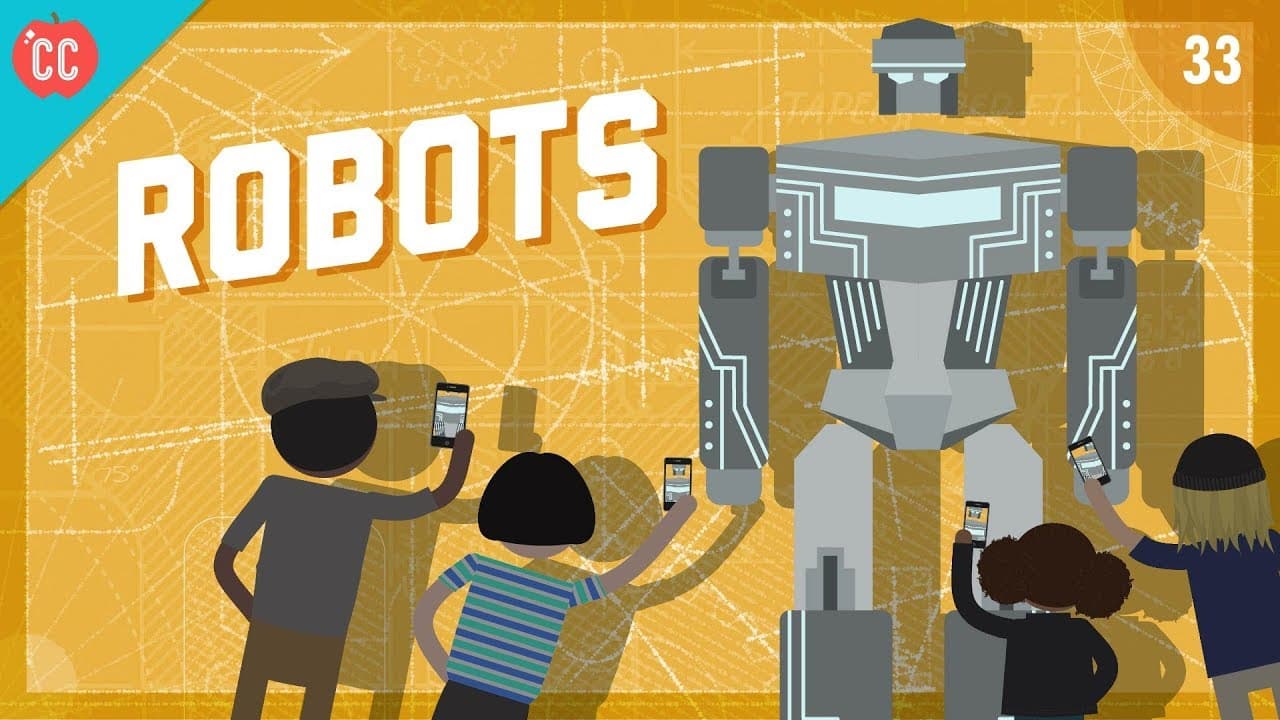
Someday in the near future, you might be wandering around town at night when out of the blue you’ll stumble across a robot. If that happens, maybe you shouldn’t be too surprised. Not so long ago, robots were mostly found in the realms of science fiction. Today, they’re vacuuming floors, building cars, and even roaming the surface of Mars. Robots ar... Read More
Key Insights
- 🤖 Robots, once a concept of science fiction, are now prevalent in various industries and environments.
- 🦾 Robotics focus on physical interaction with the environment, requiring mechanical components like sensors, actuators, and effectors.
- 🤖 The design of robots involves advanced engineering principles to enable autonomy and precision in executing tasks.
- 🤖 Robots are utilized not only to replace human tasks but also to work alongside humans, enhancing safety and efficiency in various fields.
- ⛑️ Advancements in robotics offer innovative solutions for complex tasks in industries such as mining, medicine, and disaster rescue operations.
- 🤖 Ensuring proper weight distribution and power sources are crucial aspects of designing robots for optimal performance and mobility.
- 🤖 Robots are equipped with sensors and actuators to interpret their environment and manipulate objects, enhancing their functionality in diverse tasks.
Install to Summarize YouTube Videos and Get Transcripts
Explore YouTube Video Summarizer or Get YouTube Transcript Extractor
Questions & Answers
Q: How do robots differ from artificial intelligence?
Robots interact physically with the environment to carry out tasks based on surroundings, unlike artificial intelligence, which focuses on automating decision-making for complex tasks.
Q: What are key components required for a robot to function autonomously?
Mechanical parts, sensors, actuators, and effectors are essential for robots to interpret their environment, make decisions, and manipulate objects to accomplish tasks.
Q: In what fields are robots making a significant impact?
Robots are being used in mining, medicine, space exploration, and hazardous environments like bomb disposal, enhancing safety, efficiency, and innovation.
Q: How are robots designed to adapt to diverse environments?
Robots are engineered with adjustable wheels, treads, and advanced sensors to navigate rough terrains and environments, enhancing their capability to perform tasks efficiently.
Summary & Key Takeaways
-
Robots, once limited to science fiction, are now used in mining, medicine, and space exploration, with over a hundred thousand in US factory floors since 2010.
-
Robotics differ from artificial intelligence (AI) as robots interact physically with the environment and carry out tasks based on their surroundings.
-
Robots require mechanical parts, sensors, actuators, and effectors to function autonomously, serving diverse purposes in industries and environments.
Read in Other Languages (beta)
Share This Summary 📚
Summarize YouTube Videos and Get Video Transcripts with 1-Click
Try YouTube Summary with ChatGPT & Claude or YouTube Transcript Generator
Explore More Summaries from CrashCourse 📚






Summarize YouTube Videos and Get Video Transcripts with 1-Click
Try YouTube Summary with ChatGPT & Claude or YouTube Transcript Generator