How Many Unique Ways Can You Arrange a Deck of Cards?
TL;DR
A standard deck of 52 cards can be arranged in 8.07 x 10^67 unique ways, demonstrating the principle of factorials in permutations. This immense number surpasses the total number of atoms on Earth, illustrating the vast possibilities when shuffling a simple deck of cards.
Transcript
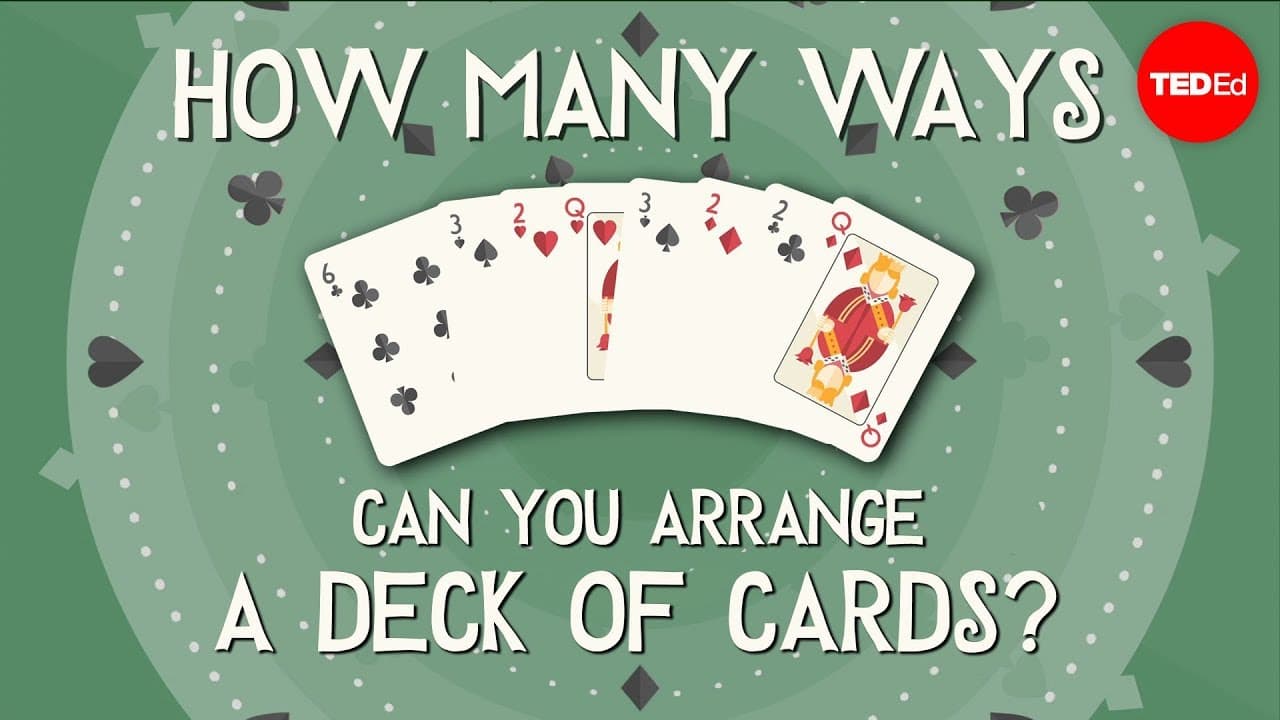
Pick a card, any card. Actually, just pick up all of them and take a look. This standard 52-card deck has been used for centuries. Everyday, thousands just like it are shuffled in casinos all over the world, the order rearranged each time. And yet, every time you pick up a well-shuffled deck like this one, you are almost certainly holding an arrang... Read More
Key Insights
- ❓ Factorials simplify the calculation of permutations in arranging objects.
- 🌥️ The number of possible card deck arrangements is astronomically large, showcasing the vastness of permutations.
- 💨 A deck of 52 cards can be arranged in more ways than atoms on Earth, highlighting the complexity of permutations.
- ❓ Factorials offer a structured method to understanding and calculating diverse arrangements.
- 🎴 Mathematics plays a crucial role in uncovering the vast array of possibilities in everyday objects like card decks.
- 😒 The use of factorials showcases the exponential growth of arrangements with increasing numbers of objects.
- 🎴 The concept of factorials and permutations extends beyond card decks, applying to various arrangements in mathematics and beyond.
Install to Summarize YouTube Videos and Get Transcripts
Explore YouTube Video Summarizer or Get YouTube Transcript Extractor
Questions & Answers
Q: How are factorials used to calculate permutations in arranging card decks?
Factorials are represented by an exclamation mark and involve multiplying the number of objects being arranged by consecutively smaller integers until reaching one. This method simplifies calculating various arrangements, such as those in a 52-card deck.
Q: Why are there so many possible arrangements for a deck of cards?
The sheer number of possibilities, 8.07 x 10^67, arises from the exponential nature of factorials. Each card position has multiple choices, showcasing the diversity of card arrangement outcomes.
Q: What is the significance of factorial calculations in understanding permutations?
Factorials provide a structured approach to determining permutations by systematically multiplying the number of objects being arranged. This method simplifies complex arrangements, making them more manageable to calculate.
Q: How does the concept of permutations in arranging cards relate to the vastness of the universe?
The immense number of possible card arrangements, exceeding atoms on Earth, highlights the unfathomable scale of mathematical possibilities. It showcases the intricacies and boundless potential of permutations in everyday objects.
Summary & Key Takeaways
-
A standard 52-card deck has countless unique arrangements due to factorial calculations.
-
Factorials, denoted by an exclamation mark, play a crucial role in determining permutations.
-
The number of possible card arrangements surpasses the atoms on Earth, showcasing the vastness of possibilities.
Read in Other Languages (beta)
Share This Summary 📚
Summarize YouTube Videos and Get Video Transcripts with 1-Click
Try YouTube Summary with ChatGPT & Claude or YouTube Transcript Generator
Explore More Summaries from TED-Ed 📚






Summarize YouTube Videos and Get Video Transcripts with 1-Click
Try YouTube Summary with ChatGPT & Claude or YouTube Transcript Generator