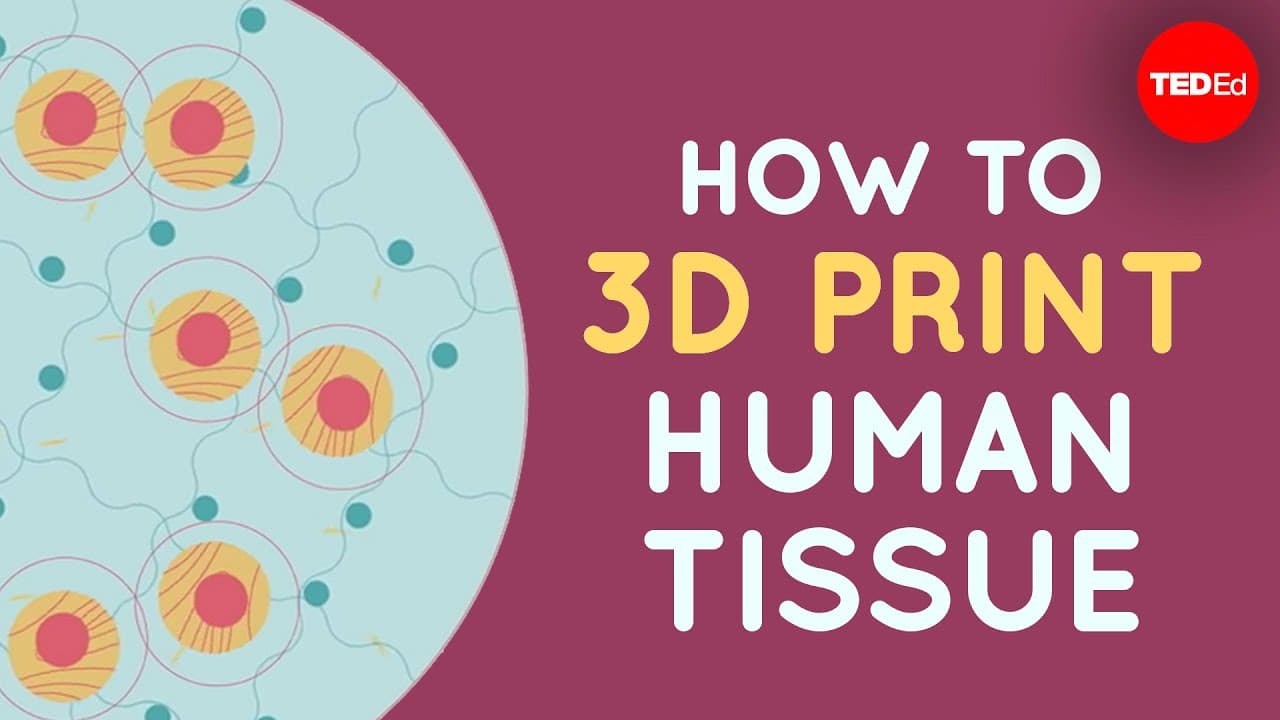
How to 3D print human tissue - Taneka Jones
TL;DR
Bioprinting is a revolutionary medical technology that aims to create custom organs and tissues using bioink, offering hope for organ transplant patients.
Transcript
There are currently hundreds of thousands of people on transplant lists, waiting for critical organs like kidneys, hearts, and livers that could save their lives. Unfortunately, there aren’t nearly enough donor organs available to fill that demand. What if instead of waiting, we could create brand-new, customized organs from scratch? That’s the... Read More
Key Insights
- 🫒 Bioprinting utilizes bioink containing living cells to create custom organs and tissues.
- 🥳 Successes in bioprinting include the implantation of bladders and nerve regeneration in rats.
- ❓ Challenges in bioprinting involve replicating complex organs and ensuring sufficient oxygen and nutrients reach cells.
- ❓ Possibilities for bioprinting extend to engineering organs with enhanced capabilities and extending human lifespan.
Install to Summarize YouTube Videos and Get Transcripts
Explore YouTube Video Summarizer or Get YouTube Transcript Extractor
Questions & Answers
Q: What is bioprinting and how does it differ from traditional 3-D printing?
Bioprinting is a branch of regenerative medicine that uses bioink containing living cells to create customized organs and tissues, whereas traditional 3-D printing typically uses metal, plastic, or ceramic materials.
Q: What are some of the successes of bioprinting in terms of organ creation?
Researchers have successfully implanted bioprinted bladders and promoted facial nerve regeneration in rats using printed tissue, showcasing the potential for organ creation through bioprinting.
Q: What are some of the challenges faced in bioprinting complex organs?
Challenges in bioprinting include the need to replicate the complex biochemical environment of major organs, ensuring sufficient oxygen and nutrients reach all cells, and integrating blood vessels into bioprinted tissue.
Q: How does bioprinting offer hope for organ transplant patients?
Bioprinting has the potential to address the shortage of donor organs by creating custom organs and tissues, reducing waiting times and the risk of rejection for transplant patients.
Summary & Key Takeaways
-
Bioprinting aims to create customized organs and tissues from scratch to address the shortage of donor organs.
-
Bioink, a printable material containing living cells, is used in bioprinting to create structures such as blood vessels and tubes for nutrient exchange.
-
While bioprinting has shown success in printing simpler structures like bladders and cartilage, challenges remain in replicating complex organs due to the need for sufficient oxygen and nutrients.
Read in Other Languages (beta)
Share This Summary 📚
Summarize YouTube Videos and Get Video Transcripts with 1-Click
Try YouTube Summary with ChatGPT & Claude or YouTube Transcript Generator
Explore More Summaries from TED-Ed 📚





Summarize YouTube Videos and Get Video Transcripts with 1-Click
Try YouTube Summary with ChatGPT & Claude or YouTube Transcript Generator