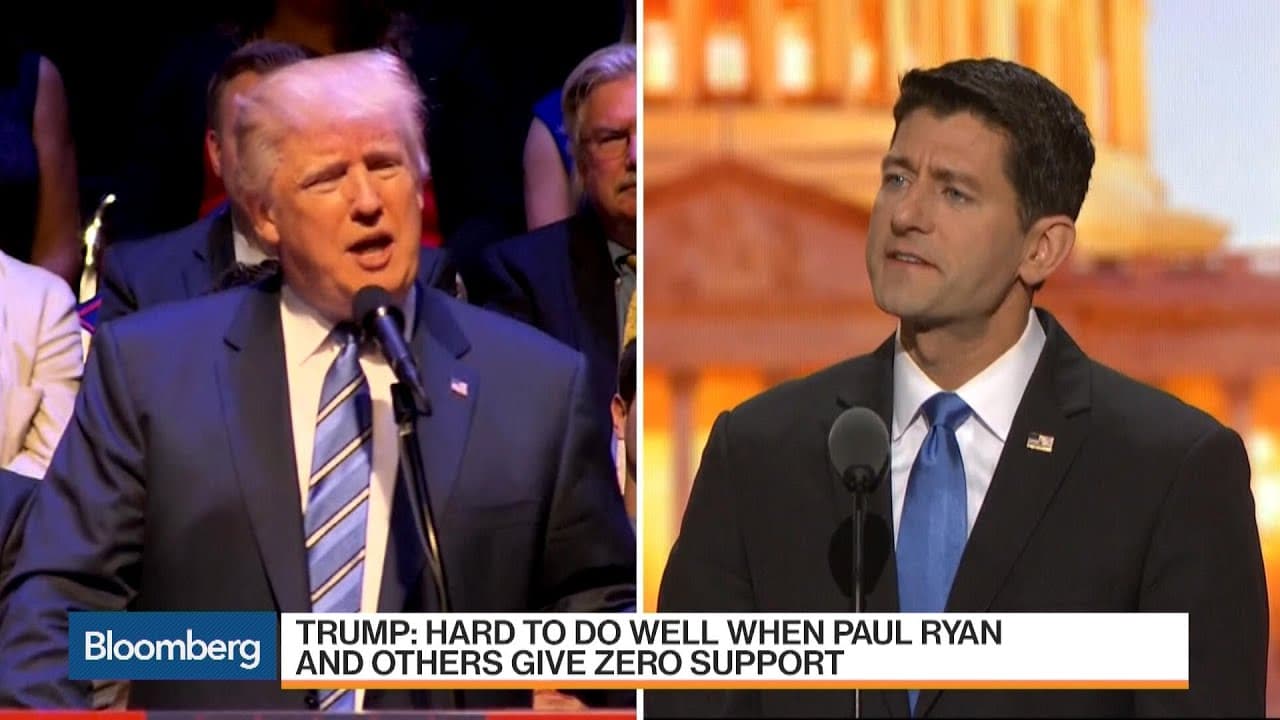
Donald Trump: Paul Ryan Is 'Weak and Ineffective'
TL;DR
Trump's conflict with GOP leadership intensifies over election strategy.
Transcript
Paul Ryan walking back his endorsement a bit yesterday, not withdrawing it completely. Correct. Why not given what we've seen here? Well, I think Paul Ryan is making a calculation uh which was really clear in his conference call with with House Republicans yesterday. And that is he knows he's torn between his personal feelings towards this and his ... Read More
Key Insights
- Paul Ryan is conflicted between his personal disapproval of Trump and his role as the Republican leader, aiming to maintain the GOP majority in Congress.
- Ryan's strategy involves allowing Republican members to decide independently while emphasizing the importance of keeping control of Congress.
- Trump's earlier claims of independence from the GOP contrast with his current criticism of party leaders like Paul Ryan for lack of support.
- Trump is building a narrative of a 'rigged election' to potentially explain a loss, positioning Ryan as a scapegoat.
- Despite defections, some figures like Marco Rubio and Chris Christie continue to support Trump, albeit with reservations.
- Chris Christie, though a Trump ally, criticized Trump's comments and emphasized the election's broader issues.
- There is uncertainty about Trump's financial backing as some donors may withdraw support following recent controversies.
- The Republican Party is experiencing a significant internal split, affecting its cohesion and strategy in the election.
Install to Summarize YouTube Videos and Get Transcripts
Explore YouTube Video Summarizer or Get YouTube Transcript Extractor
Questions & Answers
Q: What is Paul Ryan's strategy regarding his endorsement of Trump?
Paul Ryan's strategy is to balance his personal disapproval of Donald Trump with his role as the leader of the Republican caucus. He has not withdrawn his endorsement completely but has allowed GOP members to decide independently while emphasizing the importance of maintaining Republican control in Congress. This approach allows him to distance himself personally while still focusing on the party's broader goals.
Q: How has Trump's stance towards the Republican Party changed?
Trump's stance towards the Republican Party has evolved from claiming he did not need their support to criticizing its leaders for not backing him. Initially, Trump portrayed himself as a candidate who could win independently of the party, but recent statements reflect frustration with figures like Paul Ryan, whom he blames for the lack of unified support. This shift also includes setting up a narrative of a 'rigged election' to account for potential failure.
Q: What role does the concept of a 'rigged election' play in Trump's strategy?
The concept of a 'rigged election' plays a strategic role for Trump in providing an explanation for a potential loss. By suggesting the election process is unfair, Trump is creating a narrative that shifts blame away from himself and onto external factors, including lack of support from GOP leaders like Paul Ryan. This narrative serves as a preemptive justification for any unfavorable outcomes in the election.
Q: How have other Republican leaders reacted to Trump's controversies?
Other Republican leaders have reacted to Trump's controversies with a mix of continued support and criticism. While some have withdrawn endorsements, figures like Marco Rubio and Chris Christie still support Trump but express disapproval of his controversial comments. Christie, for example, criticized Trump's remarks and emphasized the broader issues at stake in the election, reflecting the internal divisions within the party.
Q: What is the impact of donor support on Trump's campaign?
Donor support is a critical factor for Trump's campaign, and there is concern that recent controversies may lead to a withdrawal of financial backing. Following a video controversy, some donors signaled intentions to close their wallets, which could impact the campaign's resources. The uncertainty around donor support adds another layer of complexity to Trump's election strategy and the overall Republican campaign.
Q: What is the significance of Marco Rubio's continued support for Trump?
Marco Rubio's continued support for Trump is significant as it highlights the internal divisions within the Republican Party. Despite controversies and defections, Rubio maintains his endorsement, suggesting a prioritization of party unity and broader electoral goals over personal disagreements with Trump. This stance reflects a strategic choice to focus on the perceived larger issues at stake in the election.
Q: How does the split within the Republican Party affect its election strategy?
The split within the Republican Party affects its election strategy by creating a lack of cohesion and unified messaging. With leaders like Paul Ryan distancing themselves from Trump and others like Marco Rubio maintaining support, the party faces challenges in presenting a consistent front. This division complicates efforts to rally voter support and maintain focus on key electoral goals, potentially impacting the party's overall effectiveness in the election.
Q: What are the broader implications of the Republican Party's internal conflict?
The broader implications of the Republican Party's internal conflict include potential long-term impacts on party unity, voter trust, and electoral success. The visible divisions may weaken the party's ability to present a cohesive platform, leading to challenges in mobilizing voter support and achieving legislative goals. Additionally, the conflict may influence future leadership dynamics and strategic decisions within the party, shaping its direction in upcoming elections.
Summary & Key Takeaways
-
Paul Ryan is navigating a complex situation where he personally disapproves of Trump but wants to maintain Republican control in Congress. He allows GOP members to make their own decisions while focusing on the broader party strategy.
-
Donald Trump has shifted from claiming independence from the Republican Party to blaming leaders like Paul Ryan for lack of support. This shift includes framing a narrative of a 'rigged election' to explain potential failure.
-
Despite some Republican leaders retracting endorsements, figures like Marco Rubio and Chris Christie still support Trump, highlighting the party's internal divisions. There is also concern about Trump's financial support as donors reconsider their contributions.
Read in Other Languages (beta)
Share This Summary 📚
Summarize YouTube Videos and Get Video Transcripts with 1-Click
Try YouTube Summary with ChatGPT & Claude or YouTube Transcript Generator
Explore More Summaries from Bloomberg Originals 📚



Summarize YouTube Videos and Get Video Transcripts with 1-Click
Try YouTube Summary with ChatGPT & Claude or YouTube Transcript Generator