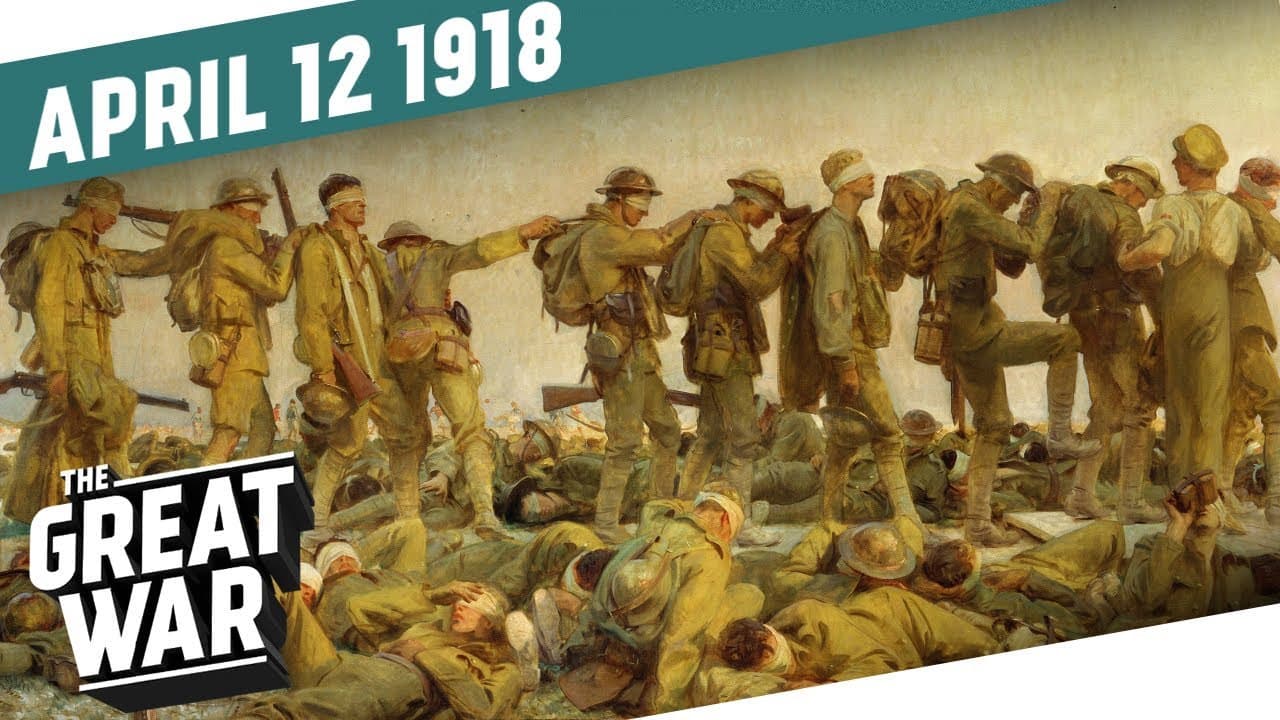
The Battle of La Lys - Operation Georgette I THE GREAT WAR Week 194
TL;DR
The German Spring Offensive continues with Operation Georgette in Flanders.
Transcript
If I were to make sensational newspaper headlines about some of this week’s activity, I wonder how they’d read? Hm... “the betrayal of an ally” or “an Emperor’s humiliation!” Yeah, those are pretty good. I’m Indy Neidell; welcome to the Great War. Last week, Operation Michael, the first phase of the German Spring Offensives, came to an end. The Ger... Read More
Key Insights
- Operation Georgette, part of the German Spring Offensive, aimed to capture key railway junctions and reach the coast between Calais and Dunkirk.
- The Battle of the Lys saw significant initial success for the Germans, capturing 6,000 Portuguese troops and creating a gap in British lines.
- Portuguese soldier Anibal Milhais, known as Soldier Million, became a legend by holding off German forces single-handedly with his Lewis gun.
- The British used a controlled retreat strategy, despite the Germans advancing within 8km of Hazebrouck, a critical railway junction.
- British Commander Sir Douglas Haig issued a rallying cry, urging troops to hold their positions with 'backs to the wall.'
- The Sixtus Affair revealed Emperor Karl of Austria's attempt to negotiate a separate peace with the Allies, causing friction with Germany.
- The United States marked one year in the war, with President Wilson condemning Germany's actions and calling for force without limit.
- The Conference of Nationalities Oppressed by Austria highlighted the Allies' support for independence movements within the Austro-Hungarian Empire.
Install to Summarize YouTube Videos and Get Transcripts
Explore YouTube Video Summarizer or Get YouTube Transcript Extractor
Questions & Answers
Q: What was the main objective of Operation Georgette?
Operation Georgette aimed to capture the Hazebrouck railway junction and reach the coast between Calais and Dunkirk. This operation was part of the broader German Spring Offensive, designed to disrupt Allied supply lines and force a strategic advantage in the region.
Q: Who was Anibal Milhais and what was his role in the battle?
Anibal Milhais, also known as Soldier Million, was a Portuguese soldier who became a legend during the Battle of the Lys. He held off German forces single-handedly with his Lewis gun, allowing his comrades to retreat safely. His actions exemplified bravery and contributed to his lasting legacy in military history.
Q: How did the British respond to the German advance during Operation Georgette?
The British executed a controlled retreat in response to the German advance during Operation Georgette. Despite being pushed back, they managed to avoid a complete rout, maintaining strategic positions and preventing the Germans from achieving their ultimate objectives. This retreat was marked by resilience and tactical withdrawal under pressure.
Q: What was the significance of the Sixtus Affair?
The Sixtus Affair was significant because it exposed Emperor Karl of Austria's secret attempts to negotiate a separate peace with the Allies, offering concessions on territories like Alsace-Lorraine. This revelation embarrassed Austria-Hungary, strained relations with Germany, and highlighted internal divisions within the Central Powers, affecting their wartime cohesion.
Q: How did President Wilson's speech reflect the United States' stance in the war?
President Wilson's speech in Baltimore marked a year since the United States entered the war, emphasizing the need for limitless force against German aggression. He criticized Germany's terms with Russia and highlighted their imperial ambitions, reinforcing the U.S. commitment to the Allied cause and signaling a resolute stance against the Central Powers.
Q: What challenges did the Germans face during Operation Georgette?
During Operation Georgette, the Germans faced challenges such as logistical difficulties in moving artillery and tanks due to soft, wet ground. These issues hindered their advance and highlighted Ludendorff's blind spot regarding the effective use of tanks, impacting the overall success of their offensive operations in Flanders.
Q: What was the outcome of the Conference of Nationalities Oppressed by Austria?
The Conference of Nationalities Oppressed by Austria, held in Rome, aimed to support independence movements within the Austro-Hungarian Empire. The Allies, including Italy, recognized the rights of Southern Slavs and other nationalities to future independence, signaling a shift in diplomatic strategies and undermining the cohesion of Austria-Hungary's multi-ethnic empire.
Q: How did the Allies plan to counter the German Spring Offensive?
To counter the German Spring Offensive, the Allies strengthened their coordination by appointing Ferdinand Foch as the General in Chief of the Allied Armies. This move aimed to unify command structures, improve strategic planning, and enhance the effectiveness of Allied responses to German advances, ultimately contributing to their ability to withstand the offensive.
Summary & Key Takeaways
-
Operation Georgette was launched by Germany as part of their Spring Offensive, targeting the British and Portuguese forces in Flanders. The initial success included capturing thousands of Portuguese troops and creating a strategic gap in British defenses. However, the British managed a controlled retreat, preventing a complete rout.
-
Emperor Karl of Austria's secret attempts to negotiate peace with the Allies were exposed in the Sixtus Affair, causing embarrassment and increasing Austria-Hungary's dependency on Germany. This revelation strained relations within the Central Powers and highlighted the fragility of their alliance.
-
The United States, marking a year in the war, reinforced its commitment to the Allied cause. President Wilson's speech in Baltimore criticized Germany's imperial ambitions and emphasized the need for limitless force to counteract German aggression, reflecting the growing resolve of the Allies.
Read in Other Languages (beta)
Share This Summary 📚
Summarize YouTube Videos and Get Video Transcripts with 1-Click
Try YouTube Summary with ChatGPT & Claude or YouTube Transcript Generator
Explore More Summaries from The Great War 📚

Summarize YouTube Videos and Get Video Transcripts with 1-Click
Try YouTube Summary with ChatGPT & Claude or YouTube Transcript Generator