How to Analyze Cellular Interactions with AI Models
TL;DR
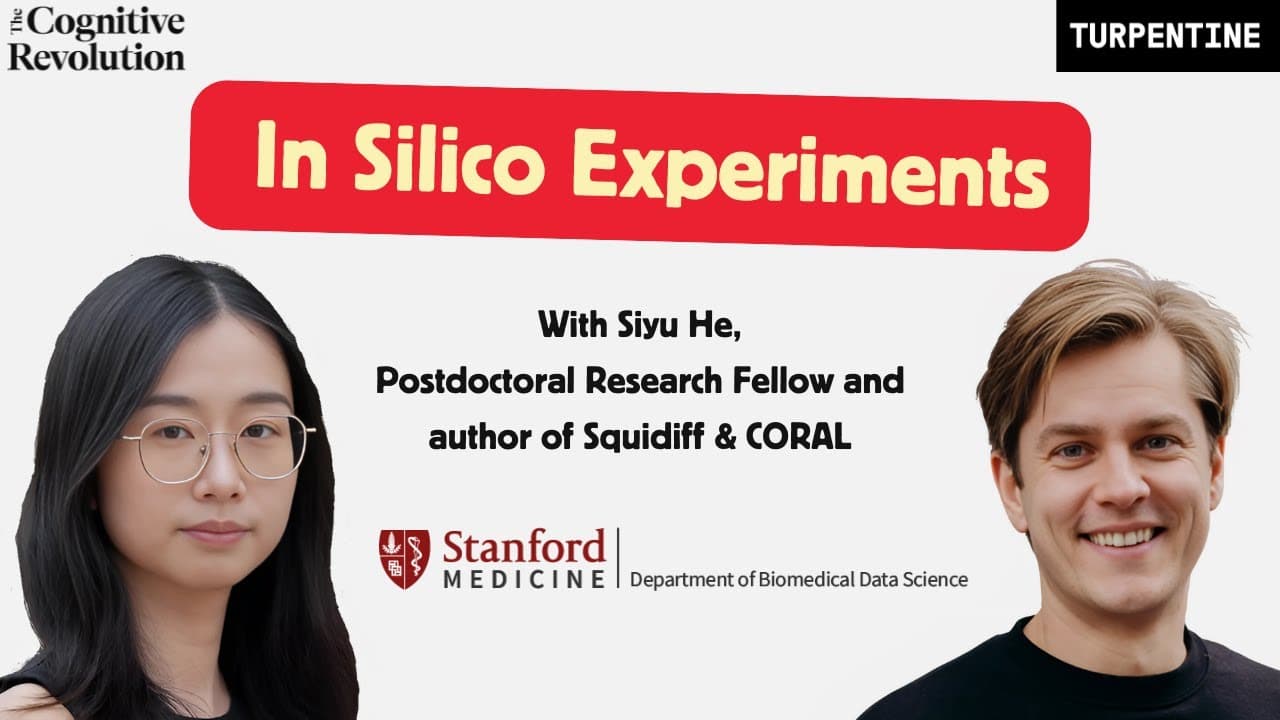
AI models like Squidiff and CORAL are transforming biological research by simulating cellular behavior and integrating data from different biological scales. Squidiff predicts cellular responses to conditions, speeding up experiments, while CORAL combines tissue data for a detailed view of cellular interactions. These advancements promise faster scientific discoveries and personalized healthcare solutions.
Transcript
hello and welcome back to the cognitive Revolution today I'm excited to share an in-depth conversation with cuu postto at Stanford in biomedical data science and Lead author of two notable recent papers that use intricate machine Learning Systems to shed light on two of the great questions in biology what causes what at the cellular level and how d... Read More
Key Insights
- Squidiff uses AI to simulate cellular transcriptomes, predicting outcomes of various conditions, which can save months of lab work.
- CORAL integrates low-resolution tissue data with high-resolution single-cell profiles, offering a comprehensive view of tissue structures.
- Transcriptomes measure gene activity in cells, providing insights into cellular states and disease mechanisms.
- Synthetic data helps validate AI models by providing ground truth scenarios, ensuring reliability in real-world applications.
- AI models can accelerate biomedical research by prioritizing experiments and predicting patient-specific drug responses.
- Spatial transcriptomics and proteomics reveal cellular interactions by maintaining location information, crucial for understanding tissue architecture.
- Graph neural networks in CORAL model local cell interactions, enhancing understanding of cellular communication.
- AI-driven models in biology face challenges like data availability and the need for accurate validation against experimental results.
Install to Summarize YouTube Videos and Get Transcripts
Explore YouTube Video Summarizer or Get YouTube Transcript Extractor
Questions & Answers
Q: How do AI models like Squidiff accelerate biological research?
AI models like Squidiff simulate cellular transcriptomes to predict how cells respond to various conditions. This capability allows researchers to bypass lengthy and expensive lab experiments by providing virtual predictions that can guide real-world experiments. By using synthetic data and advanced machine learning techniques, Squidiff saves researchers significant time and resources, accelerating the pace of scientific discovery.
Q: What is the role of synthetic data in validating AI models in biology?
Synthetic data plays a critical role in validating AI models by providing scenarios with known outcomes, known as ground truth. This allows researchers to test the accuracy and reliability of their models before applying them to real-world data. By ensuring that models perform well on synthetic data, researchers can transfer these models to real scenarios with greater confidence in their predictions and outcomes.
Q: How does CORAL integrate different levels of biological data?
CORAL integrates low-resolution tissue data with high-resolution single-cell profiles using graph neural networks. This integration provides a comprehensive view of tissue structures and cellular interactions, enabling researchers to study the architecture and communication within tissues. By combining these different data scales, CORAL offers insights that are not possible through individual data sets alone, enhancing our understanding of complex biological systems.
Q: Why is spatial information important in transcriptomics and proteomics?
Spatial information is crucial in transcriptomics and proteomics because it preserves the location context of cells within tissues. This context is essential for understanding cellular interactions and the overall architecture of tissues. Without spatial data, researchers lose valuable insights into how cells communicate and function within their native environments, which is vital for studying disease mechanisms and developing targeted treatments.
Q: What challenges do AI models face in biomedical research?
AI models in biomedical research face challenges such as data availability, integration of different data types, and accurate model validation. Obtaining high-quality, comprehensive data sets is often difficult due to privacy concerns and the complexity of biological systems. Additionally, integrating diverse data types, such as transcriptomics and proteomics, requires sophisticated models and validation against experimental results to ensure reliability and applicability in real-world scenarios.
Q: How can AI models contribute to personalized healthcare?
AI models can contribute to personalized healthcare by predicting patient-specific responses to treatments and identifying optimal therapeutic strategies. By simulating how individual patients' cells might react to various drugs, AI models can help tailor treatments to each patient's unique biological makeup. This approach promises to enhance treatment efficacy, reduce side effects, and improve overall patient outcomes, moving towards more personalized and precise medical care.
Q: What are the future directions for AI in biology as discussed in the episode?
Future directions for AI in biology include scaling up models to handle larger, more diverse data sets, developing time-series models for dynamic biological processes, and improving model accuracy and validation. Researchers aim to create comprehensive models that can simulate entire biological systems, facilitating discoveries and innovations in healthcare. Collaboration across disciplines and improved data accessibility will be crucial in advancing these AI-driven initiatives.
Q: How do graph neural networks enhance the understanding of cellular interactions in CORAL?
Graph neural networks in CORAL enhance the understanding of cellular interactions by modeling the relationships between neighboring cells. This approach captures the local communication and spatial variability within tissues, providing insights into how cells coordinate and function together. By accurately representing these interactions, graph neural networks help researchers explore the complex architecture of tissues and identify functional domains, advancing our knowledge of cellular behavior and disease mechanisms.
Summary & Key Takeaways
-
AI models like Squidiff simulate cellular transcriptomes to predict outcomes, expediting traditional biological experiments. By using synthetic data and advanced architectures, these models can save researchers months of work and provide insights into intermediate cellular states.
-
CORAL integrates low-resolution tissue data with high-resolution single-cell profiles, enabling a detailed examination of tissue structures and cellular interactions. This approach uses graph neural networks to model local cell interactions and explore spatial variability within tissues.
-
The use of synthetic data for validating AI models is crucial, as it provides ground truth scenarios that ensure model reliability. These advancements in AI-driven biomedical research promise faster scientific discoveries and personalized healthcare solutions.
Read in Other Languages (beta)
Share This Summary 📚
Summarize YouTube Videos and Get Video Transcripts with 1-Click
Try YouTube Summary with ChatGPT & Claude or YouTube Transcript Generator
Explore More Summaries from Cognitive Revolution "How AI Changes Everything" 📚






Summarize YouTube Videos and Get Video Transcripts with 1-Click
Try YouTube Summary with ChatGPT & Claude or YouTube Transcript Generator