How to Solve Projectile Motion Problems in Physics
TL;DR
To solve projectile motion problems, use kinematic equations to calculate displacement, velocity, and time based on constant acceleration. Key trajectories include objects rolling off cliffs, kicked from the ground, or launched at angles. Remember that horizontal velocity remains constant, while vertical velocity changes due to gravity, and use the quadratic formula when initial vertical speed is involved.
Transcript
this video is going to be an updated version to an earlier video that i created on projectile motion but let's go over some basics the first thing you need to know are the kinematic equations at constant speed d is equal to vt displacement is equal to velocity multiplied by the time now under constant acceleration displacement is equal to the avera... Read More
Key Insights
- 🆘 The kinematic equations help calculate displacement, velocity, and acceleration in projectile motion.
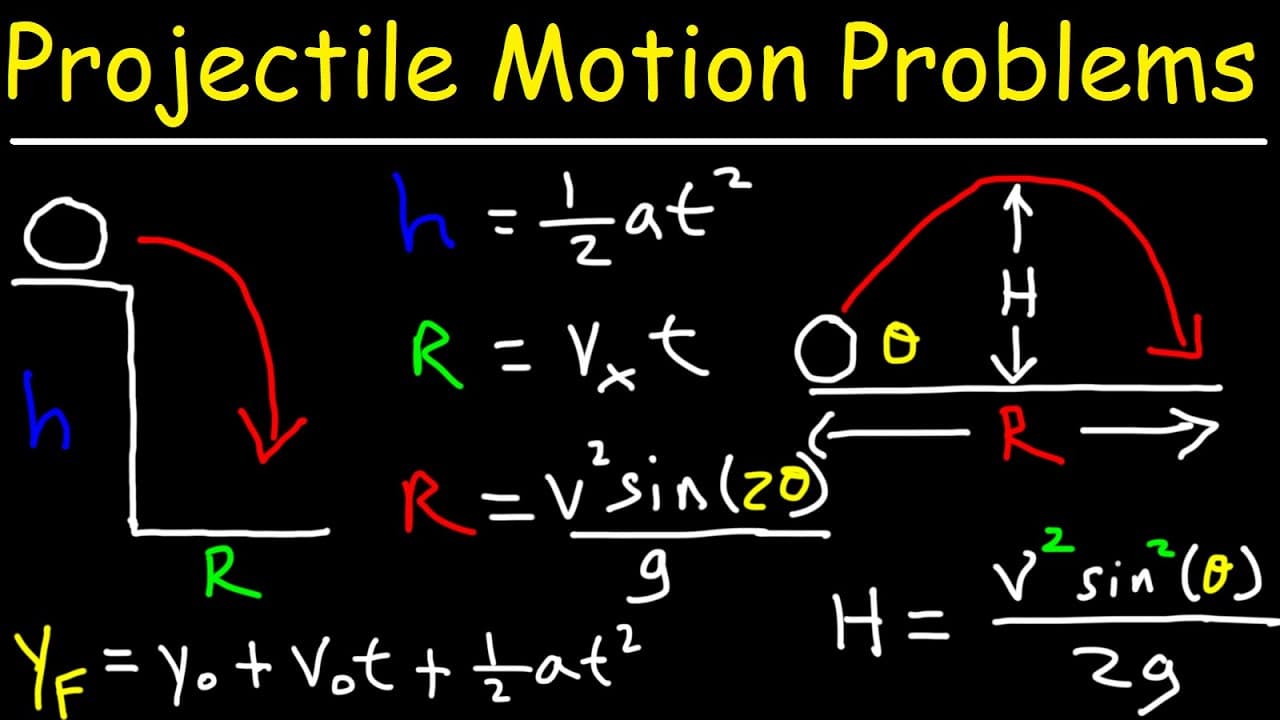
- 💬 There are three common trajectories: when a ball rolls off a cliff, when a ball is kicked off the ground, and when a ball is kicked off at an angle.
- 🤩 The initial speed, launch angle, and time of flight are key parameters in solving projectile motion problems.
- 🧡 Displacement, height, range, and time can be calculated using the kinematic equations.
- 🐎 The speed and velocity of a projectile change as it moves upward and downward in its trajectory.
- 🐎 The speed at different heights remains the same, while the velocity changes due to the effect of gravity.
- 🐎 The quadratic formula can be used to solve projectile motion problems when there is an initial speed in the vertical direction.
Install to Summarize YouTube Videos and Get Transcripts
Explore YouTube Video Summarizer or Get YouTube Transcript Extractor
Questions & Answers
Q: What are the kinematic equations for projectile motion?
The kinematic equations for projectile motion are d = vt, d = vavg * t, vf = vi + at, vf^2 = vi^2 + 2a * d, and d = vi * t + (1/2) * a * t^2.
Q: What is the difference between displacement and distance in projectile motion?
Displacement is the change in position and can be positive or negative. Distance is the total path traveled and is always positive. They are the same when an object moves in one direction without changing direction.
Q: What happens to the velocity and speed of a projectile as it moves upward and downward?
The velocity of a projectile decreases as it moves upward and increases as it moves downward. The speed of a projectile decreases as it moves upward and increases as it moves downward.
Q: How can you find the maximum height of a projectile's trajectory?
The maximum height of a projectile's trajectory can be calculated using the equation h = (v^2 * sin^2(theta)) / (2 * g), where v is the initial speed and theta is the launch angle.
Summary & Key Takeaways
-
The video covers the kinematic equations for projectile motion, including displacement, velocity, and acceleration.
-
It explains that displacement is equal to velocity times time for constant speed, and displacement is equal to average velocity times time for constant acceleration.
-
The video also discusses the three common trajectories in projectile motion and provides equations to calculate height, time, and range.
Read in Other Languages (beta)
Share This Summary 📚
Summarize YouTube Videos and Get Video Transcripts with 1-Click
Try YouTube Summary with ChatGPT & Claude or YouTube Transcript Generator
Explore More Summaries from The Organic Chemistry Tutor 📚



Summarize YouTube Videos and Get Video Transcripts with 1-Click
Try YouTube Summary with ChatGPT & Claude or YouTube Transcript Generator