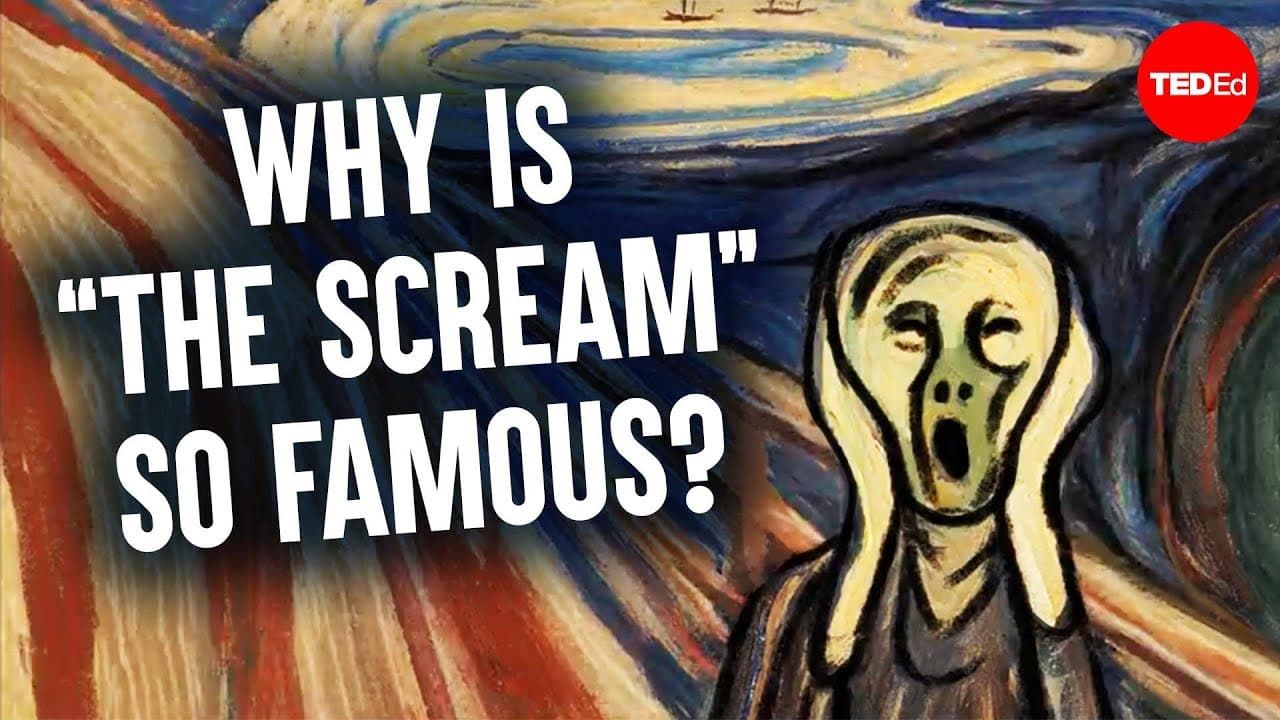
This person isn't actually screaming - Noah Charney
TL;DR
The iconic artwork "The Scream" by Edvard Munch has endured for over a century due to its powerful expression of personal suffering and its ability to resonate with universal emotions of horror and angst.
Transcript
An undulating sky melds into the landscape, two silhouettes move along a balustraded walkway, and a ghostly figure’s features extend in agony. Since Norwegian artist Edvard Munch created “The Scream” in 1893, it’s become one of the world’s most famous artworks. But why has its cry traveled so far and endured so long? Munch was born in 1863, one of ... Read More
Key Insights
- 👪 Edvard Munch's personal experiences, including illness and death within his family, greatly influenced his artistic style.
- 🍓 Munch embraced "soul painting," prioritizing raw emotions and subjective affect over realism.
- 😱 "The Scream" became a symbol for horror and angst, fueling the Expressionist movement and resonating with a universal audience.
- 😱 The figure in "The Scream" is often interpreted as reacting to an infinite scream passing through nature.
- ❓ Multiple versions and reproductions of "The Scream" have contributed to its enduring fame.
- ❓ The artwork has been featured in popular culture and even inspired its own emoji.
- 😱 "The Scream" has become an archetypal symbol, representing personal suffering and universal emotions.
Install to Summarize YouTube Videos and Get Transcripts
Explore YouTube Video Summarizer or Get YouTube Transcript Extractor
Questions & Answers
Q: How did Edvard Munch's personal experiences influence his artwork?
Munch's own encounters with illness and death, as well as his family's struggles with tuberculosis and mental illness, deeply impacted his art. He wrote about inheriting the "seeds of madness" and expressed his personal anguish through his paintings.
Q: What artistic movement did "The Scream" help fuel?
"The Scream" played a significant role in the development of the Expressionist movement, which focused on conveying intense psychological states and mapping the emotional contours of the world during and after World War I.
Q: What is the significance of the figure's expression in "The Scream"?
Based on Munch's account, many believe that the figure in "The Scream" is reacting to an infinite scream passing through nature rather than emitting the shriek itself. The haunting expression directly engages with the viewer, evoking a sense of shared suffering.
Q: How did "The Scream" gain widespread recognition and fame?
Over time, "The Scream" entered the public domain, leading to various renditions and reproductions that contributed to its popularity. It was featured in popular films, stolen and recovered in heists, and even inspired an emoji and potential use as a warning symbol by the US government.
Summary & Key Takeaways
-
Edvard Munch's personal experiences with illness, death, and mental illness heavily influenced his artwork, including "The Scream."
-
Munch broke away from academic tradition and embraced "soul painting," prioritizing raw emotions over realistic representation.
-
"The Scream" was inspired by a moment of anguish and has become an archetypal symbol for horror and angst.
Read in Other Languages (beta)
Share This Summary 📚
Summarize YouTube Videos and Get Video Transcripts with 1-Click
Try YouTube Summary with ChatGPT & Claude or YouTube Transcript Generator
Explore More Summaries from TED-Ed 📚






Summarize YouTube Videos and Get Video Transcripts with 1-Click
Try YouTube Summary with ChatGPT & Claude or YouTube Transcript Generator