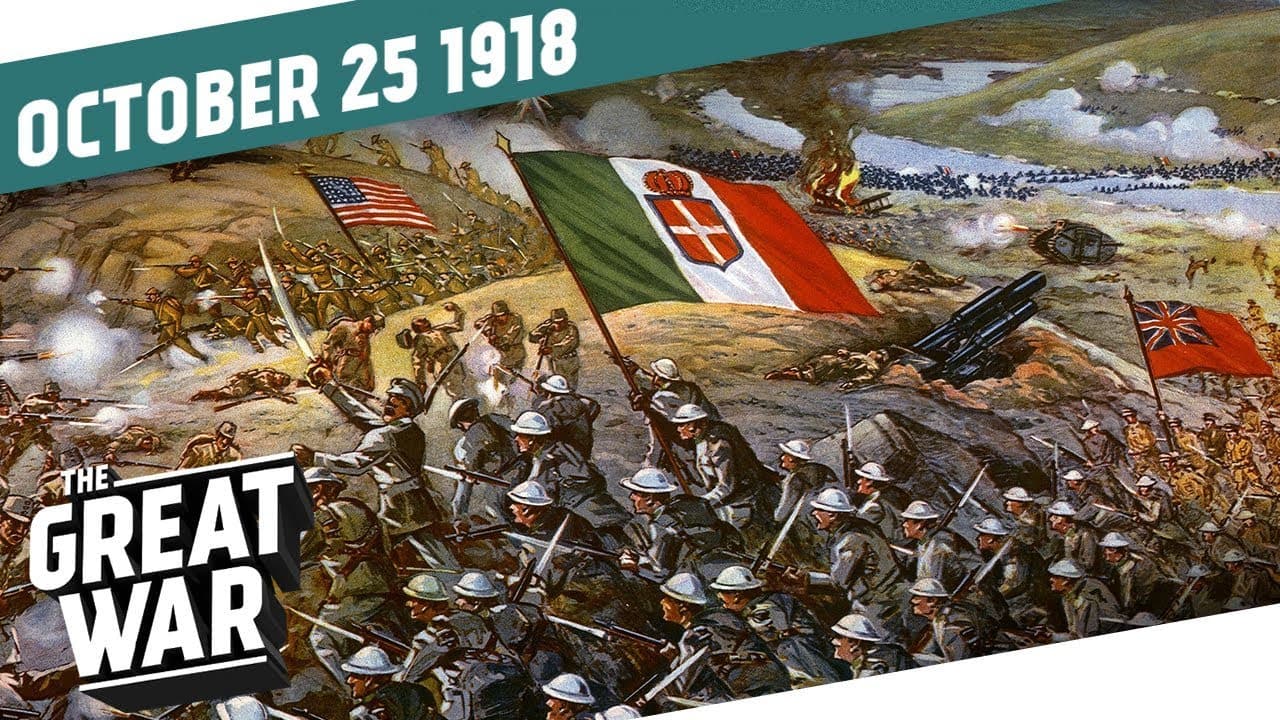
Italy Attacks - The Battle of Vittorio Veneto I THE GREAT WAR Week 222
TL;DR
The Italian army launches a major offensive against Austro-Hungarians.
Transcript
The Italian Front has been quiet since a summer offensive by the Austrians, and the Italians have been on defense for a year. Exactly a year, as it happens, for this week on the anniversary of Caporetto, the Italian army attacks! I’m Indy Neidell; welcome to the Great War. Last week there was chaos in the German Army High Command, as they tried to ... Read More
Key Insights
- The Italian Front, quiet since the summer, sees renewed action as the Italian army launches an offensive on the anniversary of Caporetto.
- American President Woodrow Wilson asserts that armistice terms must prevent Germany from resuming hostilities, indicating a strong negotiating position.
- The Allied commanders, including Foch and Haig, discuss armistice terms, focusing on disarming Germany to prevent future conflicts.
- German High Command is in disarray with Ludendorff's resignation, signaling internal chaos as the war nears its end.
- The Austro-Hungarian Empire faces internal disintegration, with Hungarian units refusing to fight and calls for national independence growing.
- The Battle of Vittorio Veneto begins with heavy artillery bombardment but sees limited gains for the Italians due to fierce Austrian resistance.
- The second wave of the Spanish Flu severely impacts military forces, highlighting the pandemic's role in weakening armies, particularly the Central Powers.
- The German Navy plans a last-ditch assault on the British Grand Fleet, reflecting a desperate attempt to make a statement despite impending defeat.
Install to Summarize YouTube Videos and Get Transcripts
Explore YouTube Video Summarizer or Get YouTube Transcript Extractor
Questions & Answers
Q: What prompted the Italian army to launch an offensive on the Italian Front?
The Italian army launched an offensive on the Italian Front on the anniversary of Caporetto. This was likely a strategic decision to capitalize on the symbolic date and to take advantage of the Austro-Hungarian Empire's internal chaos and weakening morale. The offensive aimed to regain momentum and put pressure on the Austro-Hungarian forces, which were already dealing with internal disintegration and calls for independence among their troops.
Q: What were the key concerns of the Allied commanders regarding the armistice terms with Germany?
The key concerns of the Allied commanders regarding the armistice terms with Germany were to ensure that Germany would be unable to renew hostilities in the future. This involved disarming Germany by demanding the surrender of all artillery and railway rolling stock, as well as all submarines. The goal was to prevent Germany from regrouping and launching another offensive, thereby securing a lasting peace and avoiding a resurgence of conflict.
Q: How did the resignation of Ludendorff affect the German High Command?
The resignation of Erich Ludendorff significantly affected the German High Command by creating a leadership vacuum and further destabilizing the already chaotic situation. Ludendorff's resignation was a result of internal disagreements and pressures, and it signaled a loss of confidence in the German military's ability to continue the war. His departure was met with relief and even celebration in some quarters, highlighting the growing discontent and desire for change within Germany as the war neared its end.
Q: What role did the Spanish Flu play in the weakening of military forces during this period?
The Spanish Flu played a significant role in weakening military forces during this period, particularly among the Central Powers. The second wave of the flu was far more deadly, with high case numbers reported among the American, British, and French armies. The flu's rapid spread and high mortality rate severely impacted troop strength and morale, contributing to the overall weakening of the Central Powers' military capabilities and hastening their eventual defeat in the war.
Q: How did the Austro-Hungarian Empire's internal issues contribute to its military struggles?
The Austro-Hungarian Empire's internal issues, such as growing calls for independence and refusal of Hungarian units to fight, significantly contributed to its military struggles. These internal divisions weakened the empire's ability to maintain a unified and effective military front. As nationalistic sentiments grew stronger, the empire faced increasing difficulties in mobilizing and sustaining its forces, leading to a loss of cohesion and effectiveness on the battlefield, which was exploited by the Allies.
Q: What was the significance of the Battle of Vittorio Veneto for the Italian Front?
The Battle of Vittorio Veneto was significant for the Italian Front as it marked a major offensive by the Italian army against the Austro-Hungarian forces. Despite limited territorial gains, the battle signaled a renewed Italian effort to break the stalemate and put pressure on the Austro-Hungarians. It was part of a broader Allied strategy to exploit the weakening Central Powers and hasten their defeat, contributing to the eventual collapse of the Austro-Hungarian Empire.
Q: What were the implications of the German Navy's plan for an all-out assault on the British Grand Fleet?
The German Navy's plan for an all-out assault on the British Grand Fleet had significant implications, as it represented a desperate attempt to make a final statement despite the impending defeat. This plan highlighted the German Navy's willingness to engage in a potentially suicidal mission to demonstrate courage and resolve. However, the plan also underscored the futility and desperation of the German military situation, as the war's outcome was increasingly clear and unfavorable for Germany.
Q: How did the Allied forces ensure that Germany would be unable to resume hostilities after the armistice?
The Allied forces ensured that Germany would be unable to resume hostilities after the armistice by demanding the surrender of all artillery, railway rolling stock, and submarines. These measures were designed to dismantle Germany's military infrastructure and prevent it from regrouping and launching future offensives. Additionally, the Allied commanders, with the support of President Woodrow Wilson, insisted on terms that would make it impossible for Germany to renew the fight, thereby securing a lasting peace.
Summary & Key Takeaways
-
The Italian army launches an offensive on the anniversary of Caporetto, marking a significant shift on the Italian Front, which had been quiet since the summer. This move coincides with internal chaos in the Austro-Hungarian Empire and growing unrest among its troops.
-
American President Woodrow Wilson and Allied commanders focus on ensuring that armistice terms will prevent Germany from resuming hostilities, highlighting the Allies' strong negotiating position as the war nears its conclusion.
-
The Austro-Hungarian Empire faces internal disintegration, with Hungarian units refusing to fight, while the Spanish Flu's second wave devastates military forces, contributing to the Central Powers' weakening as the war approaches its end.
Read in Other Languages (beta)
Share This Summary 📚
Summarize YouTube Videos and Get Video Transcripts with 1-Click
Try YouTube Summary with ChatGPT & Claude or YouTube Transcript Generator
Explore More Summaries from The Great War 📚

Summarize YouTube Videos and Get Video Transcripts with 1-Click
Try YouTube Summary with ChatGPT & Claude or YouTube Transcript Generator