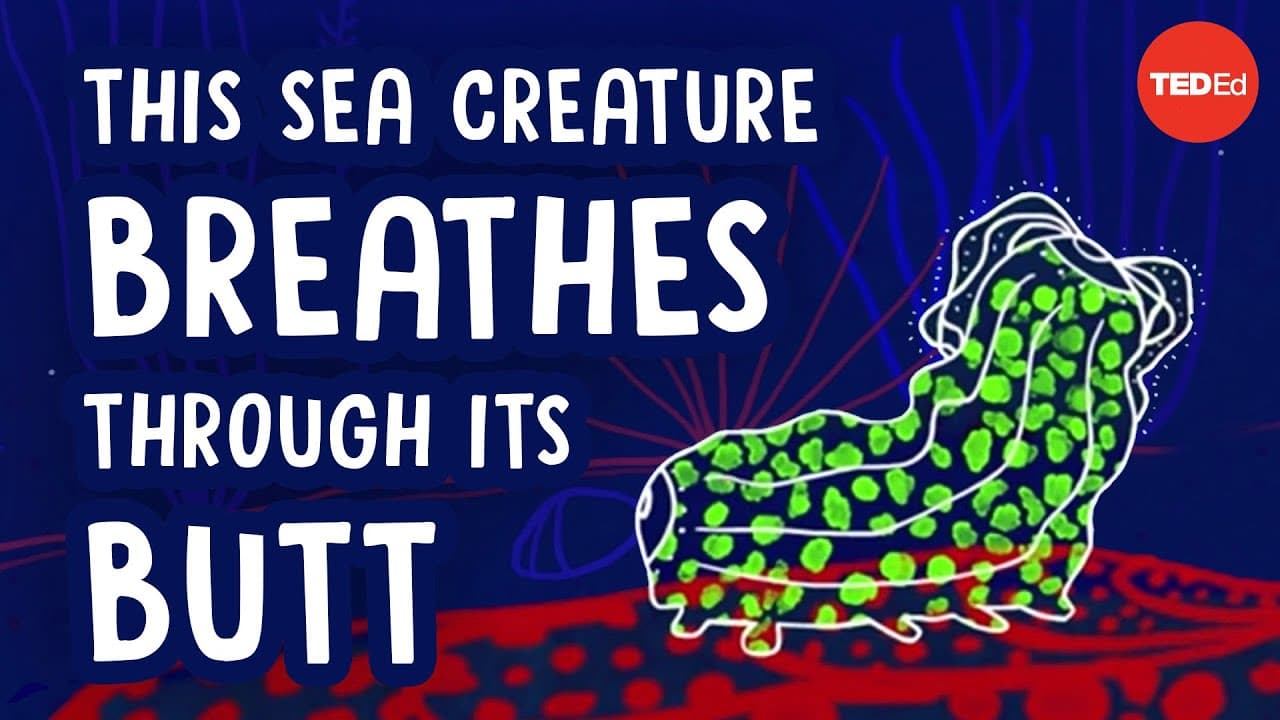
This sea creature breathes through its butt - Cella Wright
TL;DR
Sea cucumbers, often misunderstood, are vital eco-engineers of the ocean floor.
Transcript
Can you guess what you’re looking at? Is it a fuzzy sock? An overripe banana? A moldy tube of toothpaste? In fact, this is the humble sea cucumber, and while it might look odd, its daily toil paves the way for entire ecosystems to thrive. Sea cucumbers are members of the phylum Echinodermata, along with sea urchins, starfish and other radially... Read More
Key Insights
- 🤢 Sea cucumbers belong to the Echinodermata phylum, playing a vital role in marine ecosystems.
- 🤣 These ocean floor cleaners possess unique defense mechanisms like evisceration to deter predators.
- ♻️ Sea cucumbers aid in nutrient cycling by digesting organic matter and recycling nutrients.
- 🤢 They are essential in maintaining biodiversity by creating conditions for sea grass beds and shellfish to thrive.
- 🌊 Sea cucumbers contribute to coral formation and help buffer marine environments from ocean acidification.
- 🤢 Evidently, sea cucumbers are efficient eco-engineers, shaping the marine environment by their daily toil.
- 🤢 Half of the sandy seafloor is estimated to have passed through the digestive tract of sea cucumbers, highlighting their significant ecological impact.
Install to Summarize YouTube Videos and Get Transcripts
Explore YouTube Video Summarizer or Get YouTube Transcript Extractor
Questions & Answers
Q: What is the importance of sea cucumbers in marine ecosystems?
Sea cucumbers clean and oxygenate the seafloor by digesting organic matter, aiding in coral formation, and buffering marine environments from ocean acidification.
Q: How do sea cucumbers defend themselves against predators?
Sea cucumbers use their mutable collagenous tissue to eject organs in a process called evisceration, startling predators with their sticky and toxic innards, which can regenerate quickly.
Q: What is the role of sea cucumbers in nutrient cycling in the ocean?
Sea cucumbers consume detritus, excreting it back as byproducts, which helps in recycling nutrients and creating conditions for sea grass beds and shellfish to thrive.
Q: How do sea cucumbers contribute to the biodiversity of the ocean floor?
Sea cucumbers comprise a significant portion of animal biomass on the deep sea floor, cleaning the seabed and creating conditions for various marine organisms to flourish.
Summary & Key Takeaways
-
Sea cucumbers, part of Echinodermata, come in various shapes like creatures from a sci-fi film.
-
They play a crucial role in marine ecosystems by cleaning the seafloor and recycling nutrients.
-
Sea cucumbers possess unique defense mechanisms like evisceration, regenerating lost parts quickly to survive.
Read in Other Languages (beta)
Share This Summary 📚
Summarize YouTube Videos and Get Video Transcripts with 1-Click
Try YouTube Summary with ChatGPT & Claude or YouTube Transcript Generator
Explore More Summaries from TED-Ed 📚






Summarize YouTube Videos and Get Video Transcripts with 1-Click
Try YouTube Summary with ChatGPT & Claude or YouTube Transcript Generator