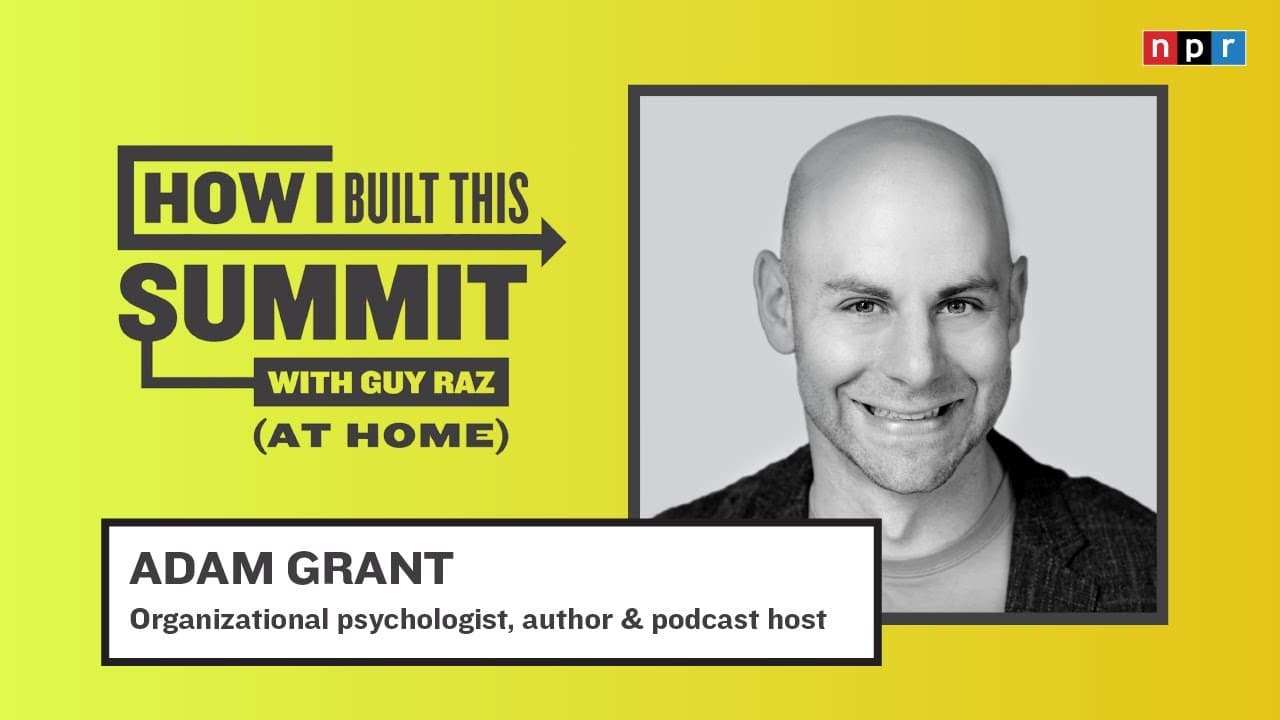
Adam Grant Talks Organizational Psychology & Entrepreneurship | How I Built This with Guy Raz | NPR
TL;DR
Manage attention by prioritizing meaningful people and projects, rather than trying to optimize every hour. Strong creative work begins with curiosity, usefulness, and a genuinely novel contribution. Capturing many ideas, revisiting recurring ones, and delaying difficult problems can support incubation, reframing, and the subconscious connections that produce valuable insights.
Transcript
welcome back everybody we are talking about innovation tonight and who better as i said on day one every night we're talking to one person who kind of embodies themes so leadership renee brown we talked to garyvee about marketing tonight innovation adam grant who's in this window next to me yes that's i think i pointed in the right direction um ada... Read More
Key Insights
- Attention management is a practical alternative to time management because people can control what receives their focus more directly than they can create additional hours. Grant prioritizes meaningful relationships and worthwhile projects, allowing the importance of the work to outweigh how long it takes.
- Meaningful work is both intrinsically motivating and beneficial to other people. Grant judges productivity by whether the work remains interesting and important, rather than by whether he has optimized every part of his schedule or completed a task within a predetermined number of hours.
- A promising project begins with sustained passion or curiosity because substantial work can follow its creator for a long time. Grant looks for subjects that excite him in the morning, remain on his mind at night, and continue incubating even when his attention is elsewhere.
- Novelty is a separate test from excitement and usefulness. A project can interest its creator and address a real concern while still adding little that is unique. Grant argues that creators should ask whether they have a distinctive contribution before committing significant effort.
- Idea generation produces large amounts of unusable material, so selection is essential. Grant records every idea in a pocket notebook, transfers the notes into a document each week, and reviews that document monthly without expecting every entry to become a project.
- Recurring ideas can signal subjects worth exploring. When Grant discovers that he independently recorded the same thought several times at different points in his life, he treats that repeated excitement as evidence that the idea may contain something interesting and developable.
- Strategic procrastination can improve creativity when a person delays a difficult, unresolved task rather than an uninteresting one. The delay creates incubation time, which can help someone access remote knowledge, reconsider the problem, and encounter a fresh creative insight.
- Subconscious thinking supports nonlinear connections that deliberate thought may miss. Conscious reasoning often advances sequentially from one step to the next, while subconscious processing can make intuitive leaps. Those leaps sometimes fail, but they can also produce useful ideas after distance from a problem.
Install to Summarize YouTube Videos and Get Transcripts
Explore YouTube Video Summarizer or Get YouTube Transcript Extractor
Questions & Answers
Q: How can attention management improve creative productivity?
Attention management improves creative productivity by directing focus toward the people and projects that matter most. Grant starts each week by identifying those priorities instead of trying to optimize every hour. When work is intrinsically motivating, useful to others, and worth sustained concentration, productivity becomes about accomplishing something important rather than completing it within the shortest possible time.
Q: What makes an idea worth developing into a project?
An idea is worth developing when it passes three tests described by Grant: it inspires genuine passion or curiosity, it is useful to other people, and it offers something novel. Excitement alone is insufficient, and usefulness alone does not establish originality. The creator should also have a distinctive contribution that justifies adding another book, product, podcast, or research project to the world.
Q: How does Adam Grant capture and evaluate new ideas?
Grant carries a small notebook and writes down ideas whenever they occur. Once each week, he types those ideas into a document. He opens the document monthly and reviews it, recognizing that much of the material will not be useful. When the same idea appears several times without him remembering its earlier appearances, he sees a possible signal that it deserves further exploration.
Q: Why is generating many weak ideas part of creativity?
Generating many weak ideas is part of creativity because creators cannot assume that every initial thought will become an elegant or useful contribution. Grant acknowledges that much of his idea document looks embarrassing when revisited. Recording everything still helps because the review process separates disposable thoughts from recurring ideas that continue to create excitement and may be strong enough for development.
Q: When can procrastination support creative thinking?
Procrastination can support creative thinking when a person delays a task because it is difficult and has not yet been figured out. According to the research Grant discusses, that delay can create opportunities for incubation, access to remote knowledge, and fresh ways of framing the problem. Delaying work merely because it is boring or unimportant does not provide the same creative benefit.
Q: Why can sleeping on a difficult problem produce an insight?
Sleeping on a difficult problem can provide distance from rigid, conscious reasoning. Grant says conscious thought often tries to move sequentially from one step to another, while subconscious thought is more capable of nonlinear processing and intuitive leaps. Those leaps may sometimes be unproductive, but they can also connect ideas in ways that lead to a useful realization after waking.
Q: How should creators respond when they cannot solve a problem immediately?
Creators can resist the impulse to finish immediately and allow an unresolved problem time to incubate. This is especially relevant for people who strongly value progress, momentum, and early completion. Temporarily setting aside a hard problem can make room for different knowledge, alternative framing, and subconscious processing, increasing the possibility that a better idea will emerge later.
Q: How does organizational psychology relate to entrepreneurship?
Organizational psychology relates to entrepreneurship through the creation and application of useful ideas about work, creativity, and human behavior. Grant initially resisted calling himself an entrepreneur because he had not launched his own company or created a conventional tangible product. He later accepted that books, podcasts, data, and ideas can function as products, making him an entrepreneur of data and ideas.
Summary
In this video, Guy Raz interviews Adam Grant, a professor, organizational psychologist, and author, about innovation and the process of building and creating. They discuss topics like time management, ideation, creativity, failure, and the importance of reflection. Adam shares insights and practical advice for entrepreneurs and individuals looking to foster innovation and growth.
Questions & Answers
Q: How does Adam approach time management and productivity?
Adam believes in shifting from time management to attention management. He focuses on what matters most to him, such as meaningful relationships and projects. He believes that efficiency is not the ultimate goal, but rather finding work that is interesting, important, and intrinsically motivating.
Q: How does Adam start the process of coming up with innovative book ideas?
Adam considers himself an entrepreneur of data and ideas. He finds that curiosity and passion are crucial starting points for any project. He also emphasizes the importance of uniqueness and whether he has a fresh perspective or unique contribution to make on a topic.
Q: How does Adam handle creative blocks and moments when nothing interesting seems to come out?
Adam acknowledges that creative blocks are inevitable for everyone. He has learned that rushing an idea before all the pieces are together often leads to frustration. He values the power of subconscious thought and stepping back to gain a different perspective. He also suggests analyzing the creative block as a curious observer and embracing the opportunity for discovery.
Q: How does Adam view procrastination in relation to creativity?
While Adam recognizes that procrastination can hinder productivity, he believes it can also be a valuable part of the creative process. Procrastination allows room for incubation, accessing remote knowledge, and reframing problems in fresh ways. It provides an opportunity for intuitive leaps and creative insights that may not arise through linear thinking.
Q: How does Adam navigate the fine line between persistence and stubbornness?
Adam emphasizes the importance of recognizing when persistence turns into stubbornness. He suggests having a challenge network of thoughtful critics who can provide independent feedback. These critics can help identify blind spots and offer perspective on whether to stick with a project or pivot. It's crucial to examine principles versus policies and remain open to reevaluating strategies.
Q: How does Adam address the fear of failure and the demoralization it may cause?
Adam acknowledges that failure can be demoralizing, especially after repeated failures. However, he believes that learning from failures and pivoting are essential for growth. He advocates for normalizing failure, recognizing it as a necessary part of taking risks and solving complex problems. Aim higher, set ambitious goals, and view failure as a stepping stone rather than defining your worth.
Q: What is a creative checkup, and why is it necessary?
A creative checkup is a scheduled reflection on one's career choices and creative pursuits. Adam recommends treating it like a medical checkup, occurring once or twice a year. It allows individuals to proactively evaluate their career paths and make adjustments if needed. By reflecting on their goals, passions, and fulfillment, they can align their creative journeys accordingly.
Q: How does Adam navigate the balance between receiving feedback and staying true to one's convictions?
Adam suggests distinguishing between principles and specific policies. Principles are fundamental beliefs, while policies are ways to manifest those beliefs. By separating the two, individuals can be open to feedback on their policies without compromising their principles. Having an open mindset and seeking feedback from a challenge network can help align convictions with effective strategies.
Q: What does Adam suggest for individuals struggling with constant self-doubt?
Adam advises individuals struggling with self-doubt to find a sense of purpose and passion. By focusing on meaningful goals and work that align with personal values, individuals can silence self-doubt and find motivation to keep going. Surrounding oneself with a supportive network and seeking independent feedback can also provide reassurance and build confidence.
Q: How does Adam define success in the context of innovation and creativity?
Adam believes that success in innovation and creativity is not limited to financial outcomes or societal recognition. He considers success as the ability to continuously learn, grow, and have an impact on others. Finding joy and fulfillment in the process of creating and innovating, regardless of external validation, is what determines true success.
Takeaways
Innovation and creativity require effective time and attention management. It is important to focus on meaningful projects and relationships rather than purely seeking efficiency. Ideation involves passion, curiosity, and a unique perspective. Creative blocks can be overcome through reflection, subconscious thought, and reframing problems. Procrastination can be beneficial when it leads to intuitive insights. Persistence needs to be balanced with open-mindedness and a willingness to pivot. Failure is a natural part of the journey and should be normalized rather than celebrated. Scheduling regular creative checkups can help individuals proactively reflect on their career paths. Separating principles from policies allows for feedback and adaptation without compromising core values. Success in innovation comes from continuous learning, growth, and having a positive impact, regardless of external recognition.
Summary & Key Takeaways
-
Adam Grant recommends shifting from time management to attention management. He begins each week by identifying the people and projects that matter most, then concentrates on work that is intrinsically motivating and beneficial to others. This approach values interesting, important outcomes over completing tasks within an artificially optimized schedule.
-
Grant describes himself as an entrepreneur of data and ideas whose books and podcasts function as products. He evaluates potential projects through three filters: personal curiosity, usefulness to other people, and novelty. A promising idea must sustain his interest, address something meaningful, and offer a contribution that does not already exist.
-
Creative development requires generating many weak ideas alongside potentially valuable ones. Grant records ideas in a pocket notebook, types them weekly, and reviews the collection monthly. Recurring ideas deserve closer examination. Strategic procrastination can also help when a difficult problem remains unresolved, because distance permits incubation, reframing, and nonlinear subconscious thought.
Read in Other Languages (beta)
Share This Summary 📚
Summarize YouTube Videos and Get Video Transcripts with 1-Click
Try YouTube Summary with ChatGPT & Claude or YouTube Transcript Generator
Explore More Summaries from NPR 📚






Summarize YouTube Videos and Get Video Transcripts with 1-Click
Try YouTube Summary with ChatGPT & Claude or YouTube Transcript Generator