Can Future Colliders Break the Standard Model?
TL;DR
Future colliders aim to surpass the Standard Model's limits.
Transcript
If you wanna make an omelet you gotta break a few eggs. And by omelet I mean a theory of everything, and by eggs I mean a billion billion subatomic particles obliterated in the next generation of giant particle colliders. In June, the consortium of Europe’s top particle physicists published their vision for the next several years of particle physic... Read More
Key Insights
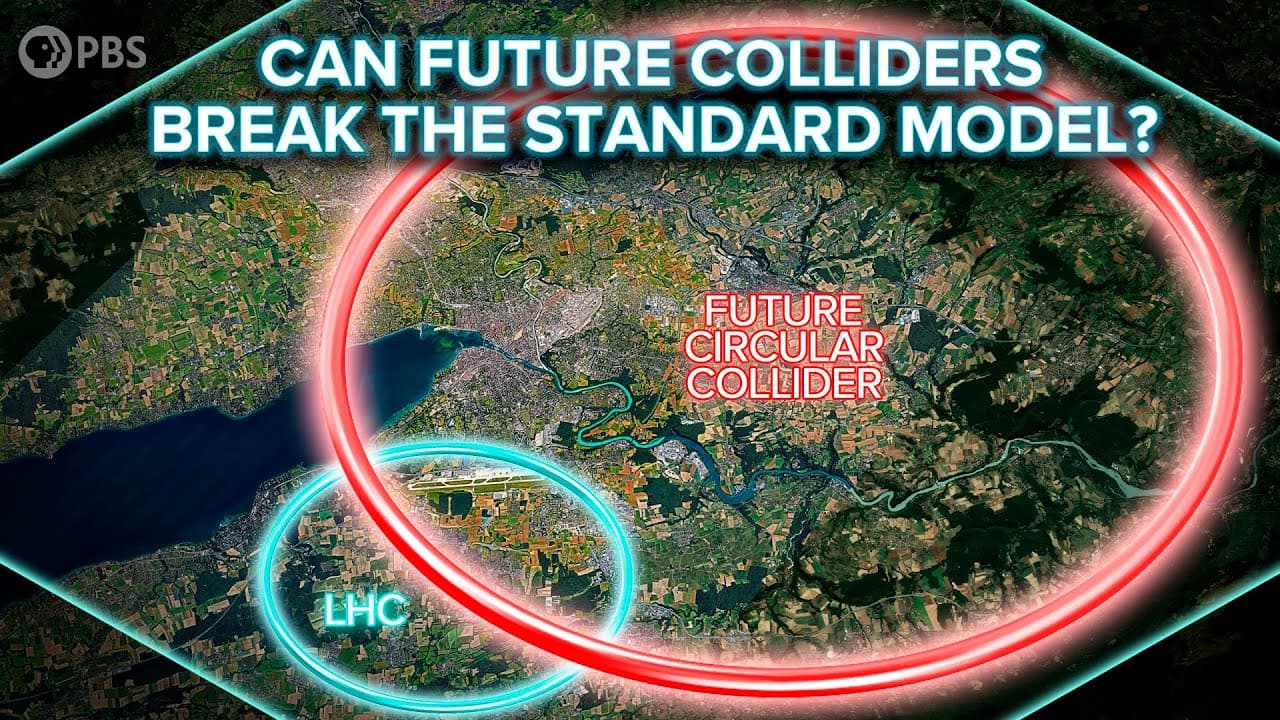
- The Future Circular Collider (FCC) is proposed to be four times the size of the Large Hadron Collider (LHC) and aims to achieve eight times its energy, potentially unveiling new physics beyond the Standard Model.
- Particle colliders have evolved from linear accelerators to complex ring colliders, greatly enhancing collision energy and allowing for more detailed exploration of subatomic particles.
- The LHC's discovery of the Higgs boson confirmed the mechanism by which particles acquire mass, completing the Standard Model but leaving some questions unanswered.
- Supersymmetry (SUSY) was anticipated to provide solutions to the Standard Model's hierarchy problem, but no evidence has been found at LHC energy levels, prompting the need for higher energy colliders.
- The FCC plans to initially collide electrons and positrons to produce Higgs particles before moving to proton-proton collisions, expanding the potential for discovering new particles.
- The FCC's development is part of a larger European strategy, while the US focuses on projects like the Electron-Ion Collider, aimed at probing quark interactions within nucleons.
- The LHC is undergoing upgrades to enhance luminosity and precision, allowing for more detailed studies within its current energy range.
- Fundamental research in particle physics, despite its high costs and uncertain returns, is crucial for advancing human knowledge and technological development.
Install to Summarize YouTube Videos and Get Transcripts
Explore YouTube Video Summarizer or Get YouTube Transcript Extractor
Questions & Answers
Q: What is the main goal of the Future Circular Collider?
The main goal of the Future Circular Collider (FCC) is to achieve collision energies significantly higher than those of the Large Hadron Collider (LHC), with the aim of discovering new particles and phenomena that could provide insights into physics beyond the Standard Model. By accelerating particles in a 100-kilometer ring and achieving up to 100 TeV energies, the FCC hopes to explore uncharted territories in particle physics.
Q: How have particle colliders evolved over time?
Particle colliders have evolved from linear accelerators, which used oscillating electric fields to accelerate particles in a straight line, to ring colliders that store particle beams in a circular path, allowing for repeated collisions. This evolution has enabled physicists to achieve higher collision energies and explore deeper into the subatomic world, leading to significant discoveries such as the Higgs boson at the LHC.
Q: Why is there a need to go beyond the Standard Model?
The Standard Model, although successful in explaining many fundamental aspects of particle physics, has limitations. It does not account for the hierarchy problem, neutrino masses, dark matter, or anomalies like the muon's magnetic moment. To address these gaps, physicists seek to explore beyond the Standard Model, hoping to find new particles or interactions that could provide a more complete understanding of the universe.
Q: What challenges does the Future Circular Collider face?
The Future Circular Collider faces several challenges, including the immense cost and complexity of construction, the need for international collaboration, and the uncertainty of discovering new particles within the expanded energy range. Despite these challenges, the potential for groundbreaking discoveries in particle physics makes the FCC a priority for the scientific community.
Q: How does the LHC's upgrade process contribute to future discoveries?
The LHC's upgrade process aims to increase its luminosity and precision by enhancing components like superconducting magnets. This will allow for more detailed studies of particle interactions within its current energy range, providing valuable data that could inform future collider experiments and potentially lead to the discovery of new particles or phenomena.
Q: What role does the US play in future collider experiments?
While the US has shifted focus from large colliders to smaller, specialized experiments, it remains active in the field. The proposed Electron-Ion Collider (EIC) at Brookhaven National Labs aims to probe the structure and interactions of quarks within nucleons. This project, endorsed by the National Academy of Sciences, represents a significant US contribution to advancing particle physics.
Q: Why is fundamental research in particle physics considered valuable?
Fundamental research in particle physics is considered valuable because it expands human knowledge and has historically led to technological advancements that benefit society. Discoveries in particle physics have contributed to the development of technologies such as medical imaging, computing, and telecommunications. Additionally, the pursuit of knowledge for its own sake is seen as a noble endeavor that elevates humanity.
Q: What is the significance of the Higgs boson discovery?
The discovery of the Higgs boson at the LHC was significant because it confirmed the mechanism by which elementary particles acquire mass, as predicted by the Standard Model. This discovery completed the Standard Model's particle roster and validated a key aspect of our understanding of particle physics. However, it also highlighted the need for further exploration to address unresolved questions and limitations of the Standard Model.
Summary & Key Takeaways
-
The Future Circular Collider (FCC) is a proposed particle accelerator that aims to achieve energies far beyond those of the current Large Hadron Collider (LHC). It is expected to provide insights into physics beyond the Standard Model, which remains incomplete despite the discovery of the Higgs boson.
-
Particle colliders have evolved significantly since the 1920s, moving from linear accelerators to complex ring colliders, allowing for more powerful collisions and the discovery of new subatomic particles. The FCC represents the next step in this evolution, with a focus on achieving higher energies.
-
The FCC's development is part of a broader strategy involving international collaboration and significant investment. While there are no guarantees of new discoveries, the potential to unlock new physics and solve existing mysteries makes it a worthwhile endeavor for the scientific community.
Read in Other Languages (beta)
Share This Summary 📚
Summarize YouTube Videos and Get Video Transcripts with 1-Click
Try YouTube Summary with ChatGPT & Claude or YouTube Transcript Generator
Explore More Summaries from PBS Space Time 📚


Summarize YouTube Videos and Get Video Transcripts with 1-Click
Try YouTube Summary with ChatGPT & Claude or YouTube Transcript Generator