Parsing Bottom Up - Computerphile
TL;DR
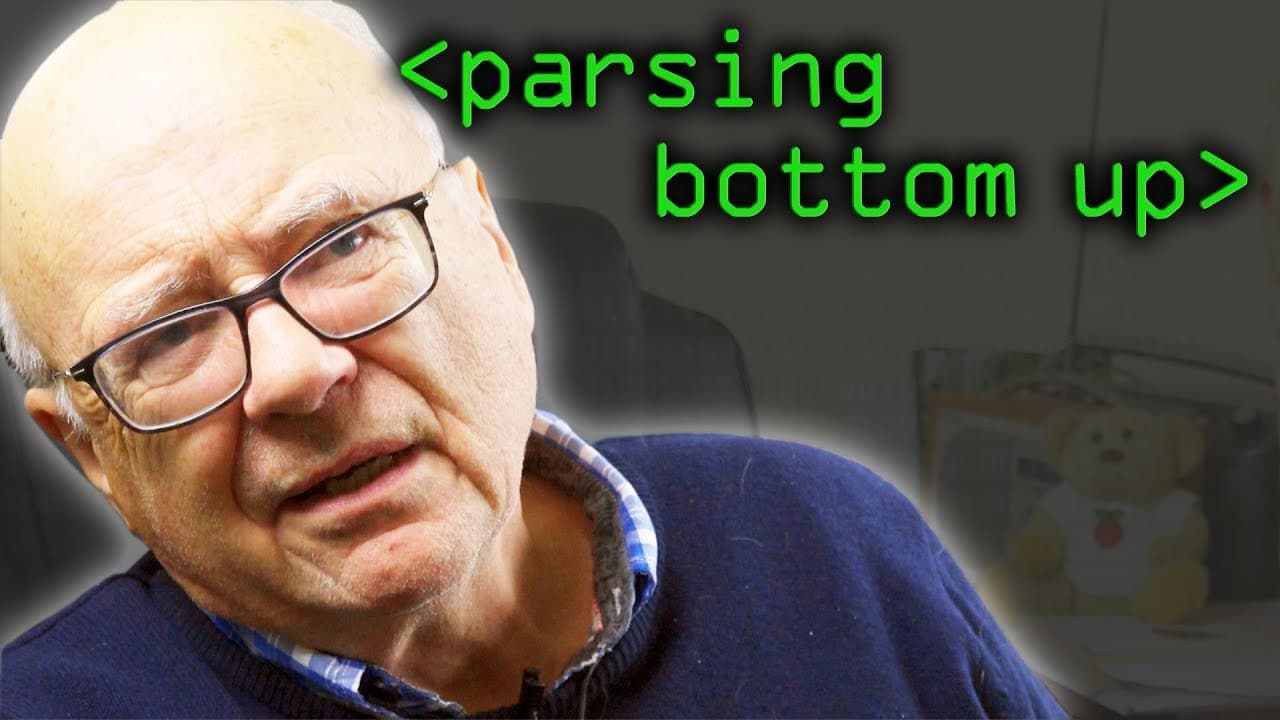
This content introduces the concepts of top-down and bottom-up parsing and explains their differences and advantages.
Transcript
last time you did a really good animation about top-down parsing we had these sentences in this totally artificial grammar which has only got about 30 words in it all in all but we started here with sentence is subject verb object and in the top-down approach you basically say okay i'll push those on the stack in a reverse order subject verb object... Read More
Key Insights
- 🌲 Top-down parsing starts from the root of the tree and develops the leaves, while bottom-up parsing starts from a correct string and works its way up the tree.
- 💁 Bottom-up parsing matches longer strings and provides more contextual information, making it more powerful than top-down parsing.
- 😒 Bottom-up parsing uses shifting to add characters to the string and reduction to simplify the string and determine the abstract structure.
- 📏 Bottom-up parsing can accurately identify the subject, verb, and object in a sentence by matching the components against the grammar rules.
- ❓ Implementing bottom-up parsing can be more complex than implementing top-down parsing.
- 😒 The use of software tools like Lex and Yak simplifies the process of writing parsers and compilers.
- 💻 Bottom-up parsing is particularly useful for analyzing computer languages like Algol 60.
Install to Summarize YouTube Videos and Get Transcripts
Explore YouTube Video Summarizer or Get YouTube Transcript Extractor
Questions & Answers
Q: What is the main difference between top-down and bottom-up parsing?
The main difference is the direction in which the parsing process occurs. Top-down parsing starts from the root and develops the leaves of the tree, while bottom-up parsing starts from a correct string and works its way up the tree.
Q: Which approach, top-down or bottom-up, is generally easier to implement?
Top-down parsing is generally easier to implement since it follows a step-by-step process of pushing components onto a stack. Bottom-up parsing, on the other hand, requires more complex handling of the stack as it works towards matching longer strings.
Q: Can bottom-up parsing accurately identify the subject, verb, and object in a sentence?
Yes, bottom-up parsing can identify the subject, verb, and object by matching the components of a correct string against the grammar rules. It uses reduction to simplify the string and determine the abstract structure of the sentence.
Q: How does bottom-up parsing handle longer strings?
Bottom-up parsing aims to match the longest possible handle, meaning it tries to find the longest possible sequence of components that matches a rule. This allows it to gather more contextual information as it matches longer strings.
Summary & Key Takeaways
-
The content explains the process of top-down parsing, where sentences are analyzed from the root of the tree to the leaves, by pushing components onto a stack in a reverse order.
-
It then introduces bottom-up parsing, which starts with a correct string and works its way up the tree, matching components from the right-hand side to the left-hand side.
-
The content demonstrates how bottom-up parsing can match longer strings and provide more contextual information, making it more powerful than top-down parsing.
Read in Other Languages (beta)
Share This Summary 📚
Summarize YouTube Videos and Get Video Transcripts with 1-Click
Try YouTube Summary with ChatGPT & Claude or YouTube Transcript Generator
Explore More Summaries from Computerphile 📚


Summarize YouTube Videos and Get Video Transcripts with 1-Click
Try YouTube Summary with ChatGPT & Claude or YouTube Transcript Generator