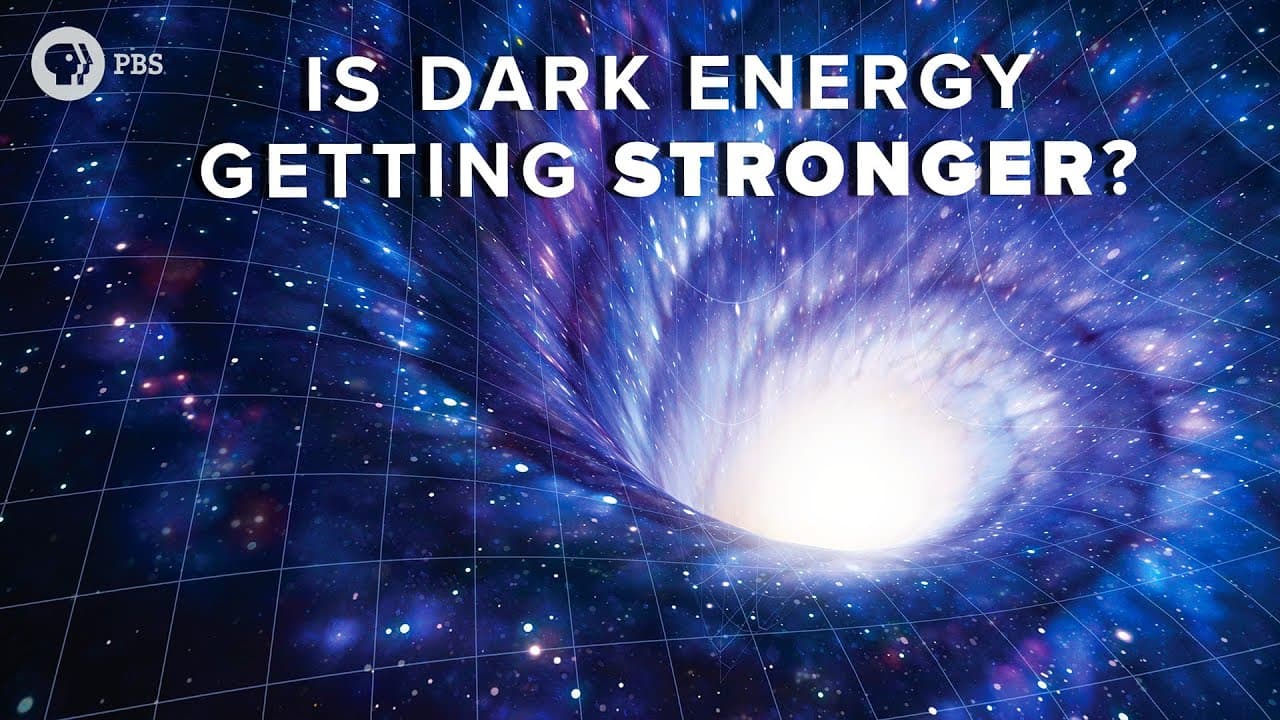
Is Dark Energy Getting Stronger?
TL;DR
Dark energy might be increasing, altering universe's future.
Transcript
Thanks to the Great Courses Plus for Supporting PBS Digital Studios. The currently accepted cosmological description of our universe is called the Lambda CDM Model and is built on the idea about the behavior of Dark Energy and Dark Matter. It’s accepted because it does a great job of explaining our observations of the universe. That is, perhaps, un... Read More
Key Insights
- The Lambda CDM Model, the current cosmological model, might be incomplete due to emerging evidence suggesting changes in dark energy and dark matter.
- A recent study in Nature Astronomy hints that the cosmological constant, representing dark energy, may not be constant and could be increasing.
- The potential increase in dark energy could lead to a scenario known as the Big Rip, where the universe could tear apart at the subatomic level.
- The discovery of dark energy in the late 1990s revolutionized cosmology, leading to the understanding that the universe's expansion is accelerating.
- Quasars, despite their variability, are being used as standard candles to measure cosmic distances and provide insights into the universe's expansion history.
- Risaliti and Lusso's study uses the X-ray and ultraviolet light emissions of quasars to propose that dark energy may be increasing over time.
- There is a discrepancy between the observed expansion rate of the universe and predictions based on the cosmic microwave background, suggesting potential issues with current models or measurements.
- Further research and data collection, particularly involving quasars, are necessary to confirm these findings and refine our understanding of dark energy's role in cosmic expansion.
Install to Summarize YouTube Videos and Get Transcripts
Explore YouTube Video Summarizer or Get YouTube Transcript Extractor
Questions & Answers
Q: What is the Lambda CDM Model?
The Lambda CDM Model is the currently accepted cosmological model that describes the universe's composition and behavior. It includes the cosmological constant (Lambda), representing dark energy, and cold dark matter (CDM). This model explains the universe's large-scale structure and expansion but is now being questioned due to new evidence suggesting changes in dark energy.
Q: What did Risaliti and Lusso's study reveal about dark energy?
Risaliti and Lusso's study, published in Nature Astronomy, suggests that the cosmological constant, associated with dark energy, might not be constant. Their research, based on the light emissions of quasars, indicates that dark energy could be increasing over time, which would have profound implications for our understanding of the universe's expansion and future.
Q: How do quasars help measure cosmic distances?
Quasars are used as standard candles to measure cosmic distances due to their extremely bright emissions, which can be observed across vast distances. By analyzing the ratio of X-ray to ultraviolet light emissions from quasars, researchers can determine their true brightness and, consequently, their distance. This method provides insights into the universe's expansion history.
Q: What is the Big Rip scenario?
The Big Rip is a hypothetical scenario where the universe's expansion accelerates to the point where it tears itself apart at the subatomic level. This could occur if dark energy continues to increase in strength, eventually affecting galaxies, planetary systems, and even atomic structures. The concept challenges our understanding of the universe's long-term future.
Q: What challenges does the study present to the Lambda CDM Model?
The study challenges the Lambda CDM Model by suggesting that dark energy may not be constant, as previously thought. This raises questions about the model's accuracy in predicting the universe's expansion rate and future. The findings highlight potential discrepancies in measurements and the need for new methods and data to refine our cosmological understanding.
Q: Why are there discrepancies in the universe's observed expansion rate?
Discrepancies in the observed expansion rate of the universe may arise from differences between predictions based on the cosmic microwave background and actual observations. These could be due to issues with current models, measurement errors, or an incomplete understanding of dark energy and dark matter. Resolving these discrepancies requires further research and data collection.
Q: What role do supernovae play in measuring cosmic expansion?
Supernovae, particularly Type 1a supernovae, serve as standard candles for measuring cosmic expansion. By comparing their known energy output with observed brightness, astronomers can determine distances and track the universe's expansion history. However, limitations in observing supernovae across all cosmic history have prompted the search for alternative methods, such as using quasars.
Q: What are the potential alternative explanations for the study's findings?
Alternative explanations for the study's findings include systematic errors in measuring supernovae or quasar distances, issues with cosmic microwave background calculations, or random variations in quasar observations. Some theories propose that dark energy's strength fluctuates or oscillates over time. Further research and more data are needed to confirm or refute these possibilities.
Summary & Key Takeaways
-
The current cosmological model, Lambda CDM, may be challenged by new evidence suggesting that dark energy could be increasing, potentially leading to a dramatic future scenario known as the Big Rip. This model's assumptions are being tested by new methods involving quasars as standard candles.
-
Risaliti and Lusso's research indicates that the cosmological constant, associated with dark energy, might not be constant. This finding is based on the analysis of quasars' light emissions, which could suggest an accelerating expansion of the universe beyond current expectations.
-
The study's implications are significant, as they could redefine our understanding of the universe's future. However, discrepancies in measurements and the need for more data emphasize the importance of continued research to verify these potential changes in dark energy's behavior.
Read in Other Languages (beta)
Share This Summary 📚
Summarize YouTube Videos and Get Video Transcripts with 1-Click
Try YouTube Summary with ChatGPT & Claude or YouTube Transcript Generator
Explore More Summaries from PBS Space Time 📚
Summarize YouTube Videos and Get Video Transcripts with 1-Click
Try YouTube Summary with ChatGPT & Claude or YouTube Transcript Generator