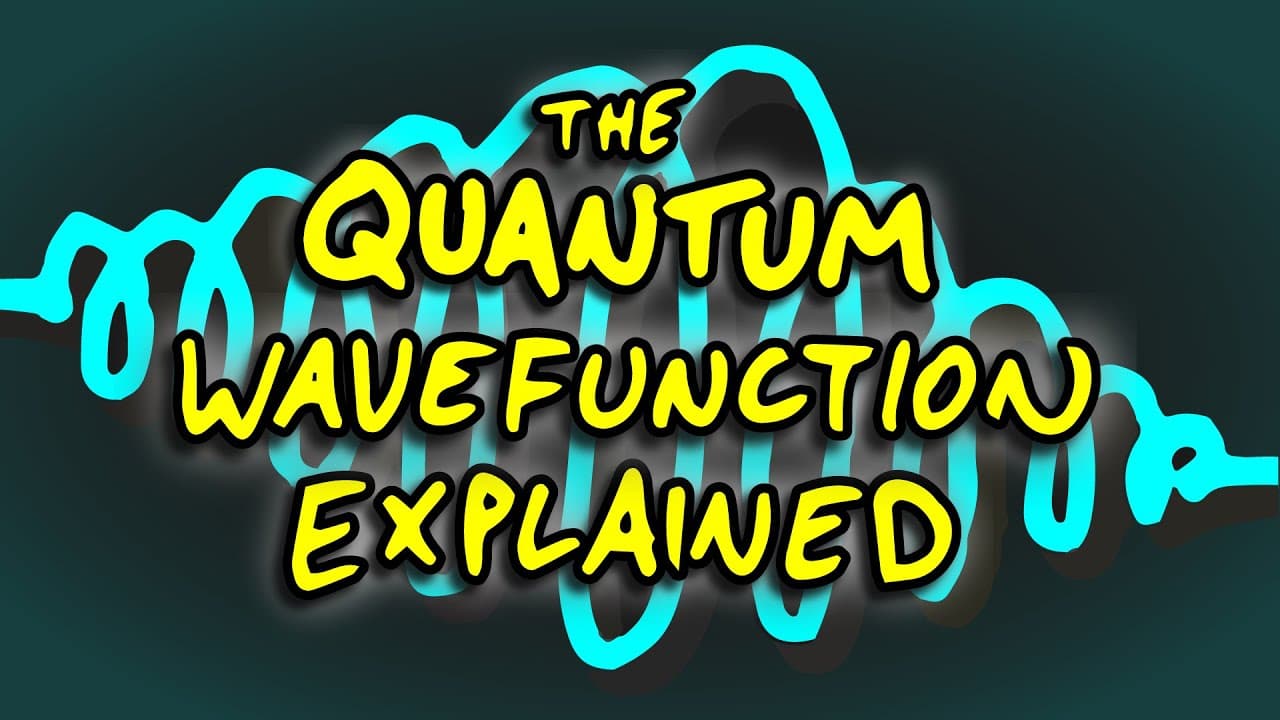
The Quantum Wavefunction Explained
TL;DR
Quantum wave functions describe particles' behaviors probabilistically through mathematical tools.
Transcript
in quantum mechanics particles are things we only see when we measure them but how they move around is described by a wave function a wave function that satisfies the schrodinger equation which i talked about in my last video it's important to note that wave functions are not unique to quantum mechanics we use wavefunctions in many other systems li... Read More
Key Insights
- 👋 Wave functions in quantum mechanics guide particle behavior probabilistically.
- 👋 Quantum wave functions are mathematical tools, not physical waves, representing probability amplitudes.
- 👋 Constraints on wave functions include normalizability, single-valuedness, continuity, and superposition.
- 👻 Superposition allows multiple wave functions to combine in quantum mechanics.
- 👋 Wave functions are essential for extracting information about quantum particles' properties.
- 👋 Understanding quantum wave functions requires knowledge of the Schrodinger equation and probability distributions.
- 👋 Quantum wave functions provide insights into the probabilistic nature of particle locations in experiments.
Install to Summarize YouTube Videos and Get Transcripts
Explore YouTube Video Summarizer or Get YouTube Transcript Extractor
Questions & Answers
Q: What is a wave function in quantum mechanics?
A wave function in quantum mechanics describes the probabilistic nature of where particles may appear and keeps track of all properties of a quantum particle.
Q: How does the wave function relate to measuring quantum particles?
The wave function helps extract measurable physical quantities like position, momentum, energy, or spin from quantum particles, explaining observations in experiments.
Q: What constraints must a wave function satisfy in quantum mechanics?
A valid wave function must be a solution of the Schrodinger equation, have a normalizable probability distribution, be single-valued, continuous, and meet superposition requirements.
Q: What role does superposition play in quantum wave functions?
Superposition allows for multiple valid wave functions to be combined, suggesting phenomena like Schrodinger's cat being dead and alive simultaneously in theory.
Summary & Key Takeaways
-
Quantum particles' movements are described by wave functions which satisfy the Schrodinger equation.
-
Wave functions exist in various systems beyond quantum mechanics, each with its own wave equation.
-
Quantum wave functions are mathematical tools representing probability amplitudes revealing particles' properties.
Read in Other Languages (beta)
Share This Summary 📚
Summarize YouTube Videos and Get Video Transcripts with 1-Click
Try YouTube Summary with ChatGPT & Claude or YouTube Transcript Generator
Explore More Summaries from Domain of Science 📚





Summarize YouTube Videos and Get Video Transcripts with 1-Click
Try YouTube Summary with ChatGPT & Claude or YouTube Transcript Generator