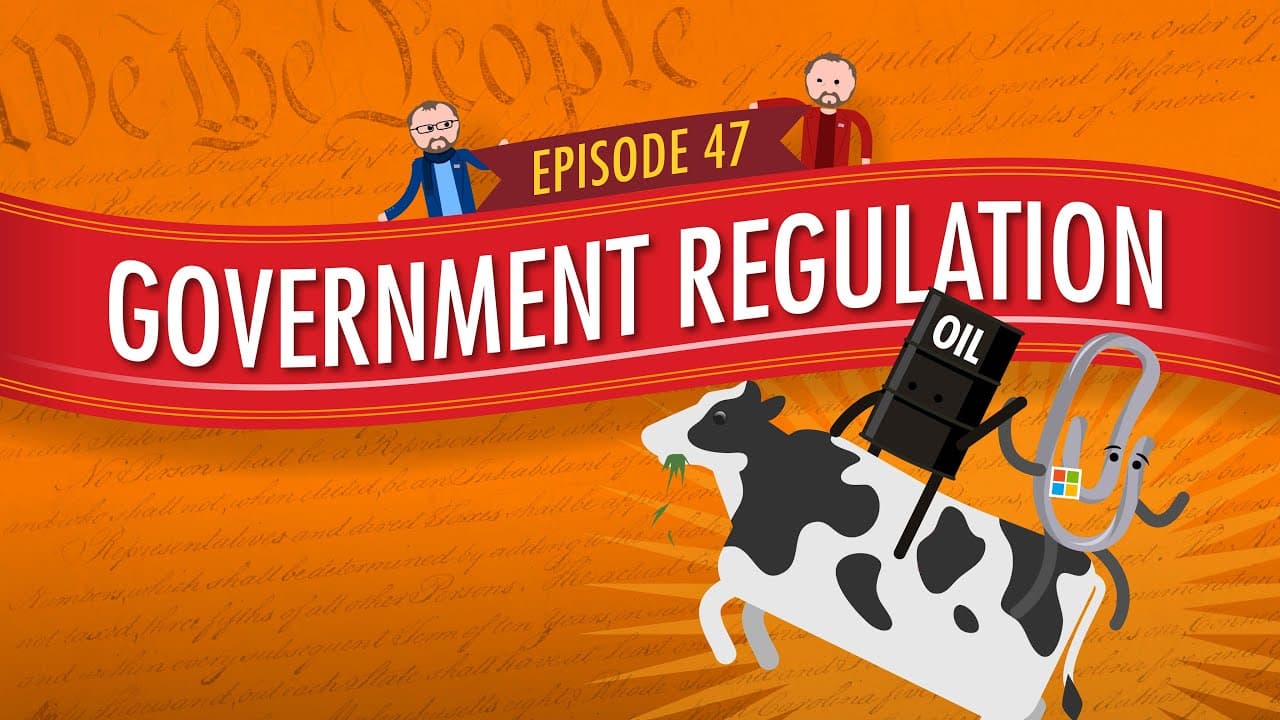
Government Regulation: Crash Course Government and Politics #47
TL;DR
Exploring government goals and policies in U.S. economic regulation.
Transcript
Hello, I’m Craig and this is Crash Course Government and Politics and today I’m going to talk a bit more about economic policy. Ran into the table there a little bit. Whoo! Economic policy can be dangerous. Specifically, we’re going to look at some of the broad goals of economic policy and some of the things that the government does to try to accom... Read More
Key Insights
- Government economic policy aims to promote stable markets, economic prosperity, business development, and protect consumers and employees.
- Stable markets are achieved through law enforcement and minimizing monopolies, ensuring predictability for businesses and consumers.
- Economic prosperity is encouraged by fostering investment confidence, regulating financial markets, and government spending on public investments.
- Business development is supported through tariffs and subsidies, though these can be controversial due to perceived unfair advantages.
- Consumer and employee protection is maintained through regulations ensuring safety and fairness, such as labor standards and product safety.
- The role of government in the economy has evolved significantly since the 19th century, particularly post-New Deal.
- Regulatory initiatives have expanded under various administrations, with the 1970s seeing significant regulatory growth under Nixon.
- Despite attempts at deregulation, the administrative regulatory state remains integral due to economic complexity and bureaucratic resilience.
Install to Summarize YouTube Videos and Get Transcripts
Explore YouTube Video Summarizer or Get YouTube Transcript Extractor
Questions & Answers
Q: What are the primary goals of government economic policy?
The primary goals of government economic policy are to promote stable markets, economic prosperity, business development, and protect consumers and employees. These goals are achieved through various regulations and initiatives that ensure predictability, foster investment, and maintain safety and fairness in the economy.
Q: How does the government promote stable markets?
The government promotes stable markets by enforcing laws, minimizing monopolies, and establishing national regulations, such as automobile fuel efficiency standards. These measures ensure a predictable environment for businesses and consumers, preventing market malfunctions and fostering economic stability.
Q: In what ways does the government encourage economic prosperity?
The government encourages economic prosperity by fostering a positive investment climate, regulating financial markets, and investing in public infrastructure and research. These actions build confidence in the economy, support innovation, and enhance the workforce, contributing to national economic growth.
Q: What is the role of subsidies in business development?
Subsidies play a role in business development by providing financial support to businesses, either directly or indirectly. While they can help businesses grow by reducing costs, subsidies are controversial as they may offer unfair advantages to certain companies, particularly large corporations or specific industries.
Q: How does the government protect consumers and employees?
The government protects consumers and employees through various regulations and standards that ensure safety and fairness. These include labor laws, workplace safety regulations, and product safety standards enforced by agencies like OSHA and the FDA, which prevent exploitation and ensure safe consumer products.
Q: How has government regulation in the economy changed over time?
Government regulation in the economy has evolved significantly, particularly since the New Deal, which marked an increased federal role in economic affairs. While earlier views favored minimal intervention, modern economic complexity has necessitated comprehensive regulatory frameworks to address various national and global challenges.
Q: What were the significant regulatory changes under President Nixon?
Under President Nixon, significant regulatory changes included the creation of agencies like OSHA and the EPA, which focused on broad economic and environmental protection. These initiatives marked a shift towards comprehensive regulation covering multiple sectors, reflecting growing concerns about workplace safety and environmental preservation.
Q: Why does the administrative regulatory state persist despite deregulation efforts?
The administrative regulatory state persists despite deregulation efforts due to the complexity of modern economic issues and the resilience of bureaucracies. As economic concerns increasingly dominate public policy, comprehensive regulatory frameworks are seen as necessary to address large-scale challenges and ensure national stability and prosperity.
Summary & Key Takeaways
-
The government's economic policy goals include promoting stable markets, prosperity, business development, and consumer protection. These goals are pursued through regulations and policies that ensure market predictability, investment confidence, and safety standards.
-
Historically, government regulation in the economy has increased, especially since the New Deal. This shift reflects the growing complexity of economic issues and the need for comprehensive solutions, despite deregulation efforts.
-
The federal government's role in economic regulation involves balancing market stability with business development and consumer protection, acknowledging that economic policies are interrelated and necessary for national prosperity.
Read in Other Languages (beta)
Share This Summary 📚
Summarize YouTube Videos and Get Video Transcripts with 1-Click
Try YouTube Summary with ChatGPT & Claude or YouTube Transcript Generator
Explore More Summaries from CrashCourse 📚



Summarize YouTube Videos and Get Video Transcripts with 1-Click
Try YouTube Summary with ChatGPT & Claude or YouTube Transcript Generator