What Are Public and Private IP Addresses?
TL;DR
Public IP addresses are unique identifiers for devices on the internet, necessary for communication. In contrast, private IP addresses are used within local networks without external approval, typically managed through Network Address Translation (NAT) to connect to the internet.
Transcript
in today's lecture we will see the public and private ipv4 addresses as usual we will start the session with the outcomes in today's lecture we have two outcomes let's see what are they upon the completion of the session the learner will be able to outcome number one we will know about the public and private ipv4 addresses and outcome number two we... Read More
Key Insights
- 🔒 Private IPv4 addresses can be used within a network without requiring approval from external sources.
- 🇨🇫 Public IPv4 addresses are globally unique and are necessary for internet communication.
- 🔒 Network Address Translation (NAT) enables communication between private networks and the internet by mapping private IP addresses to public IP addresses.
- 🛟 Private networks often connect to the internet using NAT-enabled routers or proxy servers.
- 🔒 Private IP addresses are not recognized outside of the network and are blocked by routers in the internet.
- 🧡 The first and last addresses in a network range are not used, as the first is the network address and the last is the broadcast address.
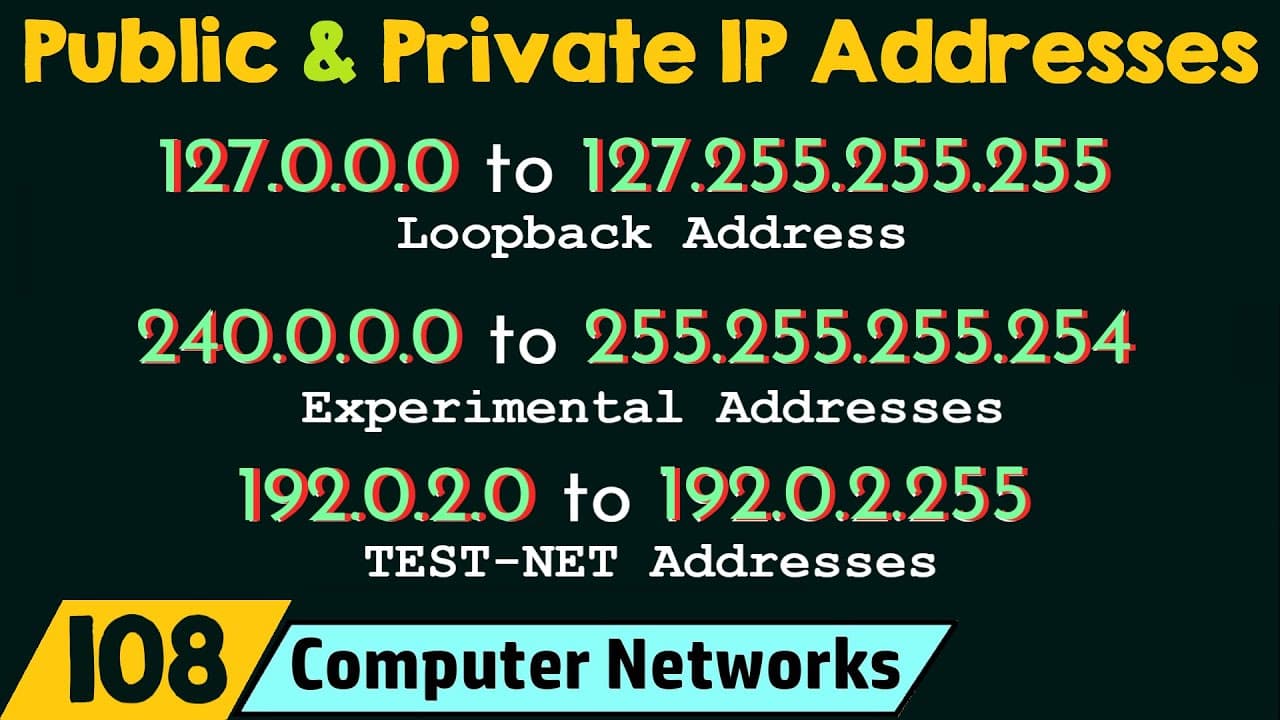
- 👻 The loopback address (127.0.0.1) is used by hosts to direct traffic to themselves.
- 😒 Special use IPv4 addresses, such as link local addresses and test net addresses, serve specific purposes.
Install to Summarize YouTube Videos and Get Transcripts
Explore YouTube Video Summarizer or Get YouTube Transcript Extractor
Questions & Answers
Q: What is the difference between public and private IPv4 addresses?
Public IPv4 addresses are globally unique and are used for communication with internet hosts, while private IPv4 addresses are used locally within a network and do not require approval from external sources.
Q: Can multiple devices have the same private IP address?
Yes, multiple devices can have the same private IP address because private IP addresses are not recognized outside of the network. The magic lies in the use of NAT or proxy servers that map private IP addresses to unique public IP addresses.
Q: How are private networks connected to the internet?
Private networks are typically connected to the internet using Network Address Translation (NAT) technology. NAT-enabled routers or proxy servers map private IP addresses to public IP addresses, allowing communication between the private network and the internet.
Q: What is the purpose of using private IP addresses?
Private IP addresses are used for devices that do not require access to the internet, such as factory machines that communicate internally. They allow for internal communication within a network and conserve public address space.
Key Insights:
- Private IPv4 addresses can be used within a network without requiring approval from external sources.
- Public IPv4 addresses are globally unique and are necessary for internet communication.
- Network Address Translation (NAT) enables communication between private networks and the internet by mapping private IP addresses to public IP addresses.
- Private networks often connect to the internet using NAT-enabled routers or proxy servers.
- Private IP addresses are not recognized outside of the network and are blocked by routers in the internet.
- The first and last addresses in a network range are not used, as the first is the network address and the last is the broadcast address.
- The loopback address (127.0.0.1) is used by hosts to direct traffic to themselves.
- Special use IPv4 addresses, such as link local addresses and test net addresses, serve specific purposes.
- Public IP addresses are assigned by Internet Service Providers (ISPs) and are necessary for communication with the internet.
Summary & Key Takeaways
-
Public IPv4 addresses are globally unique and are used for communication with internet hosts.
-
Private IPv4 addresses can be used locally within a network and do not require approval from external sources.
-
Network Address Translation (NAT) enables communication between private networks and the internet by mapping private IP addresses to public IP addresses.
Read in Other Languages (beta)
Share This Summary 📚
Summarize YouTube Videos and Get Video Transcripts with 1-Click
Try YouTube Summary with ChatGPT & Claude or YouTube Transcript Generator
Explore More Summaries from Neso Academy 📚






Summarize YouTube Videos and Get Video Transcripts with 1-Click
Try YouTube Summary with ChatGPT & Claude or YouTube Transcript Generator