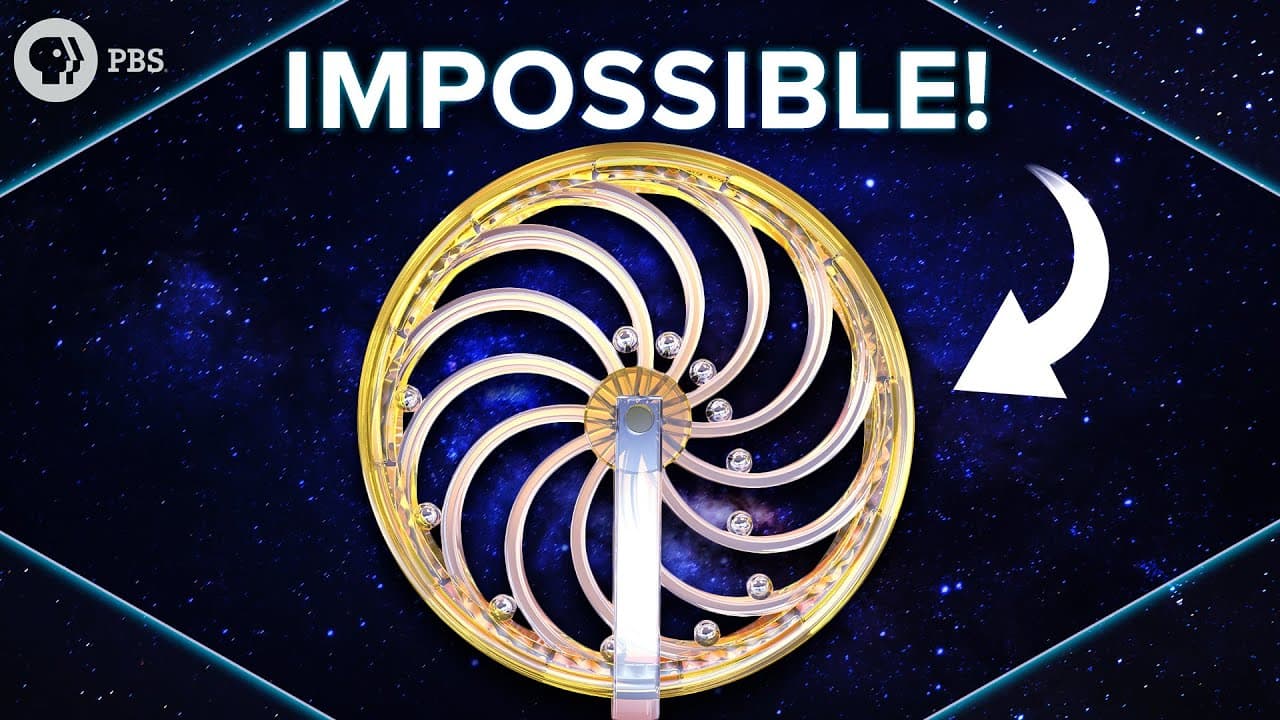
What Makes Perpetual Motion Machines Impossible?
TL;DR
Perpetual motion machines are impossible because they violate the laws of thermodynamics, either by creating energy or reversing entropy. Historical designs, like Bhāskara's wheel, and modern 'free-energy' claims fail due to these principles. Quantum mechanics also ensures that energy loss is unavoidable, solidifying the scientific consensus against such machines.
Transcript
Thanks to CuriosityStream for supporting PBS Digital Studios. Bad ideas come and go in physics. But there’s one bit of nonsense that is perhaps more persistent than all others: the perpetual motion machine. No working perpetual motion machine has ever been experiment verified. All break the laws of thermodynamics. In fact, we classify them based on... Read More
Key Insights
- Perpetual motion machines are impossible as they violate fundamental laws of thermodynamics, specifically energy conservation and entropy.
- Historical designs like Bhāskara's wheel and lodestone ramps were based on flawed principles and did not work.
- Modern 'free-energy' devices often claim to extract energy from zero-point energy, which is not feasible due to lack of an energy gradient.
- The Carnot cycle represents the most efficient possible engine, but even it cannot produce more energy than it consumes.
- Quantum mechanics and the Heisenberg uncertainty principle guarantee that some energy loss is inevitable in any system.
- The US, UK, and French patent offices refuse to review devices claiming over-unity energy production due to their inherent implausibility.
- The concept of negative mass has been used in theoretical perpetual motion designs, but these remain speculative and unproven.
- Despite historical and modern attempts, perpetual motion machines remain a scientific impossibility, often used as a tool for pseudo-scientific claims.
Install to Summarize YouTube Videos and Get Transcripts
Explore YouTube Video Summarizer or Get YouTube Transcript Extractor
Questions & Answers
Q: Why are perpetual motion machines impossible?
Perpetual motion machines are impossible because they violate the laws of thermodynamics. The first kind violates energy conservation by producing more energy than consumed, while the second kind attempts to reverse entropy, which is against the natural tendency of energy to spread out evenly.
Q: What are some historical examples of perpetual motion machines?
Historical examples include Bhāskara's wheel, which used mercury to supposedly keep a wheel turning, and lodestone ramps, where magnets were used to pull a ball uphill. These designs were based on flawed principles and did not account for energy losses such as friction.
Q: How does the Carnot cycle relate to perpetual motion?
The Carnot cycle describes the most efficient engine possible, extracting maximum energy from a temperature gradient. However, even this ideal cycle cannot produce more energy than it consumes, highlighting the impossibility of perpetual motion under ideal conditions.
Q: What role does quantum mechanics play in perpetual motion?
Quantum mechanics, through the Heisenberg uncertainty principle, ensures that all systems experience some form of energy loss. Internal parts vibrate, causing friction and heat, and even isolated systems radiate energy, making perpetual motion fundamentally impossible.
Q: Why do patent offices refuse to review perpetual motion devices?
Patent offices, like those in the US, UK, and France, refuse to review devices claiming over-unity energy production because they inherently violate established scientific principles, specifically the laws of thermodynamics, making them scientifically implausible.
Q: What is the significance of zero-point energy in perpetual motion claims?
Zero-point energy refers to the lowest possible energy state of a quantum system, which is uniform and lacks an energy gradient. This makes it inaccessible as an energy source, debunking claims that perpetual motion devices can harness it for free energy.
Q: How is negative mass used in theoretical perpetual motion designs?
Negative mass, a theoretical concept, suggests that it would be attracted to positive mass while repelling it, potentially creating indefinite acceleration. However, this remains speculative and unproven, with no practical implementation for perpetual motion devices.
Q: What impact do pseudo-scientific claims have on perpetual motion discussions?
Pseudo-scientific claims often misuse scientific terminology, like zero-point energy and plasma vibrations, to promote perpetual motion devices. These claims lack scientific validity and are more focused on financial gain, undermining genuine scientific inquiry and understanding.
Summary & Key Takeaways
-
Perpetual motion machines are a persistent myth in physics, often violating the laws of thermodynamics by either creating energy or reversing entropy. Historical attempts like Bhāskara's wheel and modern 'free-energy' devices fail due to these fundamental laws.
-
The Carnot cycle is the most efficient engine possible, demonstrating the limits of energy extraction from temperature gradients. Even in ideal conditions, perpetual motion remains impossible due to quantum mechanics and inevitable energy loss.
-
Modern designs often misuse concepts like zero-point energy and negative mass, but they fail to provide viable solutions. Patent offices refuse to review such devices, reflecting their scientific implausibility and the persistence of pseudo-scientific claims.
Read in Other Languages (beta)
Share This Summary 📚
Summarize YouTube Videos and Get Video Transcripts with 1-Click
Try YouTube Summary with ChatGPT & Claude or YouTube Transcript Generator
Explore More Summaries from PBS Space Time 📚




Summarize YouTube Videos and Get Video Transcripts with 1-Click
Try YouTube Summary with ChatGPT & Claude or YouTube Transcript Generator