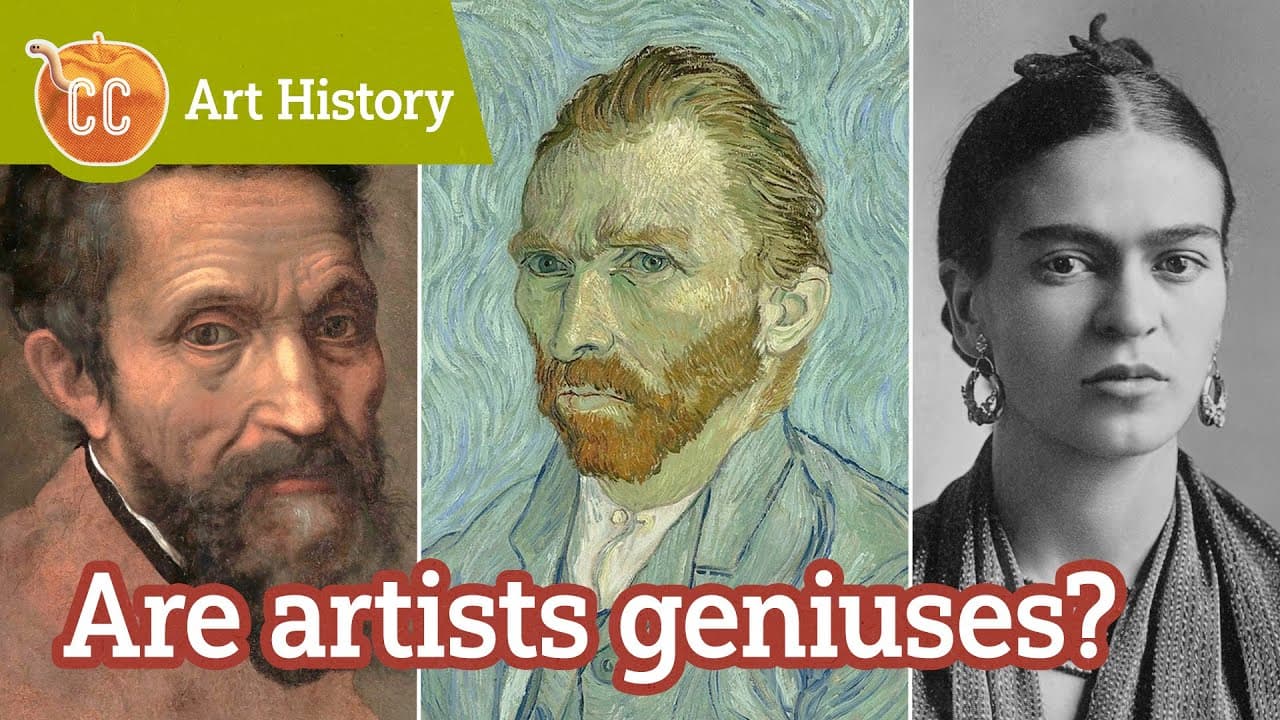
What Makes an Artist “Great”? : Crash Course Art History #4
TL;DR
Explores the historical origins and impacts of the Great Artist myth.
Transcript
Michelangelo. Van Gogh. Picasso. Warhol. Dali. Matisse. Da Vinci. Pollock. Rembrandt. Carvaggio. Chagall. Maybe a Frida Kahlo in there. Long before the current celebrity-obsessed age of social media, capital-G Great Artists have been singled out, elevated, and praised. We tend to associate art with individual artists, who are considered geniuse... Read More
Key Insights
- The concept of the 'Great Artist' originated in Renaissance Europe, where art began to be associated with individual genius rather than collective or anonymous creation.
- Guilds in medieval Europe were responsible for training artists, focusing on technical skill and craftsmanship, rather than individual fame.
- The Medici family in Florence changed the art scene by patronizing artists independently of guilds, valuing emotional expression over mere technical skill.
- Giorgio Vasari's writings in the Renaissance period contributed to the myth of the Great Artist by emphasizing biography and intellectual pursuit in art.
- Art academies emerged, emphasizing technique and intellectualism, further entrenching the notion of the Great Artist and excluding many, particularly women.
- Women artists like Artemisia Gentileschi and Elisabeth Vigée Le Brun challenged the exclusionary practices of art history, demonstrating their capabilities.
- Modern artists like Kerry James Marshall critique and explore the exclusionary nature of the Great Artist myth through their work.
- The myth of the Great Artist has had lasting global impacts, but recognizing excluded perspectives enriches our understanding of art and history.
Install to Summarize YouTube Videos and Get Transcripts
Explore YouTube Video Summarizer or Get YouTube Transcript Extractor
Questions & Answers
Q: What role did guilds play in medieval European art?
Guilds in medieval Europe were organizations that trained artists, emphasizing technical skill and craftsmanship. They functioned as intense training programs where apprentices learned from masters. Art was often produced collectively, and individual artists were not typically celebrated or well-known, with the guild itself being the point of reference for art buyers.
Q: How did the Medici family influence the concept of the Great Artist?
The Medici family, as wealthy patrons in Renaissance Florence, influenced the concept of the Great Artist by commissioning artists independently of guilds. They valued art that expressed complex ideas and emotions over mere technical skill. This patronage system elevated individual artists to celebrity status, contributing to the art vs. craft debate and the myth of the Great Artist.
Q: What was Giorgio Vasari's contribution to the myth of the Great Artist?
Giorgio Vasari contributed to the myth of the Great Artist through his writings, particularly 'The Lives of the Most Excellent Painters, Sculptors, and Architects.' He emphasized the importance of artists' biographies and intellectual pursuits, framing art as an intellectual endeavor rather than just physical labor. This helped cement the idea of artists as individual geniuses.
Q: How did art academies perpetuate the myth of the Great Artist?
Art academies, like the Royal Academy of Painting and Sculpture in Paris, perpetuated the myth of the Great Artist by emphasizing technique, intellectualism, and the notion of genius. They absorbed the concept of skill into the idea of the Great Artist, setting strict standards and promoting painting, particularly history painting, as the highest form of art.
Q: What challenges did women artists face in becoming recognized as Great Artists?
Women artists faced significant challenges in being recognized as Great Artists due to exclusionary practices, such as being barred from studying anatomy or drawing male nudes, which were essential for history painting. Despite these obstacles, women like Artemisia Gentileschi and Elisabeth Vigée Le Brun produced accomplished works, but their contributions were often marginalized or overlooked in art history.
Q: How do modern artists critique the concept of the Great Artist?
Modern artists like Kerry James Marshall critique the concept of the Great Artist by exploring themes of exclusion and representation. Marshall's work, for instance, challenges the traditional narrative by depicting Black artists in poses associated with the Great Artist myth, questioning the arbitrary and elitist criteria that have historically defined artistic greatness.
Q: What impact has the myth of the Great Artist had on global art history?
The myth of the Great Artist has had a significant impact on global art history by shaping the way art is perceived and valued. It has often excluded non-European and marginalized artists from the narrative, focusing on individual genius rather than collective or diverse contributions. This has led to a skewed understanding of art history, which modern perspectives are beginning to challenge and rectify.
Q: What future topics will be explored related to the Great Artist concept?
Future topics related to the Great Artist concept will explore the implications of great artists being not-so-great people, examining how their personal lives and actions intersect with their artistic legacy. The discussion will likely delve into the ethical considerations of celebrating artists whose behavior may have been problematic or harmful, and how this affects the perception of their work.
Summary & Key Takeaways
-
The video discusses the origins of the 'Great Artist' concept, tracing it back to Renaissance Europe where individual artists began to be celebrated for their genius, contrasting with earlier collective art creation.
-
It explores how the Medici family and figures like Giorgio Vasari shaped the idea of the Great Artist by valuing emotional expression and intellectualism in art, leading to a shift from the guild system.
-
The video also highlights the exclusion of women and non-European artists from the traditional narrative of art history, while modern artists critique and challenge these historical biases.
Read in Other Languages (beta)
Share This Summary 📚
Summarize YouTube Videos and Get Video Transcripts with 1-Click
Try YouTube Summary with ChatGPT & Claude or YouTube Transcript Generator
Explore More Summaries from CrashCourse 📚

Summarize YouTube Videos and Get Video Transcripts with 1-Click
Try YouTube Summary with ChatGPT & Claude or YouTube Transcript Generator