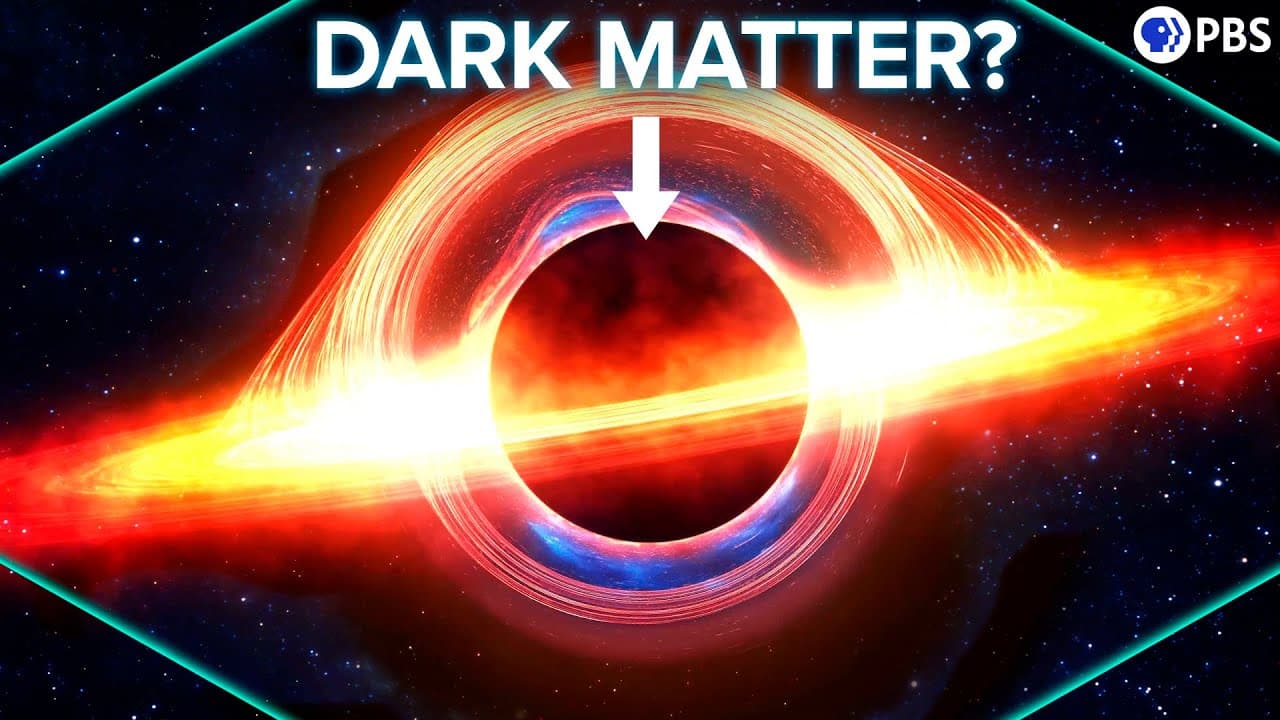
What If Dark Matter Is Just Black Holes?
TL;DR
Exploring if dark matter is composed of black holes.
Transcript
It may be that for every star in the universe there are billions of microscopic black holes streaming through the solar system, the planet, even our bodies every second. Sounds horrible - but hey, at least we’d have explained dark matter. 80% of the mass of our universe is completely invisible to us - its existence only revealed through its immense... Read More
Key Insights
- Dark matter, making up 80% of the universe's mass, remains a mystery, with some hypothesizing it could be black holes.
- Black holes are dense regions where gravity is so intense that not even light can escape, making them potential dark matter candidates.
- Primordial black holes, formed in the early universe, could theoretically account for dark matter if they existed in vast quantities.
- Studies have largely ruled out black holes formed from dying stars as the source of dark matter due to insufficient numbers.
- Microlensing studies have ruled out certain mass ranges for black holes as dark matter, limiting viable mass windows.
- The hypothesis of dark matter being black holes faces challenges, as many mass ranges have been ruled out by astrophysical observations.
- Even if black holes can't explain dark matter, their study could lead to new physics and insights into the universe's structure.
- Planck relics, hypothetical remnants of evaporated black holes, present a challenge as they would be undetectable dark matter candidates.
Install to Summarize YouTube Videos and Get Transcripts
Explore YouTube Video Summarizer or Get YouTube Transcript Extractor
Questions & Answers
Q: What is dark matter?
Dark matter is a form of matter that makes up approximately 80% of the universe's mass. It is invisible and doesn't emit or interact with electromagnetic radiation like ordinary matter, making it detectable only through its gravitational effects. Its exact nature remains one of the greatest mysteries in modern astrophysics.
Q: Why are black holes considered as potential dark matter candidates?
Black holes are considered potential dark matter candidates because they are incredibly dense regions of space where gravity is so strong that not even light can escape. This makes them effectively 'dark' objects, similar to how dark matter behaves. Additionally, black holes are known entities in physics, unlike many hypothetical particles proposed for dark matter.
Q: What are primordial black holes?
Primordial black holes are theoretical black holes that could have formed in the early universe due to density fluctuations. Unlike black holes formed from collapsing stars, primordial black holes could exist in a wide range of masses and might have been present since the universe's inception, potentially explaining dark matter if they exist in sufficient numbers.
Q: How do scientists rule out black holes as dark matter?
Scientists rule out black holes as dark matter by studying their gravitational effects on other celestial bodies and through microlensing studies. By observing the frequency of microlensing events and the dynamics of stars and galaxies, they can determine if black holes of certain masses are abundant enough to account for dark matter, ruling out mass ranges where insufficient evidence exists.
Q: What is microlensing and how is it used in this context?
Microlensing is an astronomical phenomenon where a massive object, like a black hole, passes in front of a distant light source, bending and magnifying the light. This effect can be used to detect compact objects like black holes in the galaxy. By monitoring stars for microlensing events, scientists can infer the presence and mass of potential dark matter candidates.
Q: What are Planck relics and their significance in dark matter research?
Planck relics are hypothetical remnants of black holes that have completely evaporated through Hawking radiation, leaving behind a tiny, undetectable singularity. They are significant in dark matter research as they present a potential form of dark matter that would be extremely challenging to detect, due to their minimal interaction with other matter and radiation.
Q: Why is the hypothesis of black holes as dark matter important?
The hypothesis that black holes could be dark matter is important because it offers a potential solution using known physics, unlike many speculative particle theories. If black holes were dark matter, it would provide a deeper understanding of the universe's mass distribution and could lead to new insights into both cosmology and fundamental physics.
Q: What challenges do scientists face in proving the black hole dark matter hypothesis?
Scientists face several challenges in proving the black hole dark matter hypothesis, including the need to find black holes in the right mass range and quantity to account for dark matter. Most mass ranges have been ruled out through microlensing and other astrophysical observations. Additionally, small, primordial black holes would be difficult to detect, complicating efforts to confirm their existence as dark matter.
Summary & Key Takeaways
-
Dark matter constitutes 80% of the universe's mass, and some scientists propose it could be made of black holes. Primordial black holes, formed in the early universe, are a potential candidate. However, studies have largely ruled out black holes from dying stars as they are too few in number.
-
Microlensing studies have eliminated certain mass ranges for black holes as dark matter, narrowing down the possibilities. The remaining mass windows are less likely to account for all dark matter, suggesting it may not be composed of black holes.
-
Despite the challenges in proving black holes as dark matter, the exploration of this hypothesis could lead to new physics. Planck relics, undetectable remnants of evaporated black holes, are another dark matter candidate, although difficult to study.
Read in Other Languages (beta)
Share This Summary 📚
Summarize YouTube Videos and Get Video Transcripts with 1-Click
Try YouTube Summary with ChatGPT & Claude or YouTube Transcript Generator
Explore More Summaries from PBS Space Time 📚
Summarize YouTube Videos and Get Video Transcripts with 1-Click
Try YouTube Summary with ChatGPT & Claude or YouTube Transcript Generator