Could Plants Help Solve Our Addiction to Mining?
TL;DR
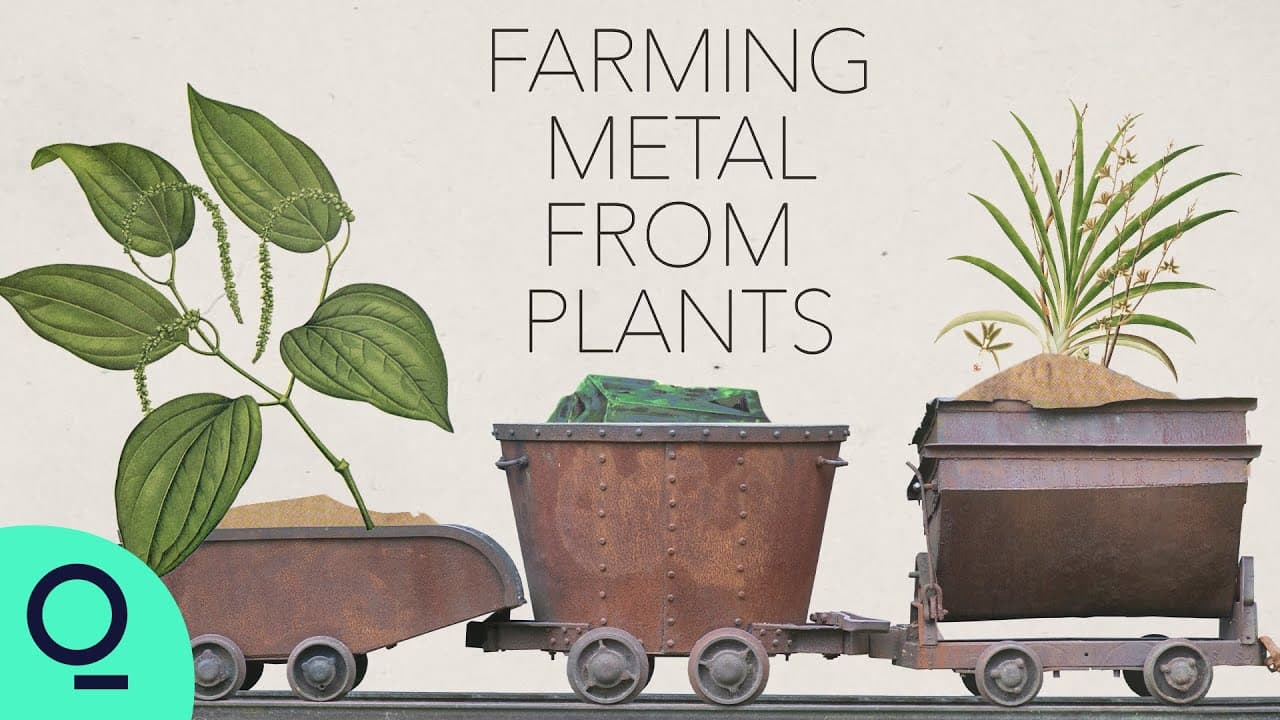
Agromining uses plants to extract metals, offering a sustainable mining alternative.
Transcript
There's a saying amongst miners that if it can't be grown, it must be mined. And this is absolutely true for the metals and the materials that we need for modern lifestyles. Demand for metals, for all kinds of metals is rising very strongly. Simply because economies are reopening from the nadir of Covid-19. That really boosts demand for all sorts o... Read More
Key Insights
- Agromining, also known as phytomining, involves growing plants that absorb metals from the soil, providing a more sustainable alternative to traditional mining methods.
- The demand for metals, especially nickel, has surged due to economic recovery from COVID-19 and the rise of electric vehicles, necessitating more sustainable mining practices.
- Traditional mining practices, particularly nickel mining, contribute significantly to environmental damage, including deforestation, air pollution, and greenhouse gas emissions.
- Hyperaccumulator plants have the unique ability to absorb high concentrations of metals, making them effective for agromining and potential tools for soil decontamination.
- The agromining process uses significantly less energy than conventional mining, offering a lower environmental impact and utilizing ultramafic soils unsuitable for traditional agriculture.
- Agromining could provide economic opportunities for local communities, particularly in regions with infertile soils, by allowing them to cultivate hyperaccumulator plants.
- While agromining cannot fully replace traditional mining, it can serve as a complementary method, particularly in areas with lower-grade nickel deposits.
- The scalability of agromining remains a challenge, requiring further research, funding, and collaboration with commercial mining companies to achieve mass production and attract investment.
Install to Summarize YouTube Videos and Get Transcripts
Explore YouTube Video Summarizer or Get YouTube Transcript Extractor
Questions & Answers
Q: What is agromining and how does it differ from traditional mining?
Agromining, also known as phytomining, is a process where hyperaccumulator plants are cultivated to absorb metals from the soil. Unlike traditional mining, which involves extracting metals through environmentally damaging methods, agromining offers a more sustainable alternative by using plants to harvest metals, thereby reducing deforestation, pollution, and greenhouse gas emissions.
Q: Why is there an increased demand for metals like nickel?
The demand for metals, especially nickel, has surged due to the economic recovery from the COVID-19 pandemic and the growing popularity of electric vehicles. Nickel is a crucial component in the production of batteries for electric vehicles, leading to an increased need for sustainable mining practices to meet this rising demand while minimizing environmental impact.
Q: What are hyperaccumulator plants and their role in agromining?
Hyperaccumulator plants are a rare group of plants that can absorb and store high concentrations of metals in their tissues. In agromining, these plants are used to extract metals from the soil, offering a sustainable alternative to traditional mining. They can also be used for soil decontamination, helping to clean up polluted areas while providing economic opportunities for local communities.
Q: How does agromining contribute to environmental sustainability?
Agromining contributes to environmental sustainability by reducing the need for traditional mining methods that cause deforestation, air pollution, and greenhouse gas emissions. The process uses significantly less energy and can be conducted on soils unsuitable for conventional agriculture, minimizing environmental impact and promoting the use of renewable resources.
Q: What are the economic benefits of agromining for local communities?
Agromining offers economic benefits for local communities, particularly in regions with infertile soils, by allowing them to cultivate hyperaccumulator plants. This provides a new source of income and employment opportunities, enabling communities to participate in the sustainable extraction of metals and potentially improve soil fertility for future agricultural use.
Q: Can agromining fully replace traditional mining methods?
Agromining cannot fully replace traditional mining methods due to the large scale and high efficiency required to meet global metal demands. However, it can serve as a complementary method, particularly in areas with lower-grade deposits. Agromining offers a sustainable alternative with a lower environmental impact, making it a valuable addition to traditional mining practices.
Q: What challenges does agromining face in terms of scalability?
The scalability of agromining is challenged by the need for further research, funding, and collaboration with commercial mining companies. While the science behind agromining is solid, achieving mass production requires the development of efficient processes, finding suitable hyperaccumulator species, and securing investment to support large-scale implementation and attract interest from major industries.
Q: What is the potential future impact of agromining on the mining industry?
Agromining has the potential to significantly impact the mining industry by providing a sustainable alternative to traditional methods. As environmental concerns and regulatory pressures increase, agromining could play a crucial role in reducing the industry's environmental footprint. Its adoption could lead to more sustainable practices, increased collaboration with local communities, and greater alignment with circular economy principles.
Summary & Key Takeaways
-
Agromining is an innovative process where hyperaccumulator plants are used to extract metals from the soil, offering a more sustainable alternative to traditional mining. This method could help reduce environmental damage caused by mining, such as deforestation and pollution, while providing economic opportunities for local communities.
-
The demand for metals, particularly nickel, has increased due to economic recovery and the rise of electric vehicles. Traditional mining methods contribute significantly to environmental degradation, prompting the need for more sustainable practices. Agromining presents a viable solution, but its scalability remains a challenge.
-
Agromining utilizes hyperaccumulator plants, which absorb high concentrations of metals, making them effective for both metal extraction and soil decontamination. While agromining cannot fully replace traditional mining, it can complement it by utilizing lower-grade deposits and providing a lower environmental impact.
Read in Other Languages (beta)
Share This Summary 📚
Summarize YouTube Videos and Get Video Transcripts with 1-Click
Try YouTube Summary with ChatGPT & Claude or YouTube Transcript Generator
Explore More Summaries from Bloomberg Originals 📚





Summarize YouTube Videos and Get Video Transcripts with 1-Click
Try YouTube Summary with ChatGPT & Claude or YouTube Transcript Generator