What Caused the Shift to Trench Warfare in WW1?
TL;DR
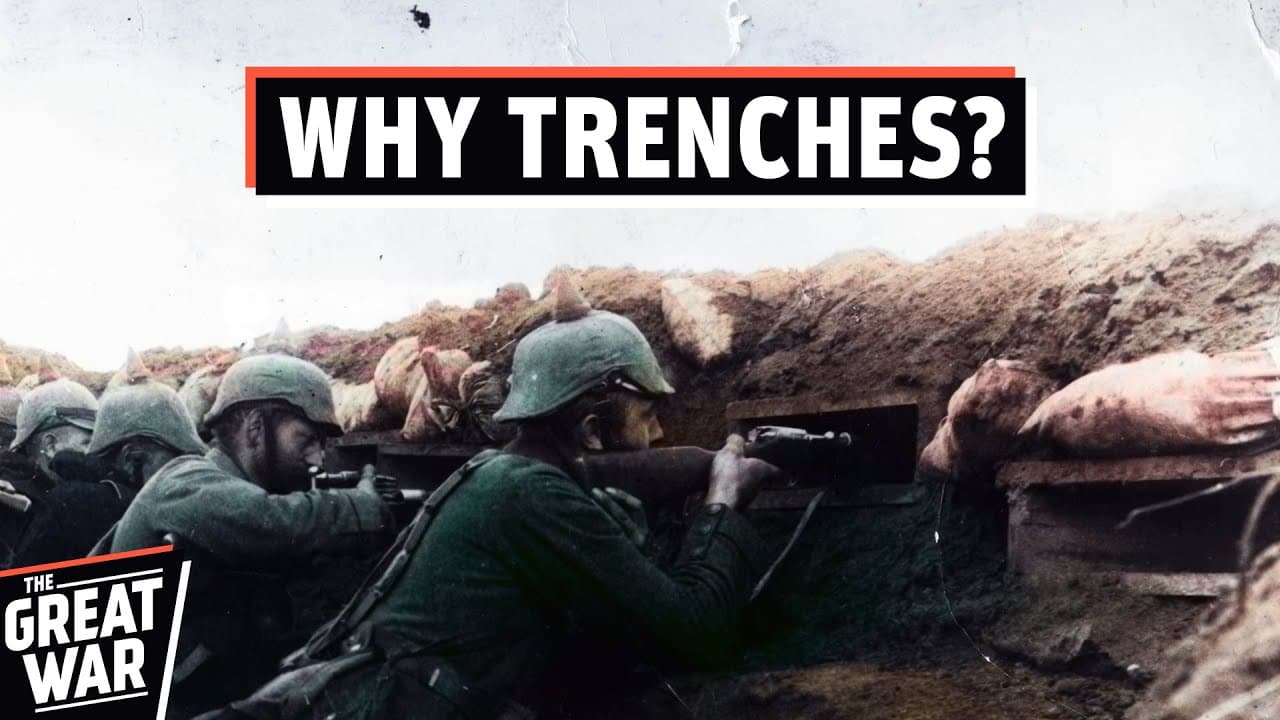
Trench warfare in World War I resulted from the failure of initial offensive strategies by both Germany and France, which were intended for quick victories. The emergence of lethal weaponry, logistical challenges, and command issues led to a stalemate, forcing armies to dig in and rely on defensive positions instead of pursuing mobile warfare.
Transcript
The Western Front in WW1 is defined in historical memory by trench warfare, where the front lines barely moved for nearly 3 years and millions of men struggled in the muddy and bloody network of trenches and wire that stretched for hundreds of kilometers. But in August 1914, the war didn’t start in the trenches, as armies clashed in the open an... Read More
Key Insights
- Trench warfare became dominant on the Western Front due to the failure of initial offensive plans by both France and Germany, which were designed for swift victories.
- The development and mass deployment of new, deadly weapons like artillery and machine guns made open battlefields extremely lethal, pushing armies into trenches for protection.
- Both the French and German armies had ambitious plans for mobile warfare that quickly failed, resulting in a transition to a static, trench-based system.
- The German Schlieffen Plan and French Plan XVII both aimed for quick victories but failed due to logistical challenges and strong defensive resistance.
- The complexity and scale of trench networks in WW1 were unprecedented, creating a formidable barrier to offensive operations.
- Command and control issues, including inadequate communication systems and difficulties in coordinating infantry and artillery, contributed to the stalemate.
- Logistical challenges, such as supply shortages and the limits of rail and road networks, hindered offensive operations and favored defensive positions.
- Trench warfare was initially seen as a temporary measure, but it persisted due to the inability to break through entrenched lines and the high cost of offensive operations.
Install to Summarize YouTube Videos and Get Transcripts
Explore YouTube Video Summarizer or Get YouTube Transcript Extractor
Questions & Answers
Q: Why did trench warfare become the dominant strategy on the Western Front?
Trench warfare became dominant on the Western Front because the initial plans for rapid, mobile warfare by both France and Germany failed. The destructive power of new weaponry made open battlefields deadly, necessitating the protection provided by trenches. Additionally, logistical challenges and communication issues made it difficult to sustain offensive operations, leading to a static, defensive strategy.
Q: What were the main reasons for the failure of the German Schlieffen Plan?
The German Schlieffen Plan failed due to several reasons, including logistical challenges, the resilience of French and British forces, and the inability to maintain supply lines and reinforcements. The plan's demand for rapid troop movements was hindered by the limits of rail and road networks, and the French defenders used their interior lines effectively to counter the German advance, leading to a stalemate.
Q: How did new weaponry influence the shift to trench warfare?
The introduction of new, deadly weaponry such as advanced artillery and machine guns made open battlefields extremely lethal. These weapons favored defensive positions, as they could inflict heavy casualties on attacking forces. The high rate of fire and extended ranges of these weapons forced armies to seek protection in trenches, leading to the entrenchment of forces and the development of trench warfare.
Q: What logistical challenges did attacking armies face during WW1?
Attacking armies during WW1 faced significant logistical challenges, including difficulties in maintaining supply lines for food, ammunition, and reinforcements. The lack of motorization meant that armies moved at the pace of marching infantrymen, and supplies were transported by horse-drawn wagons, limiting their operational reach. The defenders, however, could leverage their interior lines and rail networks to reinforce and resupply more efficiently.
Q: How did communication issues impact military operations during WW1?
Communication issues severely impacted military operations during WW1. The lack of adequate communication systems, such as telephones and wireless telegraphy, made it difficult for commanders to coordinate large armies and respond to battlefield developments. This led to delays in orders, miscommunication, and the inability to effectively coordinate infantry and artillery, contributing to the stalemate and persistence of trench warfare.
Q: Why were trench networks so difficult to break through?
Trench networks were difficult to break through due to their complexity, scale, and the defensive advantage they provided. The trenches were designed to withstand artillery bombardments and were protected by barbed wire and machine gun positions. Offensive operations required coordinated artillery support and precise timing, which were challenging to achieve given the communication and logistical issues of the time.
Q: What role did supply problems play in the transition to trench warfare?
Supply problems played a crucial role in the transition to trench warfare. Attacking armies struggled to maintain supply lines as they advanced into enemy territory, while defending armies could resupply more effectively using interior lines and rail networks. The inability to sustain offensive operations due to supply shortages forced armies into defensive positions, leading to the establishment of trench warfare.
Q: How did the failure of initial offensives lead to trench warfare?
The failure of initial offensives, such as the German Schlieffen Plan and French Plan XVII, led to trench warfare as both sides were unable to achieve quick victories. The resulting stalemate and high casualties from open battles prompted armies to dig in and establish defensive trench systems. These trenches became the primary means of protection and combat, defining the nature of warfare on the Western Front for the remainder of the conflict.
Summary & Key Takeaways
-
The transition to trench warfare on the Western Front during WW1 was a result of failed initial offensives by France and Germany, which were designed for swift victories. The development of new, deadly weaponry made open battlefields extremely lethal, forcing armies to seek protection in trenches.
-
Both the German Schlieffen Plan and French Plan XVII aimed for quick victories but were thwarted by logistical challenges and strong defensive resistance, leading to a static, trench-based system. The complexity and scale of these trench networks were unprecedented, creating a formidable barrier to offensive operations.
-
Command and control issues, including inadequate communication systems and difficulties in coordinating infantry and artillery, further contributed to the stalemate. Logistical challenges, such as supply shortages and limitations of transport networks, hindered offensive operations and favored defensive positions.
Read in Other Languages (beta)
Share This Summary 📚
Summarize YouTube Videos and Get Video Transcripts with 1-Click
Try YouTube Summary with ChatGPT & Claude or YouTube Transcript Generator
Explore More Summaries from The Great War 📚


Summarize YouTube Videos and Get Video Transcripts with 1-Click
Try YouTube Summary with ChatGPT & Claude or YouTube Transcript Generator