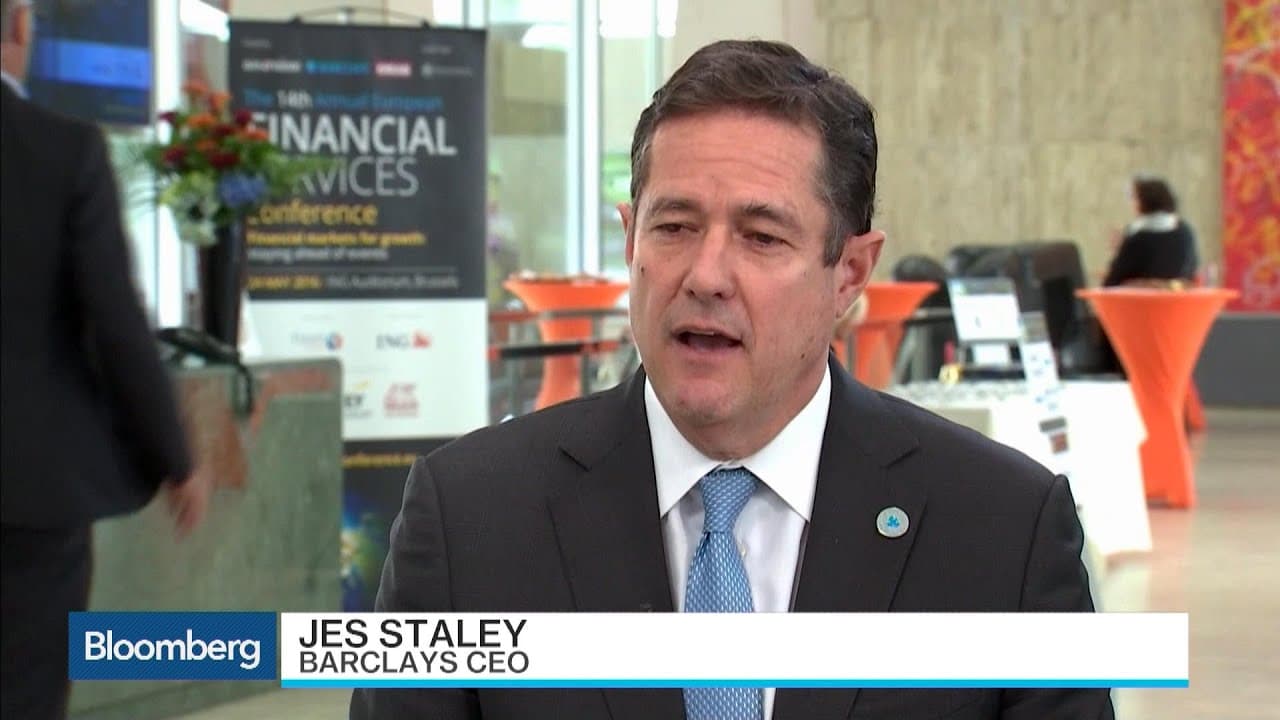
Barclays CEO Staley on Performance, Economy, Markets
TL;DR
Barclays CEO discusses bank restructuring, investment strategies, and economic challenges.
Transcript
you've been in the job for six months how's it going is the hiring freeze is still on is a restructuring going to plan I think we're in a very good place right now our core franchise of being a transatlantic consumer corporate investment bank did quite well in the first quarter our return on tangible equity was in double digits which is our goal no... Read More
Key Insights
- Jes Staley, Barclays CEO, emphasizes the bank's focus on being a transatlantic consumer and corporate investment bank, with a successful first quarter showing double-digit returns on tangible equity.
- Barclays has completed or signed agreements to sell non-core businesses in Europe and Asia, aligning with their strategic plan to focus on core operations.
- The bank has reduced its headcount by over 10,000 since Staley's tenure began, as part of a broader effort to streamline operations and improve efficiency.
- Barclays is transitioning from a controlling to a non-controlling position in Barclays Africa, with significant interest from institutional investors, indicating confidence in the region's prospects.
- Staley highlights the challenges faced by European banks, including adapting to negative interest rates and regulatory changes, while expressing optimism about the U.S. economy's potential to drive global recovery.
- Barclays performed well in the first quarter, particularly in credit and sovereign debt issuance, despite muted capital markets, showcasing the bank's resilience and strategic positioning.
- The CEO acknowledges the risks associated with liquidity in financial markets and the importance of monitoring the capital backing of institutions involved in high-frequency trading.
- Staley expresses confidence in the regulatory environment's evolution, aiming for a level playing field among global banks while addressing remaining conduct and compliance issues.
Install to Summarize YouTube Videos and Get Transcripts
Explore YouTube Video Summarizer or Get YouTube Transcript Extractor
Questions & Answers
Q: How is Barclays progressing with its restructuring plan?
Barclays has made significant progress in its restructuring plan by closing non-core businesses and signing agreements for sales across Europe and Asia. This strategic shift allows the bank to focus on its core operations as a transatlantic consumer and corporate investment bank. Additionally, the bank has reduced its headcount by over 10,000, enhancing operational efficiency.
Q: What are Barclays' plans for its position in Barclays Africa?
Barclays is transitioning from a controlling to a non-controlling position in Barclays Africa. The bank has already sold a 12% stake, and the process is ongoing, with significant interest from institutional investors. This move aligns with their strategy to focus on core operations while maintaining a presence in the African market.
Q: What challenges do European banks face according to Jes Staley?
Jes Staley identifies several challenges for European banks, including adapting to negative interest rates, regulatory changes, and the high cost of maintaining bank balance sheets. Despite these challenges, he remains optimistic about the potential for economic recovery, particularly driven by the U.S. economy, which could lead to more normalized monetary policies.
Q: How did Barclays perform in the first quarter of the year?
Barclays had a strong first quarter, particularly excelling in credit and sovereign debt issuance. Despite muted capital markets, the bank outperformed many competitors, showcasing its strategic positioning and resilience. This performance was driven by effective management and a focus on core banking activities, providing a solid foundation for future growth.
Q: What risks does Staley identify in the financial markets?
Staley highlights the risks associated with liquidity in financial markets, particularly concerning institutions involved in high-frequency trading with limited capital backing. He emphasizes the need for careful monitoring of these entities to prevent systemic risks that could destabilize the financial system, ensuring a stable market environment.
Q: How does Staley view the regulatory environment for banks?
Staley believes that the regulatory environment is evolving towards a more predictable and level playing field for banks globally. He acknowledges the challenges regulators face in balancing home and host country interests but expresses confidence that ongoing adjustments will create a fair competitive landscape for banks worldwide.
Q: What impact does Staley anticipate from Brexit on Barclays?
Staley acknowledges the uncertainty surrounding Brexit and its potential impact on financial markets. However, he emphasizes that Barclays is prepared to manage any stress resulting from the vote. The bank hopes for the UK to remain in the EU, which they believe is beneficial for their customers and clients.
Q: What are Barclays' future investment strategies?
Barclays plans to redeploy capital more efficiently across its operations, particularly in card business and corporate lending. The bank aims to maximize balance sheet efficiency and enhance earnings per share by strategically allocating resources to areas with high growth potential, providing flexibility for future investments.
Summary & Key Takeaways
-
Barclays CEO Jes Staley outlines the bank's strategic focus on core operations, with successful divestments in non-core areas and a significant headcount reduction. The bank's performance in the first quarter exceeded expectations, particularly in credit and sovereign debt issuance.
-
Staley discusses the challenges faced by European banks, including negative interest rates and regulatory changes, while expressing optimism about the U.S. economy's potential to drive global recovery. Barclays is transitioning to a non-controlling position in Barclays Africa, with strong institutional interest.
-
The CEO highlights the risks associated with liquidity in financial markets and the importance of monitoring capital backing in high-frequency trading. He emphasizes the need for a level regulatory playing field among global banks and addresses remaining conduct and compliance issues.
Read in Other Languages (beta)
Share This Summary 📚
Summarize YouTube Videos and Get Video Transcripts with 1-Click
Try YouTube Summary with ChatGPT & Claude or YouTube Transcript Generator
Explore More Summaries from Bloomberg Originals 📚






Summarize YouTube Videos and Get Video Transcripts with 1-Click
Try YouTube Summary with ChatGPT & Claude or YouTube Transcript Generator