How Do You Find the Derivative of Rational Functions?
TL;DR
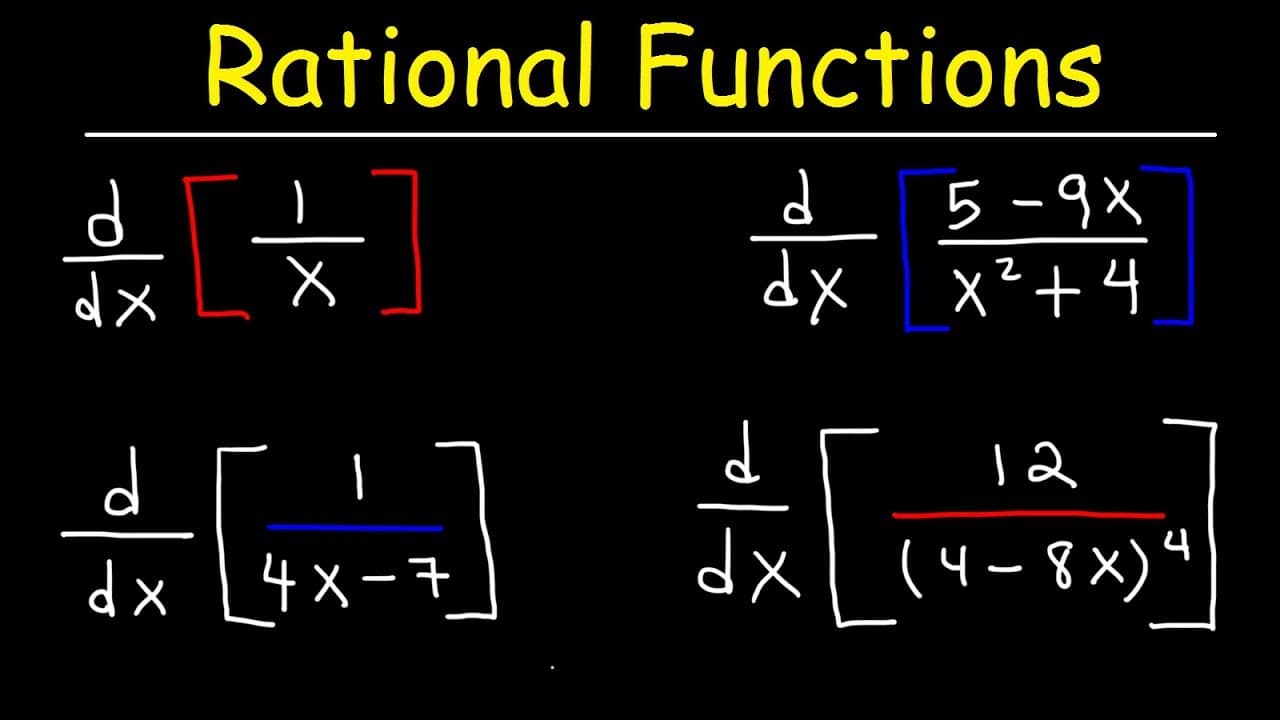
To find the derivative of rational functions, rewrite them using the power rule and chain rule. For example, the derivative of 1/x is -1/x^2, and for 1/(x+5), it is -1/(x+5)^2. Use the quotient rule for expressions like (5-9x)/(x^2+4), resulting in (9x^2-10x-36)/(x^2+4)^2.
Transcript
in this lesson we're going to talk about how to find the derivative of a rational function so let's differentiate 1 over x what is the derivative of 1 over x well first we need to rewrite the expression so this is the same as x to the minus one and now we could use the power rule and recall that the power rule the derivative of x to the n is n x ra... Read More
Key Insights
- ✊ The power rule, which states that the derivative of x^n is n*x^(n-1), is useful in finding the derivative of rational functions.
- 📏 Rational functions involve quotients of polynomials, and the derivative can be determined by applying the power rule and chain rule.
- 📏 The chain rule is necessary when differentiating rational functions where the denominator contains a function of x.
- 📏 The quotient rule is used when finding the derivative of a rational function with both the numerator and denominator involving variables.
- 😑 Differentiating rational functions often requires simplifying the expressions and combining like terms before obtaining the final derivative.
Install to Summarize YouTube Videos and Get Transcripts
Explore YouTube Video Summarizer or Get YouTube Transcript Extractor
Questions & Answers
Q: How do you find the derivative of 1/x?
To find the derivative of 1/x, you can rewrite it as x^-1 and apply the power rule to get -1/x^2.
Q: What is the derivative of 1/(x+5)?
The derivative of 1/(x+5) can be found by using the power rule and chain rule, resulting in -1/(x+5)^2.
Q: How do you differentiate 1/(4x-7)?
To differentiate 1/(4x-7), use the power rule and chain rule. The derivative is -4/(4x-7)^2.
Q: What is the derivative of 9/(x^2-6)?
The derivative of 9/(x^2-6) is -18x/(x^2-6)^2. Apply the power rule and chain rule to find the derivative.
Q: How do you find the derivative of 12/(4-8x)^4?
To find the derivative of 12/(4-8x)^4, use the power rule and chain rule. The derivative is 384/(4-8x)^5.
Q: How do you differentiate (5-9x)/(x^2+4)?
To differentiate (5-9x)/(x^2+4), use the quotient rule. The derivative is (9x^2-10x-36)/(x^2+4)^2.
Q: What is the derivative of (5-2x)/(x+4)^5?
The derivative of (5-2x)/(x+4)^5 can be found by using a combination of the chain rule and the quotient rule. The derivative is -65(5-2x)^4/(x+4)^6.
Summary & Key Takeaways
-
To find the derivative of 1/x, rewrite it as x^-1 and apply the power rule: n(x^n-1), resulting in -1/x^2.
-
For 1/(x+5), use the power rule and chain rule: -1/(x+5)^2.
-
To differentiate 1/(4x-7), use the power rule and chain rule: -4/(4x-7)^2.
-
Apply the power rule and chain rule to find the derivative of 9/(x^2-6): -18x/(x^2-6)^2.
-
Use the power rule and chain rule to find the derivative of 12/(4-8x)^4: 384/(4-8x)^5.
-
Apply the quotient rule to differentiate (5-9x)/(x^2+4): (9x^2-10x-36)/(x^2+4)^2.
-
Use a combination of the chain rule and the quotient rule to find the derivative of (5-2x)/(x+4)^5: -65(5-2x)^4/(x+4)^6.
Read in Other Languages (beta)
Share This Summary 📚
Summarize YouTube Videos and Get Video Transcripts with 1-Click
Try YouTube Summary with ChatGPT & Claude or YouTube Transcript Generator
Explore More Summaries from The Organic Chemistry Tutor 📚

Summarize YouTube Videos and Get Video Transcripts with 1-Click
Try YouTube Summary with ChatGPT & Claude or YouTube Transcript Generator