These Ancient Findings Are In Jeopardy
TL;DR
Ancient geoglyphs in the Amazon are endangered by expanding agriculture.
Transcript
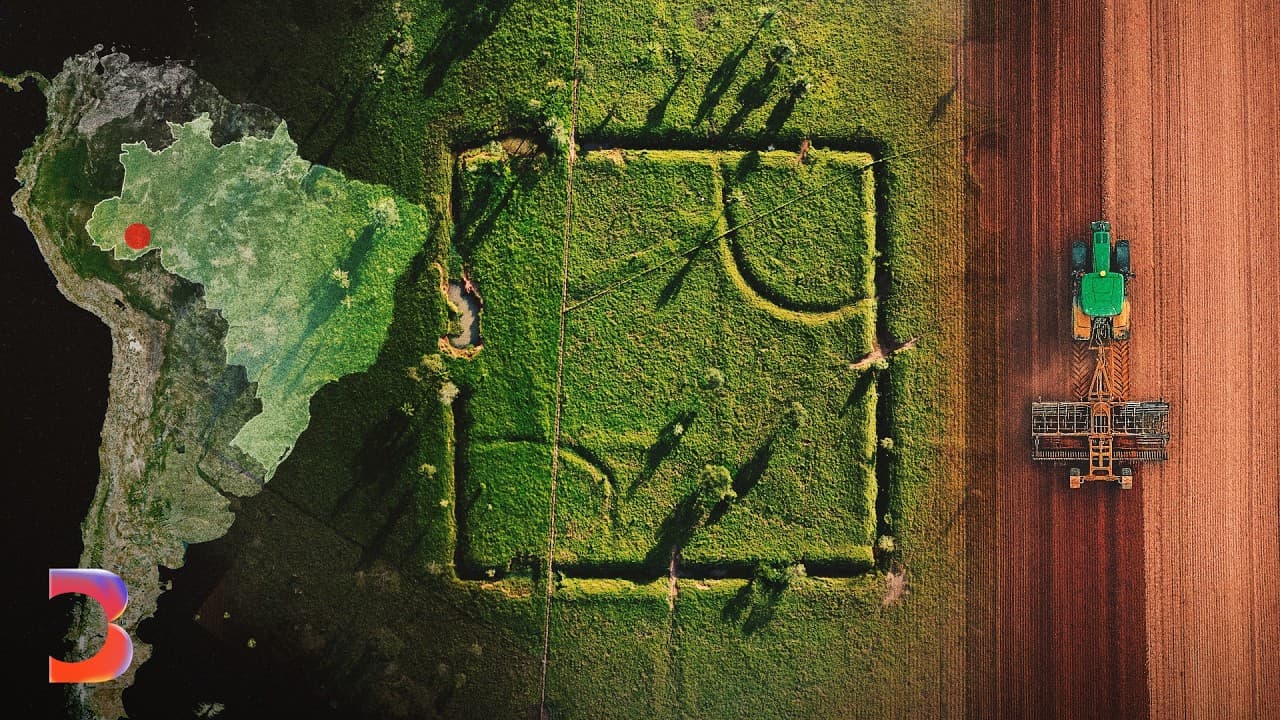
This is a geoglyph. More than a thousand have been discovered over the last few decades. They are geometric earthworks created by ancient civilizations in the southwestern Amazon. Only now are researchers discovering many of these huge sites, just as rapidly expanding soy and corn farms plow them over. The problem is, this land is also home to arch... Read More
Key Insights
- Geoglyphs are ancient earthworks in the Amazon, now threatened by expanding soy and corn farms. These sites are over 2,000 years old and hold significant cultural value.
- Antonia Barbosa, an archaeologist, is working to protect these sites, educating farmers about the cultural heritage of geoglyphs and their importance.
- The BR-317, known as the 'geoglyph highway,' is a major area where these ancient sites are located, now at risk due to agricultural expansion.
- Acre state, once focused on cattle farming, is now rapidly expanding into grain production, with soy becoming its biggest export in just seven years.
- Mechanized farming is replacing traditional practices, leading to the destruction of geoglyphs, seen as obstacles to agricultural efficiency.
- Legal battles, like the one involving Fazenda Crichá, highlight the challenges faced in preserving these sites amidst economic pressures.
- Prosecutor Luidgi Merlo Paiva dos Santos emphasizes the urgency in protecting these sites, given the economic transformation and limited public resources.
- There is potential for tourism centered around geoglyphs, which could help preserve these sites by raising public awareness and interest.
Install to Summarize YouTube Videos and Get Transcripts
Explore YouTube Video Summarizer or Get YouTube Transcript Extractor
Questions & Answers
Q: What are geoglyphs and why are they important?
Geoglyphs are ancient geometric earthworks found in the Amazon, created by civilizations over 2,000 years ago. They are important because they provide evidence of sophisticated societies that existed long before European contact, offering insights into ancient agricultural practices and cultural heritage.
Q: Who is leading the efforts to protect the geoglyphs?
Antonia Barbosa, an archaeologist for Brazil’s National Institute of Historic and Artistic Heritage, is leading the efforts to protect the geoglyphs. She is responsible for informing landowners about the cultural significance of these sites and is actively working to prevent their destruction by expanding agriculture.
Q: What challenges are faced in preserving the geoglyphs?
Preserving the geoglyphs faces several challenges, including rapid agricultural expansion, legal battles over land use, and limited public resources. Mechanized farming and economic pressures prioritize agricultural efficiency over cultural preservation, leading to the destruction of these significant archaeological sites.
Q: How has the economy of Acre state changed in recent years?
Acre state's economy has shifted from primarily cattle farming to a focus on grain production, particularly soy. This change has been driven by new trade routes and increased demand from international markets like China and Europe. As a result, soy has become the state's largest export product in a short period.
Q: What legal case exemplifies the conflict between agriculture and preservation?
The legal case against Assuero Veronez exemplifies the conflict between agriculture and preservation. Veronez, who switched from cattle grazing to mechanized farming, destroyed a geoglyph on his property. The ongoing legal battle highlights the complexities and slow pace of resolving such conflicts amidst rapid agricultural expansion.
Q: What role can tourism play in protecting the geoglyphs?
Tourism can play a significant role in protecting the geoglyphs by raising public awareness and interest in these ancient sites. By promoting the cultural and historical value of geoglyphs, tourism can generate economic incentives for preservation and encourage local and international efforts to safeguard these archaeological treasures.
Q: Why is there an urgent need to protect the geoglyphs now?
There is an urgent need to protect the geoglyphs due to the rapid pace of agricultural expansion and the economic transformation occurring in the region. Without immediate action, many of these ancient sites could be permanently lost to mechanized farming, diminishing the cultural heritage and historical understanding of the area.
Q: What is the significance of the 'geoglyph highway'?
The 'geoglyph highway,' or BR-317, is a significant area where many ancient geoglyphs are located. It represents a cultural hotspot that is now threatened by expanding agriculture. The highway's nickname underscores the concentration of these earthworks and the urgent need for measures to protect them from destruction.
Summary & Key Takeaways
-
In the southwestern Amazon, ancient geoglyphs are under threat from Brazil's rapidly expanding agriculture industry. These earthworks, over 2,000 years old, are being destroyed as soy and corn farms grow. Efforts to protect them are underway, led by archaeologists like Antonia Barbosa.
-
Acre state is experiencing an economic transformation, shifting from cattle grazing to mechanized farming. This shift has made soy the state's largest export, but it also endangers the region's rich archaeological heritage, including many geoglyphs.
-
Legal battles over land use, such as the case against Assuero Veronez, highlight the complexity of balancing economic growth with cultural preservation. There is a pressing need for public awareness and potential tourism to help protect these ancient sites.
Read in Other Languages (beta)
Share This Summary 📚
Summarize YouTube Videos and Get Video Transcripts with 1-Click
Try YouTube Summary with ChatGPT & Claude or YouTube Transcript Generator
Explore More Summaries from Bloomberg Originals 📚





Summarize YouTube Videos and Get Video Transcripts with 1-Click
Try YouTube Summary with ChatGPT & Claude or YouTube Transcript Generator