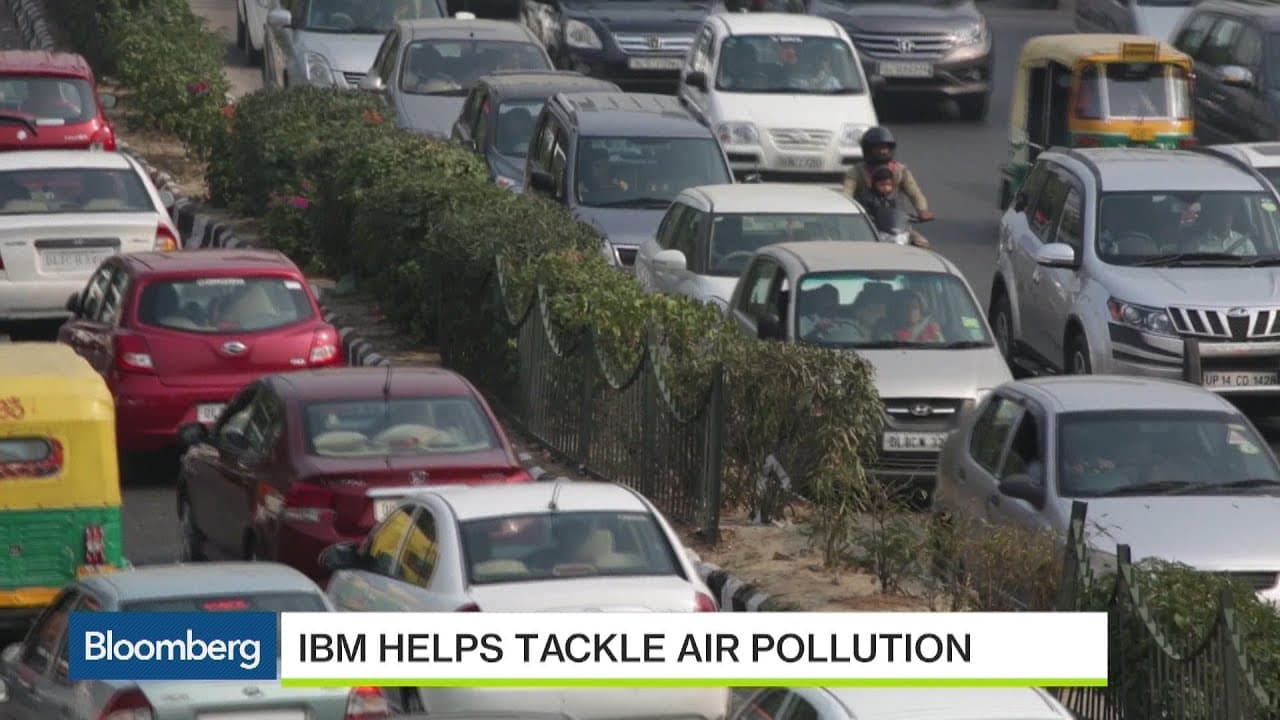
IBM Wants to Use A.I. to Fight Air Pollution
TL;DR
IBM uses AI to predict and mitigate air pollution.
Transcript
How will your technology help in situations like this? Well, the first opportunity that we have is to be able to bring in the capabilities that the internet of things affords us in terms of environmental monitoring, in terms of sensors that are available for us and combine them into models and bring being able to then bring in machine learning and ... Read More
Key Insights
- IBM leverages the Internet of Things (IoT) to enhance environmental monitoring through sensors, enabling improved air pollution forecasts up to 10 days in advance.
- The technology integrates machine learning and cognitive capabilities to refine air quality forecasts, allowing for proactive measures against pollution.
- Scenario analysis facilitated by the technology helps in implementing actions like traffic control or production limits during severe pollution episodes.
- IBM's technology played a role in Beijing's decision to issue a red alert for air pollution, contributing to a 20% reduction in pollution over the year.
- The system can attribute pollution sources at a sector or regional level, aiding in identifying and ranking factories or zones for emission reduction.
- IBM's AI uses a blend of physics and chemistry models, enhanced by machine learning to optimize model parameters for better prediction accuracy.
- The technology collects data from various sources, including satellites and traffic, to create a comprehensive pollution monitoring system.
- Model blending, a key feature of IBM's approach, allows for continuous learning and adjustment, leading to superior forecasting outcomes.
Install to Summarize YouTube Videos and Get Transcripts
Explore YouTube Video Summarizer or Get YouTube Transcript Extractor
Questions & Answers
Q: How does IBM's technology improve air pollution forecasts?
IBM's technology enhances air pollution forecasts by integrating the Internet of Things (IoT) with machine learning and cognitive capabilities. This approach allows for the collection and analysis of sensor data, leading to improved accuracy in predicting pollution levels up to 10 days in advance. By using model blending, the system continuously learns and adjusts parameters for better predictions.
Q: What role did IBM's technology play in Beijing's air pollution management?
IBM's technology was crucial in Beijing's decision to issue a red alert for air pollution. The city's environmental agency uses IBM's system to provide guidance and take actions, such as issuing alerts. Over the year, this technology contributed to a 20% reduction in pollution levels, demonstrating its effectiveness in managing air quality.
Q: Can IBM's technology trace pollution sources accurately?
Yes, IBM's technology can trace pollution sources to specific sectors or regions. By using forecasting capabilities with one-kilometer resolution, the system can attribute emissions to likely sources, such as factories or highways. This allows for ranking and prioritizing emission reduction efforts, aiding in targeted pollution management strategies.
Q: How does IBM's AI system work to fight pollution?
IBM's AI system fights pollution by collecting data from various sources, including satellite and traffic data. It uses a combination of physics and chemistry models, enhanced by machine learning, to optimize model parameters. This results in better prediction accuracy, enabling proactive measures to be taken against pollution.
Q: What is the significance of model blending in IBM's technology?
Model blending is a significant aspect of IBM's technology as it involves using machine learning to determine the optimal combination of physics and chemistry models. By learning from past experiences, the system adjusts parameters for improved accuracy, leading to superior forecasting outcomes compared to using standalone models.
Q: How does IBM's technology collect and use data for pollution monitoring?
IBM's technology collects data from a variety of sources, including sensors, satellite data, and traffic information. This comprehensive data collection allows for a detailed analysis of pollution patterns. The system then uses AI to blend models and refine predictions, providing a robust framework for monitoring and managing air quality.
Q: What are the potential actions enabled by IBM's pollution forecasting system?
IBM's pollution forecasting system enables several actions, such as traffic control and production limits, during severe pollution episodes. By predicting air quality levels in advance, authorities can implement measures to mitigate pollution impacts, ensuring better health outcomes and compliance with environmental regulations.
Q: How does IBM's technology contribute to long-term pollution reduction?
IBM's technology contributes to long-term pollution reduction by providing accurate forecasts and source attribution, allowing for targeted emission reduction strategies. By continuously learning and improving prediction models, the system aids in implementing effective pollution control measures, ultimately leading to sustained improvements in air quality.
Summary & Key Takeaways
-
IBM's technology utilizes IoT and AI to predict air pollution levels, allowing cities to take preventive actions. By integrating machine learning, the system improves forecast accuracy, enabling authorities to implement measures like traffic control to mitigate pollution impacts.
-
In Beijing, IBM's technology was instrumental in issuing a red alert for air pollution, contributing to a significant reduction in pollution levels. The system's ability to attribute emissions to specific sources helps in prioritizing emission reduction efforts.
-
The technology combines physics and chemistry models with AI to enhance prediction accuracy. By learning from past data, the system adjusts model parameters, resulting in more reliable forecasts compared to traditional models, thus aiding in better pollution management.
Read in Other Languages (beta)
Share This Summary 📚
Summarize YouTube Videos and Get Video Transcripts with 1-Click
Try YouTube Summary with ChatGPT & Claude or YouTube Transcript Generator
Explore More Summaries from Bloomberg Originals 📚



Summarize YouTube Videos and Get Video Transcripts with 1-Click
Try YouTube Summary with ChatGPT & Claude or YouTube Transcript Generator