What If Gravity Is an Emergent Force Instead of Fundamental?
TL;DR
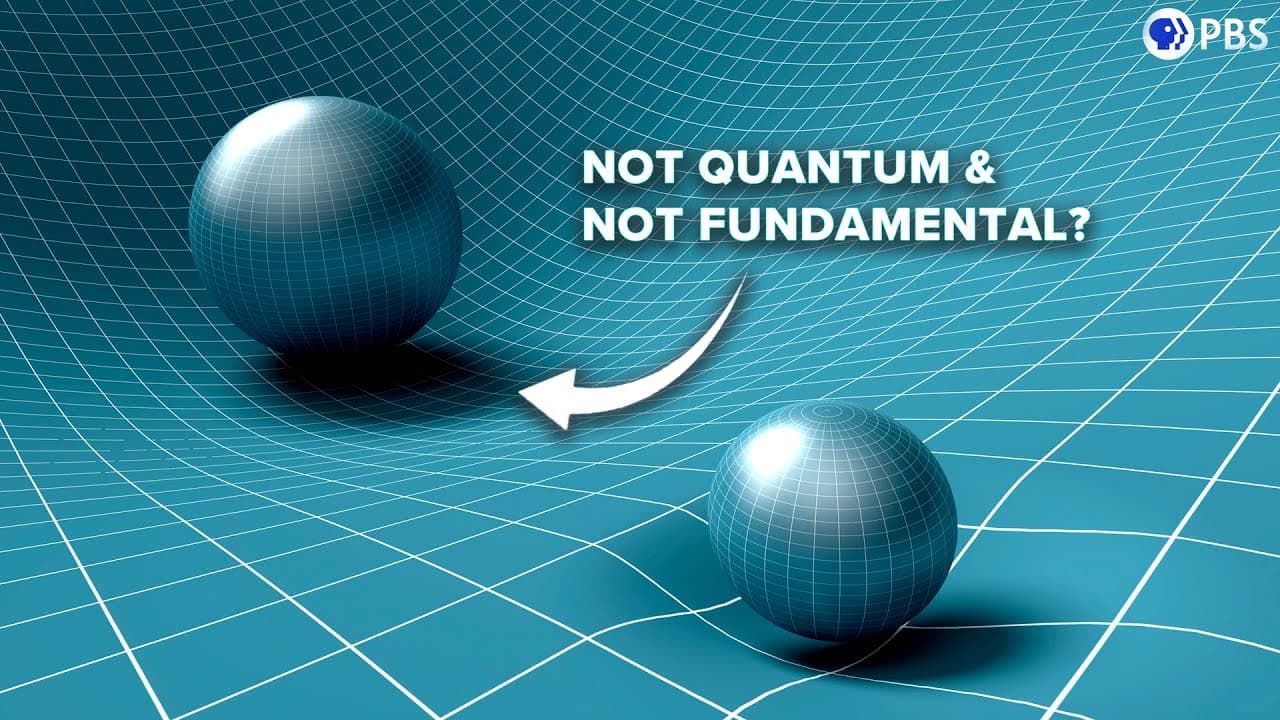
Gravity may not be a fundamental force but rather an emergent effect of the universe's tendency toward entropy. Erik Verlinde's entropic gravity theory proposes that gravity arises from the increase in entropy at the holographic boundary of the universe, challenging traditional notions and offering new perspectives on dark matter and dark energy.
Transcript
We're told there are four fundamental forces - the strong and weak nuclear forces, electromagnetism, and gravity. Except maybe gravity is actually no more fundamental than the force of a stretched elastic band. Maybe gravity is just an entropic byproduct—an emergent effect of the universe’s tendency to disorder. So if you allow that entropy to ... Read More
Key Insights
- Gravity is traditionally considered one of the four fundamental forces, but some theories suggest it may be an emergent force resulting from entropy.
- Erik Verlinde's entropic gravity theory posits that gravity arises from the universe's tendency towards disorder, rather than being a fundamental force.
- The holographic principle suggests that all information in the universe can be encoded on a boundary, with gravity emerging from this encoding.
- Verlinde's theory draws from black hole thermodynamics, where entropy is proportional to the surface area of the black hole, as per the Bekenstein-Hawking formula.
- In a holographic universe, gravity may emerge from the boundary's entropy, affecting the bulk's interior, similar to how an elastic band exerts force.
- The concept of entropic gravity challenges the traditional view of gravity as a property of spacetime, proposing it as a statistical byproduct of entropy.
- Verlinde's theory has implications for understanding dark matter and dark energy, suggesting they may also be emergent phenomena related to entropy.
- Entropic gravity is a controversial theory, with ongoing debates about its validity and the necessity of a holographic dual to the gravitational universe.
Install to Summarize YouTube Videos and Get Transcripts
Explore YouTube Video Summarizer or Get YouTube Transcript Extractor
Questions & Answers
Q: What is Erik Verlinde's entropic gravity theory?
Erik Verlinde's entropic gravity theory posits that gravity is not a fundamental force but an emergent phenomenon resulting from the universe's tendency towards increasing entropy. According to this theory, gravity arises as a statistical byproduct of the interactions and configurations that maximize entropy, challenging the traditional view of gravity as an inherent property of spacetime.
Q: How does the holographic principle relate to entropic gravity?
The holographic principle is central to entropic gravity theory, suggesting that all information in the universe can be encoded on a boundary. In this framework, gravity emerges from the entropy on this boundary, affecting the interior or 'bulk' of the universe. This principle implies that the gravitational forces we observe are a result of the universe's boundary conditions and entropy, rather than being fundamental forces.
Q: What role does black hole thermodynamics play in entropic gravity?
Black hole thermodynamics is a foundation for entropic gravity, particularly the Bekenstein-Hawking formula, which relates a black hole's entropy to its surface area. This concept is extended in entropic gravity to suggest that gravity itself is an entropic force, arising from the statistical mechanics of entropy, much like the thermodynamic properties observed in black holes, where entropy is a measure of hidden information.
Q: Can entropic gravity explain dark matter and dark energy?
Entropic gravity has been proposed as a framework to explain dark matter and dark energy. Erik Verlinde's theory suggests that these phenomena may also be emergent effects related to entropy, rather than mysterious, unseen substances or energies. However, this explanation requires additional assumptions and remains a topic of debate among physicists, with further research needed to validate these claims.
Q: What are the main criticisms of entropic gravity?
Critics of entropic gravity argue that it relies heavily on assumptions, such as the existence of a holographic dual to our universe, which have not been conclusively proven. Additionally, while it provides a novel perspective on gravity, it must still demonstrate its ability to replicate the predictions of general relativity and account for all observed gravitational phenomena, which remains a significant challenge.
Q: How does entropic gravity differ from traditional views of gravity?
Traditional views consider gravity as a fundamental force, a property of spacetime itself. In contrast, entropic gravity views it as an emergent force arising from the statistical tendency towards increased entropy. This perspective challenges the notion of gravity as an intrinsic force, instead proposing it as a byproduct of thermodynamic principles, akin to the behavior of elastic materials or gases.
Q: What is the significance of the holographic boundary in entropic gravity?
In entropic gravity, the holographic boundary is significant because it encodes the information that gives rise to gravitational forces within the universe. The idea is that the boundary's entropy dictates the behavior of the bulk, or the interior space, where gravity emerges as a result of the statistical mechanics of the boundary's information content, offering a new way to conceptualize gravitational interactions.
Q: Is entropic gravity widely accepted in the scientific community?
Entropic gravity is not yet widely accepted and remains a controversial topic within the scientific community. While it is taken seriously by some physicists due to its novel approach and potential to explain complex phenomena like dark matter and dark energy, it faces skepticism due to its reliance on unproven assumptions and the need to demonstrate consistency with established gravitational theories like general relativity.
Summary & Key Takeaways
-
Gravity is traditionally seen as a fundamental force, but Erik Verlinde's entropic gravity theory suggests it emerges from the universe's tendency towards entropy. This theory challenges conventional views by proposing that gravity is not a fundamental force but rather a statistical byproduct of entropy, with implications for understanding dark matter and dark energy.
-
The holographic principle, which posits that all information in the universe can be encoded on a boundary, plays a crucial role in Verlinde's theory. According to this principle, gravity may emerge from the boundary's entropy, affecting the interior of the universe, similar to the force exerted by an elastic band.
-
Entropic gravity is a controversial theory that has sparked debates among physicists. While it offers a novel perspective on gravity, its validity depends on assumptions like the existence of a holographic dual to the gravitational universe, and it remains to be seen if it can fully explain phenomena like dark matter and dark energy.
Read in Other Languages (beta)
Share This Summary 📚
Summarize YouTube Videos and Get Video Transcripts with 1-Click
Try YouTube Summary with ChatGPT & Claude or YouTube Transcript Generator
Explore More Summaries from PBS Space Time 📚
Summarize YouTube Videos and Get Video Transcripts with 1-Click
Try YouTube Summary with ChatGPT & Claude or YouTube Transcript Generator