SN1 SN2 E1 E2 Reaction Mechanism - Test Review
TL;DR
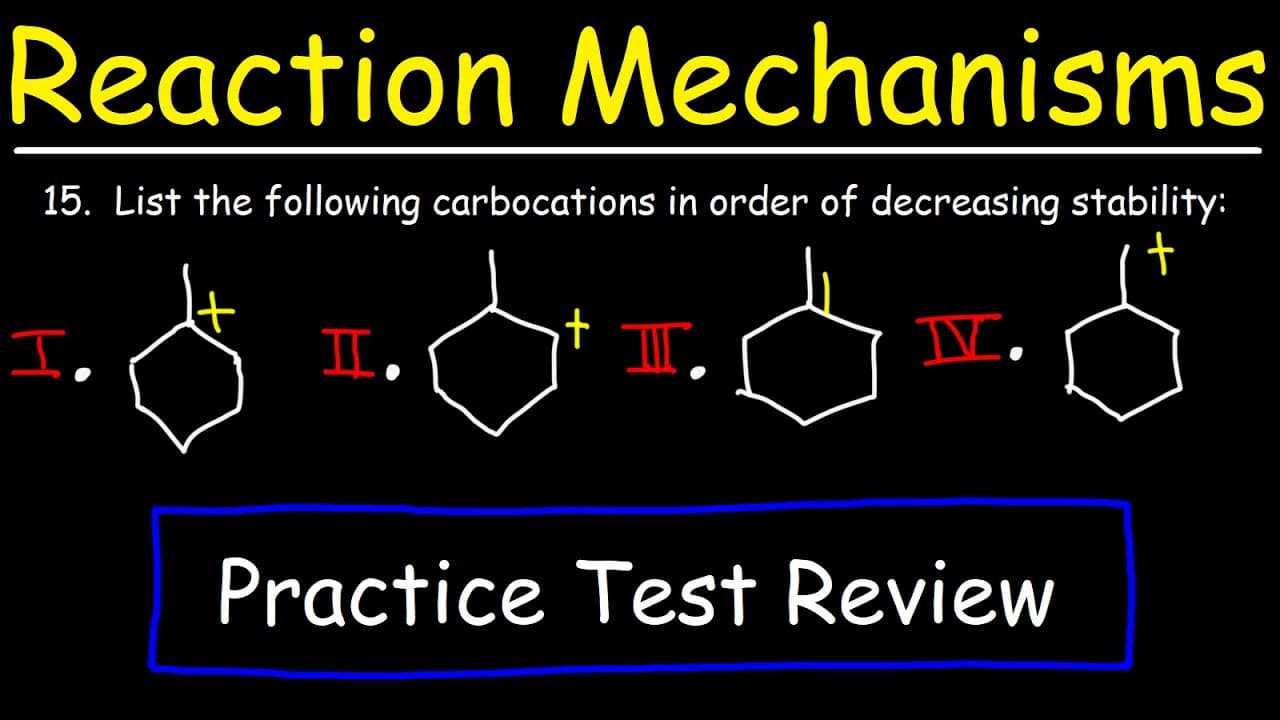
Learn everything you need to know about Sn1, Sn2, E1, and E2 reactions in one video.
Transcript
now this video is for those of you who may have a test on sn1 sn2 e1 e2 reactions and you want to just learn everything that you need to know in one video now i do recommend watching another video that i have on youtube which is entitled sn1 sn2 e1 e2 reaction mechanisms it'll give you a good overview of what you need to know to answer these proble... Read More
Key Insights
- ⚾ The type of alkyl halide, nucleophile/base, and solvent determine the reaction mechanism and products in Sn1, Sn2, E1, and E2 reactions.
- ❓ Tertiary substrates are not suitable for Sn2 reactions due to steric hindrance.
- 🤩 Leaving group stability and solvent polarity play key roles in determining reaction outcomes.
- ❓ Sn1 reactions involve carbocation intermediates and may undergo rearrangements.
- 💁 E1 reactions occur under acidic conditions and involve the formation of carbocation intermediates followed by elimination of a leaving group.
Install to Summarize YouTube Videos and Get Transcripts
Explore YouTube Video Summarizer or Get YouTube Transcript Extractor
Questions & Answers
Q: Which type of alkyl halides are suitable for Sn2 reactions?
Methyl alkyl halides and primary alkyl halides are more reactive in Sn2 reactions. Tertiary alkyl halides are not suitable for Sn2 reactions due to steric hindrance.
Q: What is the major product of an Sn1 reaction?
In an Sn1 reaction, the major product is a substitution product, which involves the replacement of the leaving group with a nucleophile. Rearrangements may occur, leading to different products.
Q: How does the leaving group stability affect the reaction in Sn1 and Sn2 reactions?
In both Sn1 and Sn2 reactions, leaving group stability plays a role. Generally, better leaving groups are more stable, allowing for easier departure and nucleophilic substitution in Sn1 reactions.
Q: What is the effect of solvent on Sn2 reactions?
Sn2 reactions are favored in polar aprotic solvents, which allow for better nucleophile access to the electrophilic carbon. Polar protic solvents favor Sn1 reactions.
Q: How does the strength of nucleophiles affect the reaction in Sn1 and Sn2 reactions?
In Sn2 reactions, stronger nucleophiles are more reactive and undergo displacement of the leaving group. In Sn1 reactions, nucleophilic strength is less important as the carbocation intermediate is formed before nucleophilic attack.
Summary & Key Takeaways
-
Sn1, Sn2, E1, and E2 reactions are important in organic chemistry and involve nucleophilic substitution and elimination reactions.
-
The reaction mechanisms and products depend on the type of substrate, nucleophile/base, and solvent used.
-
Tertiary substrates are not suitable for Sn2 reactions, while primary alkyl halides are preferred for Sn2 reactions.
-
Sn1 reactions involve the formation of a carbocation intermediate, which can rearrange if a more stable carbocation can be formed.
-
E1 reactions occur under acidic conditions and involve the formation of a carbocation intermediate followed by elimination of a leaving group.
Read in Other Languages (beta)
Share This Summary 📚
Summarize YouTube Videos and Get Video Transcripts with 1-Click
Try YouTube Summary with ChatGPT & Claude or YouTube Transcript Generator
Explore More Summaries from The Organic Chemistry Tutor 📚


Summarize YouTube Videos and Get Video Transcripts with 1-Click
Try YouTube Summary with ChatGPT & Claude or YouTube Transcript Generator