Hawking Radiation
TL;DR
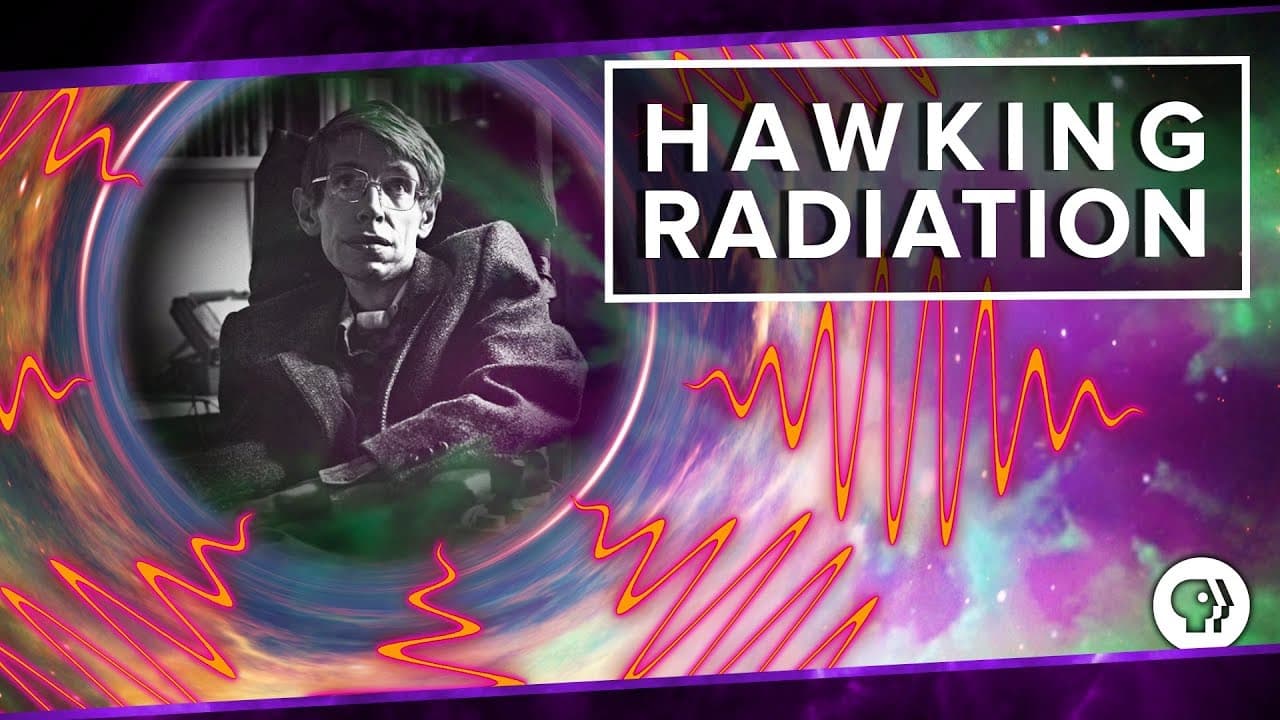
Stephen Hawking's theory shows black holes emit radiation and slowly evaporate.
Transcript
[MUSIC PLAYING] He was perhaps the greatest genius of our time. Stephen Hawking peered behind the curtain of reality and glimpsed the true workings of the universe. He inspired all of us to pursue our curiosity, no matter the obstacles. However, his true legacy is his work. He made profound contributions across physics from quantum theory to cosmol... Read More
Key Insights
- Stephen Hawking revolutionized physics by proposing that black holes emit radiation, contradicting prior beliefs that they only grow.
- Hawking radiation arises from the interaction of quantum fields with the extreme curvature of spacetime near black holes.
- The concept involves virtual particles near the event horizon, where one is consumed by the black hole, allowing the other to escape.
- Hawking's calculation used Bogoliubov transformations to approximate the effects of curved spacetime on quantum fields, leading to his radiation prediction.
- Hawking radiation is mostly thermal, with its temperature inversely related to the black hole's mass, making larger black holes cooler.
- The radiation primarily consists of massless particles like photons, with massive particles requiring higher energy to form.
- Hawking's work highlights the need for a quantum theory of gravity to fully explain the phenomenon of black hole radiation.
- The information paradox, raised by Hawking radiation, questions how quantum information is preserved as black holes evaporate.
Install to Summarize YouTube Videos and Get Transcripts
Explore YouTube Video Summarizer or Get YouTube Transcript Extractor
Questions & Answers
Q: What is the significance of Hawking radiation?
Hawking radiation is significant because it challenges the previous notion that black holes only grow and never shrink. It introduces the idea that black holes can emit radiation and slowly evaporate over time, which has profound implications for our understanding of black holes and the laws of physics, particularly the intersection of quantum mechanics and general relativity.
Q: How does Hawking radiation relate to quantum mechanics?
Hawking radiation relates to quantum mechanics through the concept of virtual particle pairs that appear near a black hole's event horizon. Quantum field theory suggests that these particles can be separated, with one particle escaping as radiation and the other being absorbed by the black hole. This process is deeply rooted in quantum mechanics, as it involves the behavior of quantum fields in curved spacetime.
Q: Why is Hawking radiation considered thermal?
Hawking radiation is considered thermal because the spectrum of the emitted particles resembles that of thermal radiation. The temperature of this radiation is related to the surface area of the black hole's event horizon and inversely proportional to its mass. This thermal nature indicates that black holes have a temperature and can radiate energy like any other hot object, albeit at very low temperatures for large black holes.
Q: What role do Bogoliubov transformations play in Hawking's theory?
Bogoliubov transformations play a crucial role in Hawking's theory by providing a mathematical framework to approximate the effects of curved spacetime on quantum fields. These transformations help describe how the vibrational modes of quantum fields are mixed or scattered due to the presence of a black hole, leading to the emission of Hawking radiation. They enable the calculation of radiation without a complete theory of quantum gravity.
Q: What is the information paradox associated with Hawking radiation?
The information paradox arises from the idea that Hawking radiation appears to cause the loss of quantum information, which contradicts the principle that information should be conserved in quantum mechanics. As black holes emit radiation and evaporate, it seems that the information about the matter that fell into the black hole is lost, posing a significant challenge to our understanding of quantum mechanics and requiring a resolution for a complete theory of quantum gravity.
Q: How does Hawking radiation affect the lifespan of a black hole?
Hawking radiation affects the lifespan of a black hole by causing it to lose mass over time. As the black hole emits radiation, it gradually loses energy, leading to a decrease in its mass. This process continues until the black hole eventually evaporates completely. The rate of mass loss is slow for large black holes but accelerates as they become smaller, potentially leading to a rapid and explosive end.
Q: Can Hawking radiation be observed directly?
Currently, Hawking radiation has not been observed directly due to its extremely weak nature. The radiation emitted by black holes is incredibly faint, especially for large black holes, making it challenging to detect with existing technology. Observations of Hawking radiation would require detecting the subtle thermal emissions from black holes, which remain a significant experimental challenge in astrophysics.
Q: What are the implications of Hawking radiation for the theory of everything?
The implications of Hawking radiation for the theory of everything are profound, as it highlights the need for a unified theory that combines quantum mechanics and general relativity. Hawking's work suggests that black holes are key to understanding the fundamental nature of the universe, and resolving the mysteries of Hawking radiation, such as the information paradox, is crucial for developing a complete theory of quantum gravity that can explain all physical phenomena.
Summary & Key Takeaways
-
Stephen Hawking's theory of Hawking radiation suggests that black holes emit radiation due to quantum effects near their event horizons. This emission leads to the slow evaporation of black holes, challenging previous assumptions about their eternal growth and permanence.
-
Hawking's work combines quantum mechanics and general relativity to explain how black holes can emit particles. By using mathematical tools like Bogoliubov transformations, he showed that virtual particle pairs near black holes can result in real particle emissions.
-
The radiation emitted by black holes appears thermal and is primarily composed of massless particles. The temperature of this radiation is inversely related to the black hole's mass, making smaller black holes hotter and potentially explosive.
Read in Other Languages (beta)
Share This Summary 📚
Summarize YouTube Videos and Get Video Transcripts with 1-Click
Try YouTube Summary with ChatGPT & Claude or YouTube Transcript Generator
Explore More Summaries from PBS Space Time 📚
Summarize YouTube Videos and Get Video Transcripts with 1-Click
Try YouTube Summary with ChatGPT & Claude or YouTube Transcript Generator