Electroweak Theory and the Origin of the Fundamental Forces
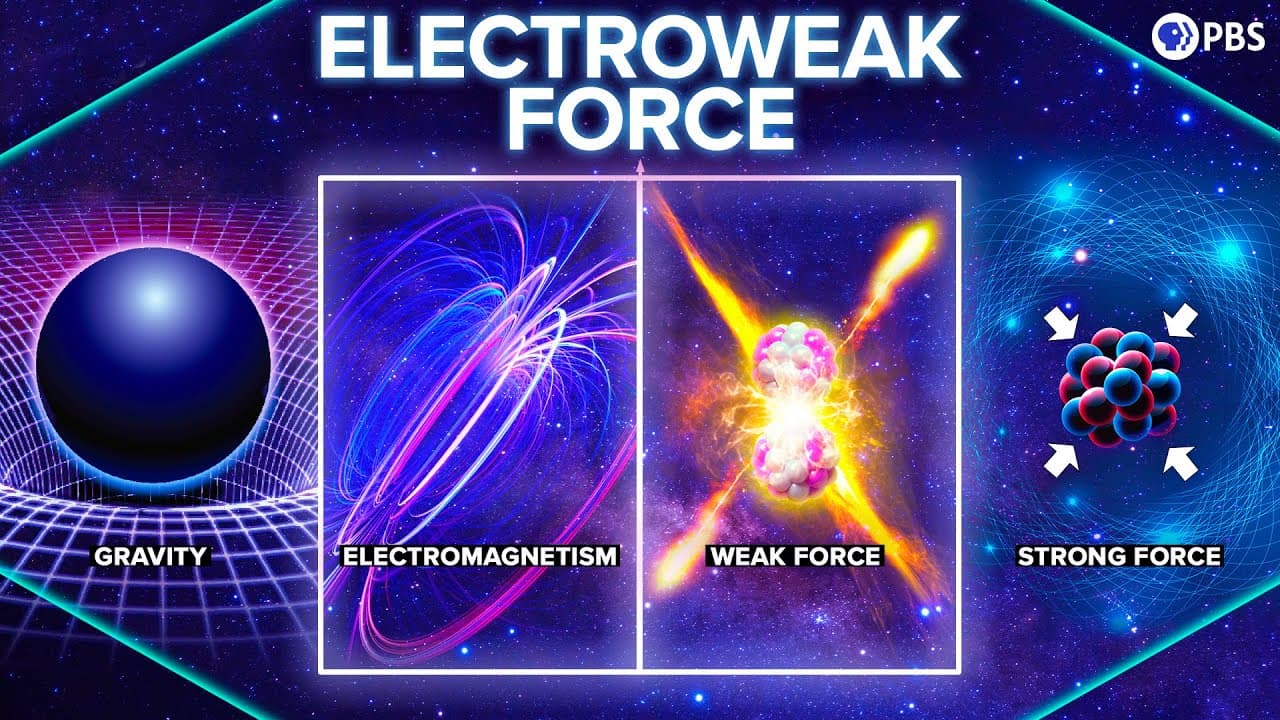
TL;DR
Exploration of how electromagnetic and weak forces were once unified.
Transcript
Our universe seems pretty complicated. We have a weird zoo of elementary particles, which interact through very different fundamental forces. But some extremely subtle clues in nature have led us to believe that the forces of nature were once unified, ruled by a single, grand symmetry. But how does one force separate into multiple? And how do the f... Read More
Key Insights
- The universe's fundamental forces may have originated from a single, grand symmetry, which later separated into multiple forces.
- Electroweak unification shows that electromagnetic and weak forces were once a single force, leading to the discovery of the Higgs field.
- The weak interaction, responsible for certain types of radioactive decay, was first identified through beta decay involving neutrons and protons.
- Enrico Fermi's early quantum description of beta decay involved a 'four fermion' interaction, but it only worked at low energies.
- Quantum electrodynamics (QED) describes electromagnetism through gauge theory, where charged particles interact via mediating particles like photons.
- Julian Schwinger proposed that the weak interaction involves gauge bosons, leading to the idea that electromagnetism plays a role in weak interactions.
- Massive force carriers like W bosons in the weak force require breaking the symmetry of gauge theory, leading to the discovery of the Higgs particle.
- The electroweak unification suggests that the weak force and electromagnetism arise from a larger symmetry group that breaks spontaneously at low temperatures.
Install to Summarize YouTube Videos and Get Transcripts
Explore YouTube Video Summarizer or Get YouTube Transcript Extractor
Questions & Answers
Q: What is the significance of electroweak unification?
Electroweak unification is significant because it reveals that the electromagnetic and weak forces were once a single force, governed by a unified symmetry. This unification helps explain how particles gain mass through the Higgs field and provides a deeper understanding of the fundamental forces in the universe.
Q: How was the weak interaction first identified?
The weak interaction was first identified through the process of beta decay, where a neutron transforms into a proton by emitting an electron and a neutrino. This process was initially described by Enrico Fermi's 'four fermion' interaction, which modeled the interaction as a direct conversion of particles.
Q: What role does quantum electrodynamics play in understanding fundamental forces?
Quantum electrodynamics (QED) plays a crucial role in understanding electromagnetism as a gauge theory, where charged particles interact through mediating particles like photons. QED provides a successful framework for describing electromagnetic interactions and highlights the importance of symmetries in fundamental forces.
Q: What did Julian Schwinger propose about the weak interaction?
Julian Schwinger proposed that the weak interaction involves gauge bosons, suggesting that the mediating particles must be charged. This proposal hinted at a connection between the weak interaction and electromagnetism, as the weak interaction could change neutral particles into charged ones, indicating a shared role with electromagnetic forces.
Q: Why was the mass of W bosons a theoretical challenge?
The mass of W bosons posed a theoretical challenge because gauge bosons, according to gauge theory symmetries, should be massless. The existence of massive W bosons indicated a need to break the symmetry of gauge theory, leading to the discovery of the Higgs particle, which provides mass to these force carriers.
Q: How does spontaneous symmetry breaking relate to electroweak unification?
Spontaneous symmetry breaking is crucial to electroweak unification as it explains how the larger symmetry group, SU(2)xU(1), breaks at low temperatures. This breaking results in a massless photon field and a massive weak force field, allowing the weak force bosons to gain mass while preserving the unified symmetry at high energies.
Q: What is the role of the Higgs field in particle physics?
The Higgs field plays a fundamental role in particle physics by providing mass to particles through the mechanism of spontaneous symmetry breaking. It is essential for the electroweak unification, as it allows the weak force bosons to gain mass, and its discovery confirmed the theoretical predictions of the standard model.
Q: How does the electroweak unification influence the search for deeper symmetries?
The electroweak unification has influenced the search for deeper symmetries by showing that fundamental forces can be unified under larger symmetry groups. This has led to efforts to include the strong nuclear force and find a grand unified theory, potentially encompassing all fundamental forces within a single framework of symmetries.
Summary & Key Takeaways
-
The video explores how the electromagnetic and weak forces were once unified under a single symmetry, leading to the concept of electroweak unification. This unification helped in understanding the Higgs field and how particles gain mass, emphasizing the role of symmetries in the fundamental forces.
-
The weak interaction, initially identified through beta decay, was described by Enrico Fermi's 'four fermion' interaction. However, it was Julian Schwinger's proposal of gauge bosons that linked weak interactions with electromagnetism, hinting at a deeper connection between these forces.
-
The electroweak unification involved breaking the symmetry of gauge theory to account for massive W bosons, which was a theoretical challenge. This led to the discovery of the Higgs particle and set the stage for further exploration of fundamental forces and their unification.
Read in Other Languages (beta)
Share This Summary 📚
Summarize YouTube Videos and Get Video Transcripts with 1-Click
Try YouTube Summary with ChatGPT & Claude or YouTube Transcript Generator
Explore More Summaries from PBS Space Time 📚




Summarize YouTube Videos and Get Video Transcripts with 1-Click
Try YouTube Summary with ChatGPT & Claude or YouTube Transcript Generator