Are there Undiscovered Elements Beyond The Periodic Table?
TL;DR
Exploration of undiscovered elements and their potential impact.
Transcript
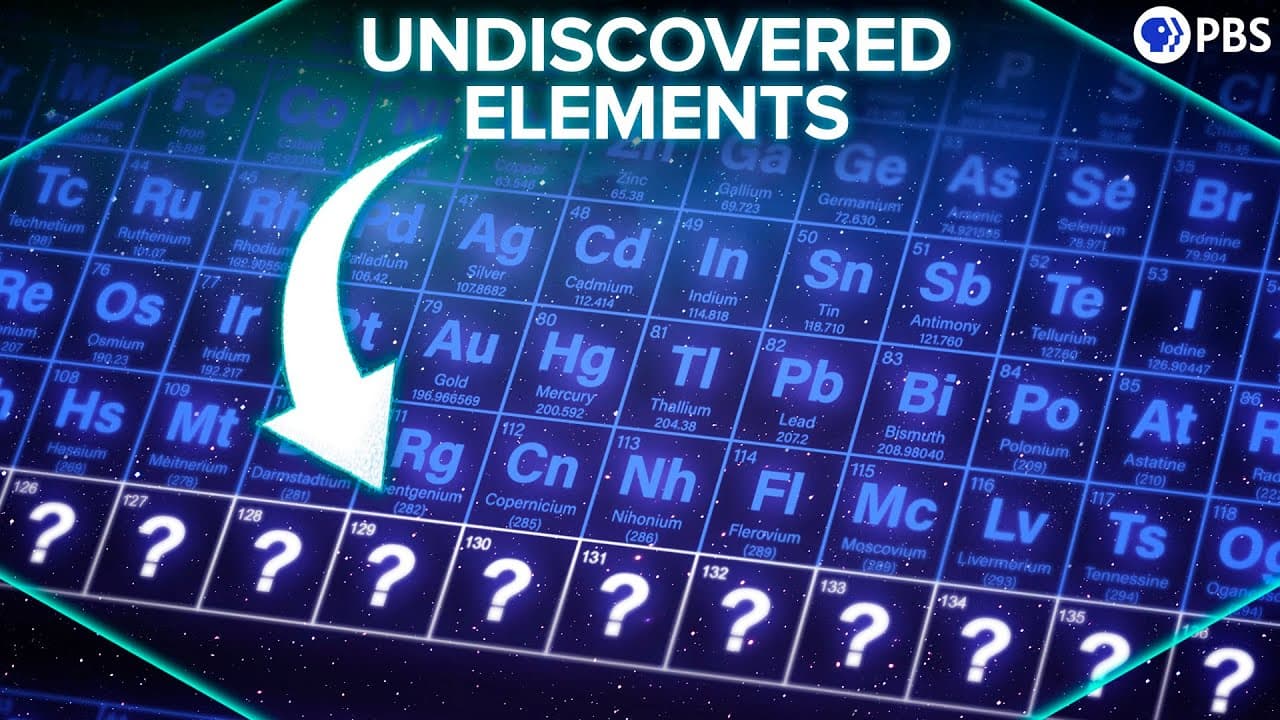
Adamantium, bolognium, dilithium. Element Zero, Kryptonite. Mythril, Netherite, Orichalcum, Unobtanium. We love the idea of fictional elements with miraculous properties that science has yet to discover. But is it really possible that new elements exist beyond the periodic table? Science fiction in particular often imagines artificial, or yet-to-be... Read More
Key Insights
- The periodic table's elements are defined by atomic number, but gaps historically existed, suggesting possibilities for new elements.
- Mendeleev's periodic table had gaps for undiscovered elements, many of which were later identified, like scandium and germanium.
- Technetium was the first artificially created element, discovered through particle accelerator experiments, highlighting the potential for synthetic elements.
- Elements with more than 83 protons, like technetium, often have only unstable isotopes, making them rare in nature.
- Nuclear stability is influenced by the balance of protons and neutrons, magic numbers, and nuclear forces, making predictions complex.
- The island of stability theory suggests certain heavy elements might have longer half-lives, offering new scientific and practical opportunities.
- Artificial elements like technetium and plutonium have practical applications in medicine and energy, demonstrating the value of synthetic discoveries.
- Future discoveries in the island of stability could lead to new materials with transformative properties, comparable to previous technological eras.
Install to Summarize YouTube Videos and Get Transcripts
Explore YouTube Video Summarizer or Get YouTube Transcript Extractor
Questions & Answers
Q: What defines the elements on the periodic table?
Elements on the periodic table are defined by their atomic number, which corresponds to the number of protons in the nucleus. This determines their chemical properties and placement on the table. Historically, gaps in the table indicated undiscovered elements, which were later identified as technology advanced.
Q: Why was technetium the first artificial element discovered?
Technetium was the first artificial element discovered because it does not occur naturally on Earth due to its instability. It was created in 1937 when molybdenum was bombarded in a particle accelerator, adding a proton and forming technetium. Its discovery highlighted the potential for creating elements not found naturally.
Q: What is the concept of the island of stability?
The island of stability is a theoretical region in the periodic table where superheavy elements might possess longer half-lives and greater stability. This concept suggests that certain combinations of protons and neutrons could result in stable isotopes, offering new opportunities for scientific discovery and practical applications.
Q: How do nuclear forces influence element stability?
Element stability is influenced by a balance of nuclear forces. The strong nuclear force holds protons and neutrons together, while electromagnetic forces can cause instability by repelling protons. The presence of neutrons helps buffer these forces, and specific 'magic numbers' of nucleons can further stabilize nuclei.
Q: What are the practical applications of artificial elements?
Artificial elements have numerous practical applications. For example, technetium is used in medical imaging due to its short half-life, minimizing radiation exposure. Plutonium is critical in nuclear reactors for energy production. These elements demonstrate the potential for synthetic discoveries to impact technology and society significantly.
Q: What challenges exist in discovering new elements?
Discovering new elements involves overcoming challenges related to their creation and stability. Many superheavy elements decay rapidly, making detection difficult. Advanced computational models and experimental techniques are needed to predict and synthesize these elements, aiming to find stable configurations and extend the periodic table.
Q: How does the video relate to the concept of fictional elements?
The video begins by referencing fictional elements with miraculous properties, using them as a metaphor to explore the real scientific pursuit of undiscovered elements. It transitions from fiction to reality, discussing the historical and ongoing efforts to identify new elements with potentially transformative properties.
Q: Why is the discovery of new elements significant for science?
The discovery of new elements is significant because it can lead to breakthroughs in understanding nuclear physics, material science, and chemistry. New elements might possess unique properties that revolutionize technology, similar to how silicon transformed electronics. Exploring these possibilities could open new frontiers in science and industry.
Summary & Key Takeaways
-
The video explores the potential existence of undiscovered elements beyond the periodic table, drawing parallels to historical gaps filled by elements like technetium. It delves into the concept of nuclear stability and the possibility of an 'island of stability' where new, stable elements may exist.
-
The discussion covers the historical context of element discovery, the role of synthetic elements in modern technology, and the complex factors influencing nuclear stability. The potential for new elements to revolutionize science and technology is highlighted, akin to past material advancements.
-
The video emphasizes the importance of continued exploration in nuclear physics, suggesting that discovering new elements could have significant scientific and practical impacts, similar to the transformative effects of past material discoveries like silicon and plutonium.
Read in Other Languages (beta)
Share This Summary 📚
Summarize YouTube Videos and Get Video Transcripts with 1-Click
Try YouTube Summary with ChatGPT & Claude or YouTube Transcript Generator
Explore More Summaries from PBS Space Time 📚
Summarize YouTube Videos and Get Video Transcripts with 1-Click
Try YouTube Summary with ChatGPT & Claude or YouTube Transcript Generator