How to Space Training for Optimal Skill Learning
TL;DR
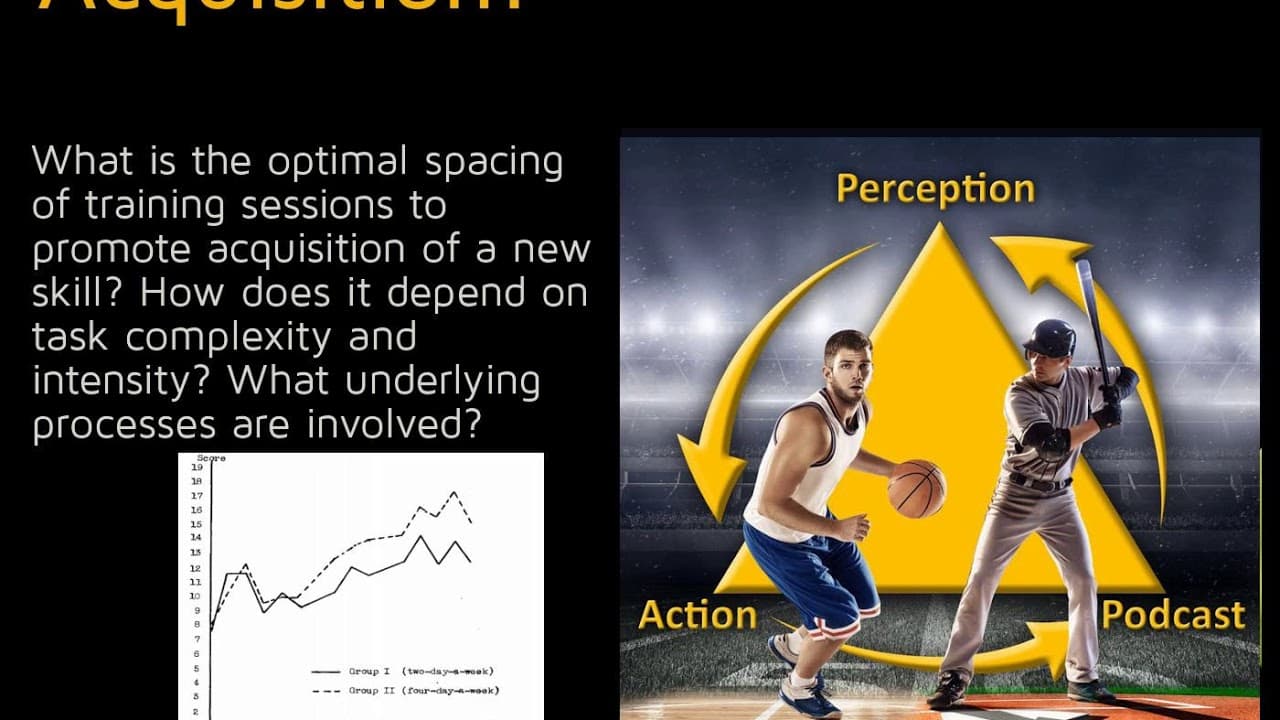
Optimal skill acquisition is achieved by spacing training sessions rather than massing them. Factors like task complexity, intensity, and previous experience influence the effectiveness of spaced training. An intermediate intensity level and some initial mass practice for novices may enhance learning. Spacing allows for better memory consolidation and reconsolidation, making skills more durable.
Transcript
today on the perception and action podcast what is the optimal spacing of training sessions tomorrow acquisition of a new skill how does it depend on the task complexity and intensity what underlying processes are involved so it's time for a call to action hi everyone this is Rob gray from Arizona State University in perception action calm welcome ... Read More
Key Insights
- Spaced practice generally results in better skill retention than massed practice.
- Task complexity and learner experience influence the effectiveness of spaced training.
- Intermediate intensity levels in training optimize skill acquisition.
- Initial mass practice may benefit novices by allowing initial skill consolidation.
- Spacing aids memory reconsolidation, enhancing long-term skill retention.
- Variability in practice is crucial for effective reconsolidation in spaced training.
- Sleep plays a significant role in consolidating skills learned through spaced practice.
- Retrieval difficulty during spaced practice enhances long-term memory retention.
Install to Summarize YouTube Videos and Get Transcripts
Explore YouTube Video Summarizer or Get YouTube Transcript Extractor
Questions & Answers
Q: How does spacing training sessions benefit skill acquisition?
Spacing training sessions improves skill acquisition by allowing better memory consolidation and reconsolidation. This process makes skills more durable and enhances long-term retention. It is particularly effective when combined with variability in practice, which enriches the learning context and facilitates memory retrieval.
Q: What factors influence the effectiveness of spaced practice?
The effectiveness of spaced practice is influenced by task complexity, intensity, and the learner's prior experience. More complex tasks or tasks for novice learners may require some initial mass practice to establish a foundation. Intermediate intensity levels are generally optimal for learning.
Q: Why might initial mass practice be beneficial for novices?
Initial mass practice can be beneficial for novices because it allows for the initial consolidation of skills. This concentrated practice helps establish a foundational understanding of the skill, upon which spaced practice can build more effectively for long-term retention.
Q: How does task complexity affect the spacing effect?
Task complexity affects the spacing effect by potentially delaying the benefits of spaced practice. More complex tasks may require more repetitions and longer durations before performance stabilizes, delaying the appearance of the benefits typically associated with spaced practice.
Q: What role does variability play in spaced practice?
Variability in practice is crucial in spaced practice as it enhances learning by providing a richer context for memory encoding. It helps trigger reconsolidation processes, which are essential for integrating and strengthening new skills over time, leading to better retention.
Q: How does sleep contribute to the benefits of spaced practice?
Sleep contributes to the benefits of spaced practice by facilitating the consolidation of skills learned during training. It allows for the processing and strengthening of memories, making them more durable and accessible for future retrieval, thus enhancing skill retention.
Q: What is the reconsolidation theory of the spacing effect?
The reconsolidation theory suggests that after initial consolidation, retrieving a memory returns it to an unstable state, allowing it to be modified and strengthened with additional experiences. Spacing practice allows for this reconsolidation, enhancing learning and retention over time.
Q: Why is intermediate intensity optimal for spaced practice?
Intermediate intensity is optimal for spaced practice because it balances the need for sufficient challenge to promote learning without overwhelming the learner. It avoids the downsides of both too high and too low intensity, ensuring effective skill acquisition and retention.
Summary & Key Takeaways
-
Research shows that spacing out practice sessions is more effective for skill retention than massing them. However, this effect varies with task complexity and learner experience. Spacing allows for better memory consolidation and reconsolidation, crucial for long-term retention.
-
Initial mass practice can be beneficial for beginners, providing a foundation for skill consolidation. Intermediate levels of practice intensity are optimal, avoiding the downsides of both high and low intensity.
-
Variability in practice is essential to trigger reconsolidation processes, enhancing learning and retention. Sleep also plays a critical role in the consolidation of skills acquired through spaced practice.
Read in Other Languages (beta)
Share This Summary 📚
Summarize YouTube Videos and Get Video Transcripts with 1-Click
Try YouTube Summary with ChatGPT & Claude or YouTube Transcript Generator
Explore More Summaries from Rob Gray 📚
Summarize YouTube Videos and Get Video Transcripts with 1-Click
Try YouTube Summary with ChatGPT & Claude or YouTube Transcript Generator