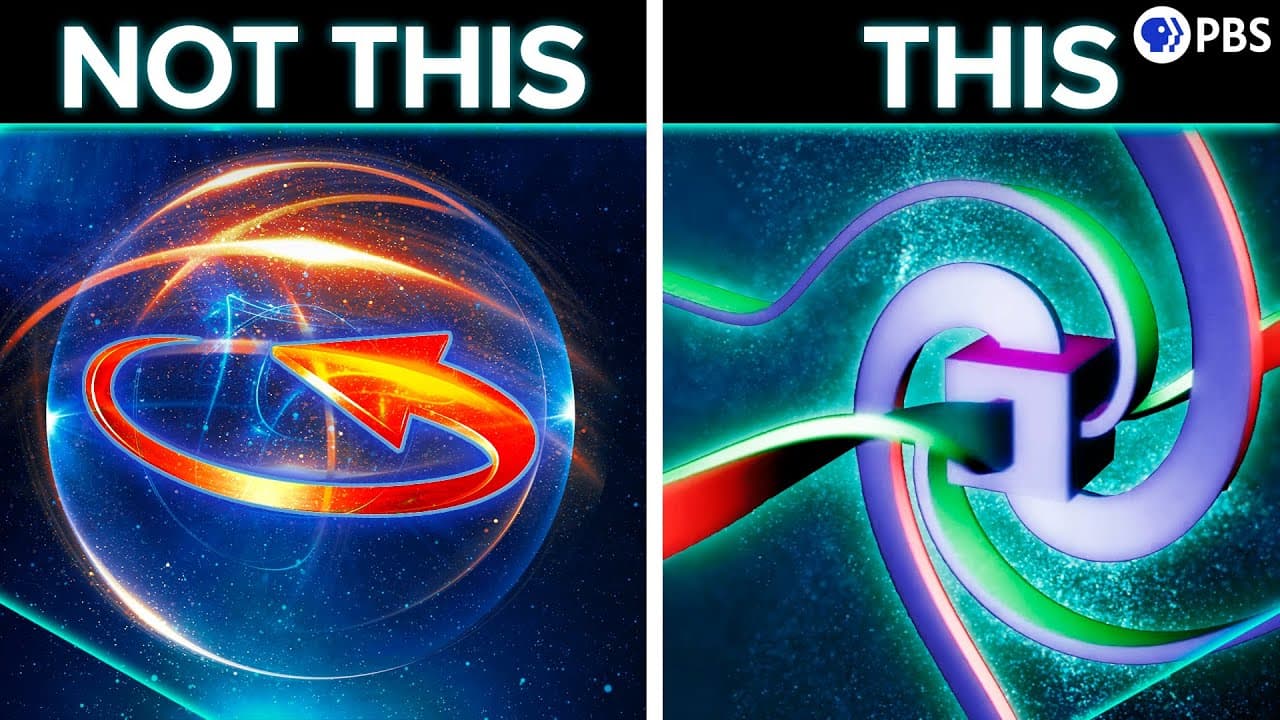
Electrons DO NOT Spin
TL;DR
Quantum spin is a fundamental yet mysterious property of particles.
Transcript
Quantum mechanics has a lot of weird stuff
- but there’s one thing that everyone agrees that no one understands. I’m talking about quantum spin. Let’s find out how chasing this elusive little behavior of the electron led us to some of the deepest insights into the nature of the quantum world. There’s a classic demonstration done in undergraduate p... Read More
Key Insights
- Quantum spin is not a classical rotation but an intrinsic property of particles like mass or charge.
- The Einstein de-Haas effect demonstrates how magnetization can lead to rotational motion, revealing quantum spin's peculiar nature.
- The Zeeman effect shows energy level splitting due to magnetic fields, hinting at spin's role in electron behavior.
- Wolfgang Pauli highlighted the impossibility of classical spinning for electrons, coining the term 'classically non-describable two-valuedness.'
- The Stern-Gerlach experiment demonstrated the quantized nature of spin, showing particles align in specific directions.
- Spinors, mathematical objects describing particles, require 720-degree rotation to return to the original state, unlike classical objects.
- Fermions, with half-integer spins, and bosons, with integer spins, exhibit different behaviors due to their spin properties.
- Spin statistics theorem explains how spin affects particle interactions, crucial for the structure of matter and reality.
Install to Summarize YouTube Videos and Get Transcripts
Explore YouTube Video Summarizer or Get YouTube Transcript Extractor
Questions & Answers
Q: What is quantum spin?
Quantum spin is an intrinsic property of particles that behaves like angular momentum but without classical rotation. It is a fundamental aspect of quantum mechanics, akin to mass or charge, and plays a crucial role in particle interactions and the structure of matter.
Q: How does the Einstein de-Haas effect demonstrate quantum spin?
The Einstein de-Haas effect shows that when a magnetic field magnetizes a cylinder, it begins to rotate. This occurs because the electrons' spins align, creating angular momentum that the cylinder compensates for. This demonstrates how quantum spin can influence macroscopic motion despite not being classical rotation.
Q: What did the Stern-Gerlach experiment reveal about spin?
The Stern-Gerlach experiment revealed that particles like electrons possess a quantized magnetic moment. When silver atoms were passed through a magnetic field, they deflected into discrete spots on a detector, indicating that spin can only take specific orientations, thus confirming its quantized nature.
Q: Why can't electrons be classical spinning objects?
Electrons cannot be classical spinning objects because if they were, they would need to spin faster than the speed of light to produce the observed magnetic moment. Additionally, electrons are point-like with no size, making classical rotation nonsensical, as pointed out by Wolfgang Pauli.
Q: What are spinors and how do they relate to quantum spin?
Spinors are mathematical objects used to describe particles with spin. Unlike classical vectors that return to their original state after a 360-degree rotation, spinors require a 720-degree rotation. This unique property highlights the non-classical nature of quantum spin and is essential in quantum mechanics.
Q: How do fermions and bosons differ in terms of spin?
Fermions have half-integer spins (e.g., 1/2), while bosons have integer spins (e.g., 0, 1). This difference leads to distinct behaviors: fermions obey the Pauli Exclusion Principle, preventing them from occupying the same quantum state, whereas bosons can occupy the same state, allowing phenomena like Bose-Einstein condensation.
Q: What is the significance of the spin statistics theorem?
The spin statistics theorem explains how the spin of particles influences their statistical behavior and interactions. It underpins the fundamental difference between fermions and bosons, affecting how matter is structured and how particles interact, which is crucial for understanding the universe's fabric.
Q: How does quantum spin relate to the structure of reality?
Quantum spin is a clue to the structure of matter and reality, as it affects particle interactions and the formation of matter. Spinors, which describe particles with spin, suggest that spin is a fundamental aspect of spacetime, potentially offering insights into the universe's underlying structure.
Summary & Key Takeaways
-
Quantum spin is a fundamental property of particles, distinct from classical rotation, crucial for understanding electron behavior.
-
Experiments like the Einstein de-Haas effect and Stern-Gerlach reveal the unique and quantized nature of spin.
-
Spinors describe particles' rotation, affecting interactions and the structure of matter through the spin statistics theorem.
Read in Other Languages (beta)
Share This Summary 📚
Summarize YouTube Videos and Get Video Transcripts with 1-Click
Try YouTube Summary with ChatGPT & Claude or YouTube Transcript Generator
Explore More Summaries from PBS Space Time 📚


Summarize YouTube Videos and Get Video Transcripts with 1-Click
Try YouTube Summary with ChatGPT & Claude or YouTube Transcript Generator