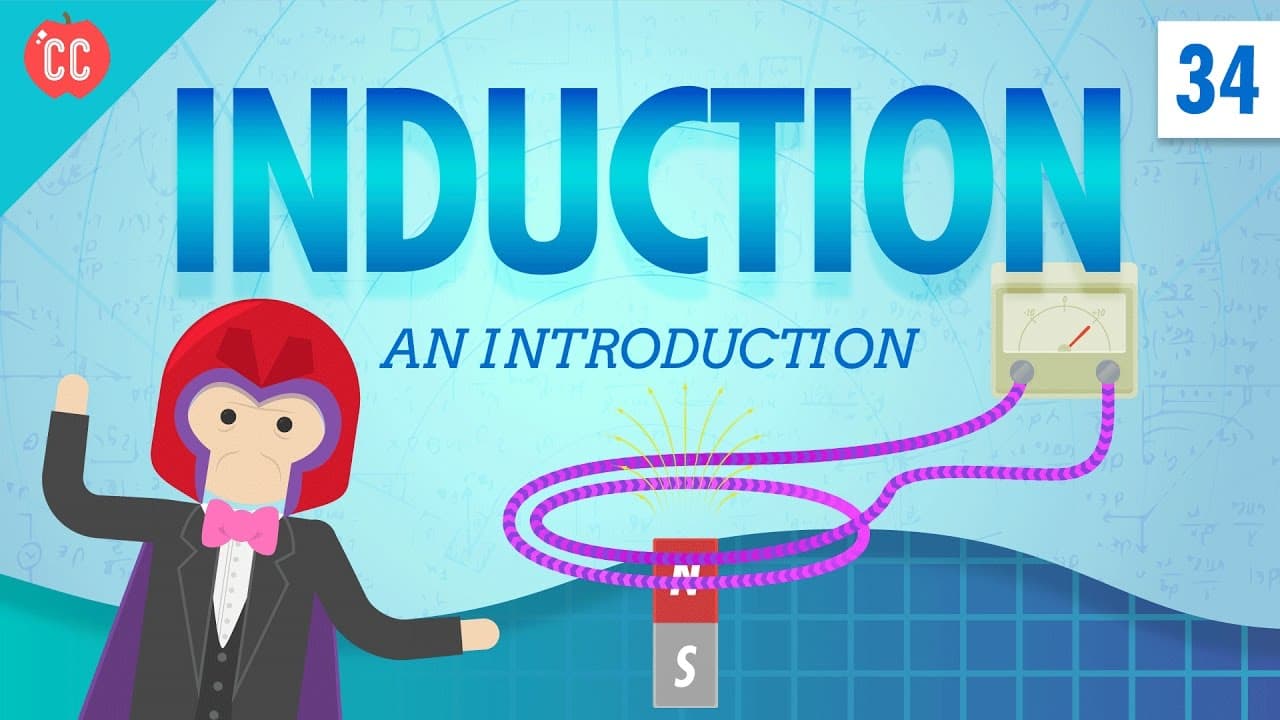
Induction - An Introduction: Crash Course Physics #34
TL;DR
Magnetic fields induce electric currents when they change over time.
Transcript
This episode is supported by Prudential. Physicists learned a lot about electricity and magnetism in the 19th century. We’ve already talked about one of the biggest discoveries – that electric currents can create magnetic fields. And once scientists had figured that out, they wondered if the opposite was also true. Could magnetic fields create – or... Read More
Key Insights
- Faraday's Law of Induction states that a changing magnetic field induces an electromotive force (emf) in a loop of wire, which can generate an electric current.
- Magnetic flux, represented by Φ_B, is a measure of the magnetic field through a loop of wire, and changes in magnetic flux induce emf.
- Three factors affect magnetic flux: the strength of the magnetic field (B), the area of the loop (A), and the angle (theta) between the magnetic field and the loop.
- Lenz's Law helps determine the direction of the induced current, stating that the magnetic field generated by the induced current opposes the change in magnetic flux.
- The induced emf in a coil of wire is equal to the number of loops times the change in magnetic flux over time, multiplied by a negative sign.
- Changing the area of the loop or the angle between the loop and the magnetic field can also induce an emf, even if the magnetic field strength remains constant.
- Magnetic induction is crucial for technologies like hard drives, where changing magnetic fields induce currents to read and write digital information.
- Understanding magnetic induction involves concepts like magnetic flux, emf, Lenz's Law, and the right-hand rule to predict current direction.
Install to Summarize YouTube Videos and Get Transcripts
Explore YouTube Video Summarizer or Get YouTube Transcript Extractor
Questions & Answers
Q: What is Faraday's Law of Induction?
Faraday's Law of Induction states that a changing magnetic field induces an electromotive force (emf) in a loop of wire. This principle explains how electric currents can be generated by varying magnetic fields, a discovery that has paved the way for numerous technological applications, including the functioning of electric generators and transformers.
Q: How does magnetic flux relate to emf?
Magnetic flux, denoted as Φ_B, is a measure of the magnetic field passing through a loop of wire. Changes in magnetic flux induce an electromotive force (emf) in the loop. The relationship is governed by Faraday's Law, which indicates that the emf is proportional to the rate of change of the magnetic flux over time.
Q: What factors affect magnetic flux?
Three primary factors affect magnetic flux: the strength of the magnetic field (B), the area of the loop (A), and the angle (theta) between the magnetic field and a line perpendicular to the loop. Changes in any of these factors can alter the magnetic flux, thereby inducing an electromotive force (emf) in the loop.
Q: How does Lenz's Law determine the direction of induced current?
Lenz's Law states that the direction of the induced current's magnetic field opposes the change in magnetic flux that produced it. This means that if the magnetic flux increases, the induced current generates a magnetic field that opposes the increase, and vice versa, ensuring energy conservation.
Q: How is the induced emf calculated for a coil of wire?
The induced emf in a coil of wire is calculated by multiplying the number of loops (N) by the change in magnetic flux over time, and then applying a negative sign. This formula accounts for the cumulative effect of each loop in the coil, as each loop experiences the same change in magnetic flux.
Q: How does changing the area of the loop affect emf?
Changing the area of the loop within a magnetic field affects the magnetic flux, which in turn induces an electromotive force (emf). If the area within the magnetic field changes, the flux changes, leading to an induced emf. This principle is crucial for understanding how devices like electric generators function.
Q: What role does magnetic induction play in hard drives?
Magnetic induction is fundamental to the operation of hard drives, particularly those with rotating disks. Information is stored by magnetizing sections of the disk. As the disk rotates, the changing magnetic fields induce currents in the read/write head, allowing computers to process the stored digital information.
Q: How does the right-hand rule help in determining current direction?
The right-hand rule is a mnemonic for determining the direction of current flow in a magnetic field. By pointing the thumb in the direction of the magnetic field generated by the induced current, the fingers indicate the direction of the current. This rule is essential for applying Lenz's Law and understanding electromagnetic interactions.
Summary & Key Takeaways
-
This Crash Course Physics episode explores magnetic induction, focusing on how changing magnetic fields induce electric currents. Faraday's discovery of this phenomenon led to significant technological advancements, such as hard drives. The episode explains key concepts like magnetic flux, Lenz's Law, and the right-hand rule for determining current direction.
-
Faraday's Law of Induction reveals that a changing magnetic field induces an electromotive force (emf) in a loop of wire. Magnetic flux, affected by field strength, loop area, and angle, plays a crucial role. The episode also discusses how these principles apply to modern technology, including data storage.
-
Understanding the direction of induced currents requires Lenz's Law, which states that the induced magnetic field opposes the change in magnetic flux. The episode illustrates these principles with practical scenarios and emphasizes their importance in devices like hard drives, where magnetic induction enables digital information processing.
Read in Other Languages (beta)
Share This Summary 📚
Summarize YouTube Videos and Get Video Transcripts with 1-Click
Try YouTube Summary with ChatGPT & Claude or YouTube Transcript Generator
Explore More Summaries from CrashCourse 📚






Summarize YouTube Videos and Get Video Transcripts with 1-Click
Try YouTube Summary with ChatGPT & Claude or YouTube Transcript Generator