How Does Time Travel Work in Physics?
TL;DR
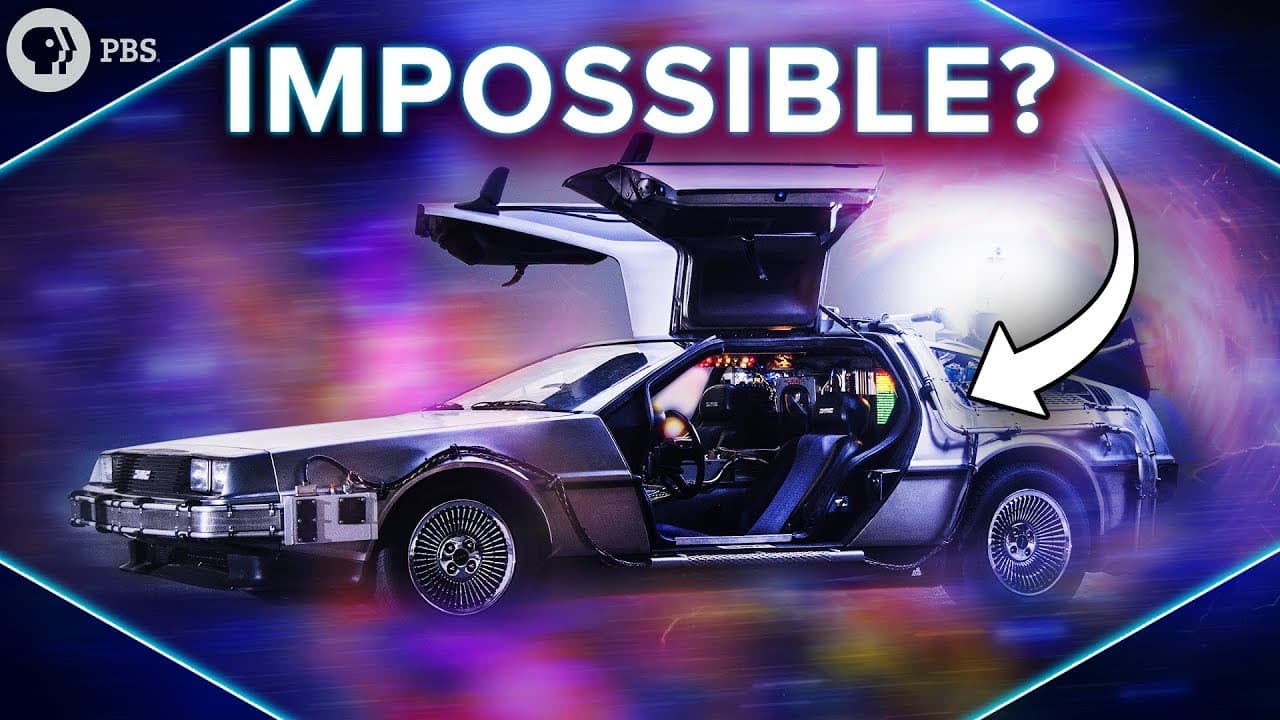
Time travel, while theoretically possible according to Einstein's theories of relativity, faces significant practical challenges. Special relativity allows for future time travel at different rates, but not backwards. General relativity suggests wormholes could enable time travel, but requires negative mass, which is not yet proven to exist. Current physics lacks a fundamental law prohibiting time travel, but paradoxes and causality issues remain unresolved.
Transcript
If time travel turns out to be possible, I hereby invite future time travelers to join me on set I’ll post the address one year from today. Okay. Right now. Well that's a bummer. Time travel stories are cool because both the past and future are somehow more interesting than the present and because everyone secretly wants a do-over. But so far it ap... Read More
Key Insights
- Einstein's theories of relativity allow for the possibility of time travel.
- Special relativity permits time travel to the future at different rates, but not backwards.
- Traveling faster than light could theoretically allow backward time travel, but requires infinite energy.
- Tachyons, hypothetical particles with imaginary mass, could travel faster than light, but lack evidence.
- Wormholes in general relativity could enable time travel but need negative mass to remain stable.
- Negative energy, as seen in the Casimir effect, might help stabilize wormholes, but large-scale application is unproven.
- The Tipler cylinder is a theoretical time machine requiring an infinitely long, rotating dense cylinder.
- Paradoxes like the grandfather paradox challenge time travel, but principles like Novikov Self-Consistency suggest self-consistent loops.
Install to Summarize YouTube Videos and Get Transcripts
Explore YouTube Video Summarizer or Get YouTube Transcript Extractor
Questions & Answers
Q: How does special relativity allow for time travel?
Special relativity allows for time travel to the future at different rates by describing how time intervals change depending on relative speeds. A fast-moving spaceship experiences time slower compared to someone on Earth. However, this results in a one-way trip to the future, not backward time travel.
Q: Why is faster-than-light travel significant for time travel?
Faster-than-light travel is significant because it theoretically enables backward time travel. As speeds exceed light, time could tick backward, allowing navigation to past points in spacetime. However, achieving such speeds requires infinite energy, making it practically impossible with current understanding.
Q: What are tachyons and their role in time travel?
Tachyons are hypothetical particles with imaginary mass that could travel faster than light, potentially enabling backward time travel. Despite being mathematically possible, there is no empirical evidence for their existence, and their role in practical time travel remains speculative.
Q: How could wormholes enable time travel?
Wormholes, hypothetical structures in general relativity, could create shortcuts in spacetime, allowing travel between distant points in time. To enable time travel, a wormhole's ends must be offset in time, achieved by accelerating one end. However, stabilizing a wormhole requires negative mass, which is not proven to exist.
Q: What is negative energy and its relevance to time travel?
Negative energy, like that seen in the Casimir effect, might help stabilize wormholes for time travel. It involves lowering energy density in a vacuum, but scaling this effect to maintain a large wormhole remains unproven. Negative energy is crucial for counteracting gravitational forces that collapse wormholes.
Q: What is the Tipler cylinder and its significance?
The Tipler cylinder is a theoretical time machine concept involving an infinitely long, rotating dense cylinder. Its rotation drags spacetime into a vortex, creating closed timelike curves for backward time travel. However, practical construction is impossible without infinite length or modifying spacetime with negative energy.
Q: What are time travel paradoxes and how are they addressed?
Time travel paradoxes, like the grandfather paradox, challenge causality by allowing events that could prevent their own occurrence. The Novikov Self-Consistency Principle suggests closed timelike curves are possible if they are self-consistent, meaning backward travel leads to the same future configuration, avoiding contradictions.
Q: Why is time travel considered impossible by many physicists?
Many physicists consider time travel impossible due to the absence of time travelers and the potential for causality paradoxes. While no fundamental law prohibits time travel, its challenges remain unresolved. Theories like the Chronology Protection Conjecture suggest physics will prevent paradoxes, maintaining logical consistency in the universe.
Summary & Key Takeaways
-
Time travel is theoretically possible under Einstein's relativity, which allows for different rates of time passage based on speed. However, practical backward time travel faces hurdles, such as the need for negative mass to stabilize wormholes. Current physics doesn't prohibit time travel, but paradoxes challenge its feasibility.
-
Special relativity allows for future-directed time travel at varying rates, but backward time travel requires faster-than-light travel, which demands infinite energy. Tachyons, particles with imaginary mass, could theoretically travel faster than light, yet lack empirical evidence.
-
General relativity suggests wormholes could enable time travel if stabilized with negative mass, a concept not yet proven. The Tipler cylinder, another theoretical time machine, requires an infinitely long rotating cylinder. Time travel paradoxes remain unresolved, though principles like Novikov's offer potential solutions.
Read in Other Languages (beta)
Share This Summary 📚
Summarize YouTube Videos and Get Video Transcripts with 1-Click
Try YouTube Summary with ChatGPT & Claude or YouTube Transcript Generator
Explore More Summaries from PBS Space Time 📚
Summarize YouTube Videos and Get Video Transcripts with 1-Click
Try YouTube Summary with ChatGPT & Claude or YouTube Transcript Generator