Life on Europa?
TL;DR
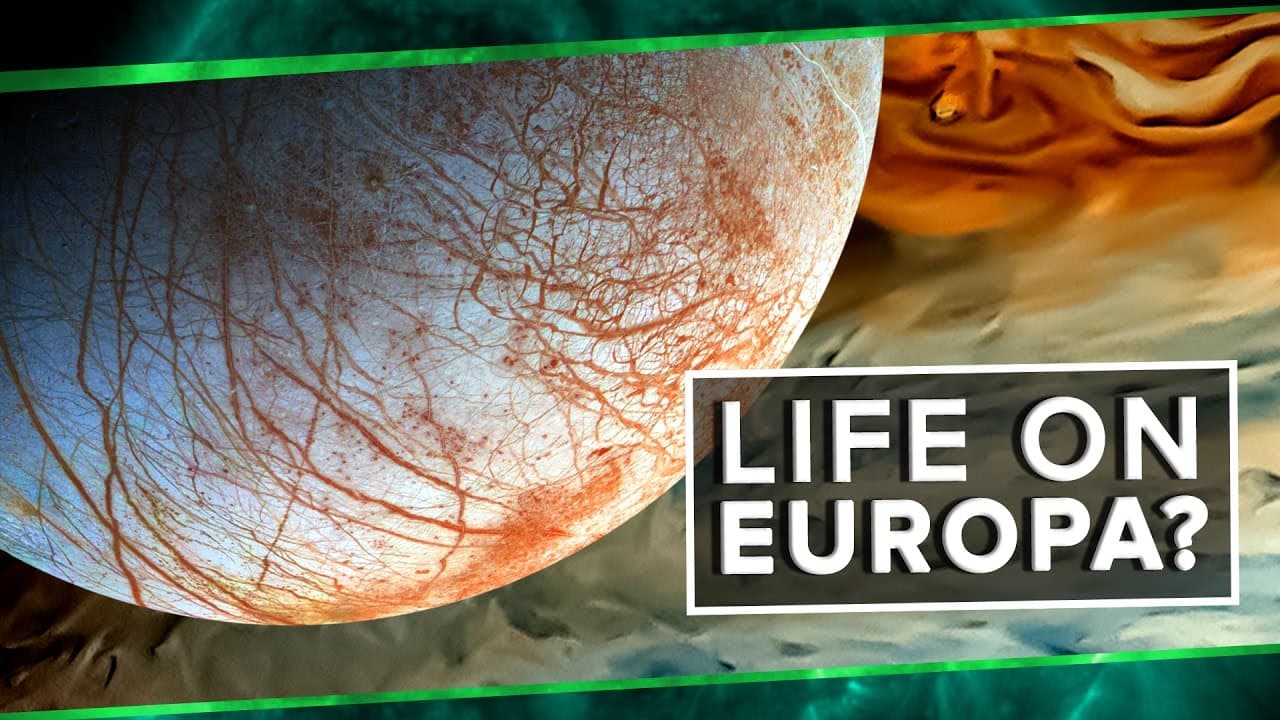
Evidence suggests Europa may harbor life beneath its icy surface.
Transcript
[MUSIC PLAYING] This week NASA announced even more evidence of plumes erupting from the surface of Jupiter's moon Europa. We're becoming increasingly sure that there's a vast ocean of water beneath Europa's icy crust. But does that ocean have a life? [MUSIC PLAYING] This new evidence of water plumes was found by the Hubble Space Telescope, which to... Read More
Key Insights
- NASA's Hubble Space Telescope has detected water plumes on Europa, indicating a subsurface ocean beneath its icy crust.
- Europa is considered a prime candidate for extraterrestrial life due to its potential ocean and energy sources from tidal interactions with Jupiter.
- The presence of reddish-brown material on Europa's surface suggests possible sea salt deposits, hinting at oceanic interactions with the rocky interior.
- Hydrothermal vents on Europa, if present, could provide energy and minerals necessary for life, similar to Earth's deep-sea ecosystems.
- The iron-sulfur world hypothesis suggests life on Earth may have originated around hydrothermal vents, providing a model for potential life on Europa.
- Europa's ocean is estimated to be 100 kilometers deep, making exploration challenging but possible with future missions like NASA's Europa Clipper.
- Detection of specific molecules in Europa's water plumes could indicate biological processes, offering indirect evidence of life.
- Congress's mandate for a lander complicates NASA's Europa mission, but additional funding may accelerate exploration efforts.
Install to Summarize YouTube Videos and Get Transcripts
Explore YouTube Video Summarizer or Get YouTube Transcript Extractor
Questions & Answers
Q: What evidence suggests Europa may have a subsurface ocean?
The Hubble Space Telescope detected water plumes erupting from Europa's surface, indicating a subsurface ocean beneath its icy crust. These observations were made as Europa passed in front of Jupiter, with the plumes blocking some of Jupiter's light. This finding, along with previous detections of hydrogen and oxygen ions, supports the existence of a vast ocean.
Q: Why is Europa considered a prime candidate for extraterrestrial life?
Europa is considered a prime candidate for extraterrestrial life due to the presence of a subsurface ocean, potential hydrothermal vents, and energy from tidal interactions with Jupiter. These conditions are similar to those on Earth, where life thrives around deep-sea hydrothermal vents, suggesting that Europa could host similar ecosystems.
Q: What challenges do scientists face in exploring Europa's ocean?
Exploring Europa's ocean presents challenges due to its estimated depth of 100 kilometers and the thick icy crust covering it. Reaching the ocean floor to study potential hydrothermal vents requires advanced technology and long-duration missions. NASA's Europa Clipper mission aims to address these challenges with high-resolution imaging and radar mapping.
Q: How could hydrothermal vents on Europa support life?
Hydrothermal vents on Europa could support life by providing energy and minerals essential for biological processes. Similar to Earth's deep-sea ecosystems, these vents could host life forms that extract energy from chemicals like hydrogen sulfide. The iron-sulfur world hypothesis suggests that life on Earth may have originated around such vents, offering a model for potential life on Europa.
Q: What role does Europa's surface material play in the search for life?
Europa's surface material, particularly the reddish-brown gunk, may indicate sea salt deposits from oceanic interactions. This suggests that the ocean is in contact with the rocky interior, a crucial factor for life. Studying these surface materials can provide insights into the ocean's composition and potential biological processes.
Q: What is the significance of detecting specific molecules in Europa's water plumes?
Detecting specific molecules in Europa's water plumes could provide evidence of biological processes. Molecules such as isotopic ratios and chirality of certain compounds can indicate the presence of life. By analyzing these plumes, scientists can gather indirect evidence of life without directly accessing the subsurface ocean.
Q: How has Congress influenced NASA's Europa exploration plans?
Congress has influenced NASA's Europa exploration plans by providing additional funding and mandating the inclusion of a lander in the mission. This adds complexity and development time but accelerates efforts to explore Europa. NASA may conduct separate missions to scout landing sites and deploy the lander, balancing congressional requirements with scientific goals.
Q: What future missions are planned to explore Europa?
NASA's Europa Clipper mission, expected to launch in the 2020s, aims to explore Europa with high-resolution imaging, radar mapping, and chemical analysis of the surface and plumes. Congress's mandate for a lander may lead to separate missions, enhancing our understanding of Europa's potential for life and guiding future exploration efforts.
Summary & Key Takeaways
-
NASA's Hubble Space Telescope has observed water plumes on Jupiter's moon Europa, suggesting a vast subsurface ocean. The potential for life is increased by the presence of water and possible hydrothermal vents, similar to Earth's deep-sea ecosystems. Future missions aim to explore Europa's ocean and search for signs of life.
-
Europa's surface features, such as reddish-brown material, may indicate sea salt deposits from oceanic interactions. This, along with energy from tidal forces, makes Europa a promising location for extraterrestrial life. Detecting specific molecules in the water plumes could provide evidence of biological processes.
-
Exploration of Europa faces challenges due to its deep ocean and icy crust. NASA's Europa Clipper mission, possibly including a lander, aims to study the moon's surface and interior. Congress's additional funding may expedite these efforts, potentially revealing Europa's secrets within the next decade.
Read in Other Languages (beta)
Share This Summary 📚
Summarize YouTube Videos and Get Video Transcripts with 1-Click
Try YouTube Summary with ChatGPT & Claude or YouTube Transcript Generator
Explore More Summaries from PBS Space Time 📚


Summarize YouTube Videos and Get Video Transcripts with 1-Click
Try YouTube Summary with ChatGPT & Claude or YouTube Transcript Generator