How Do Steam Engines Convert Heat to Work?
TL;DR
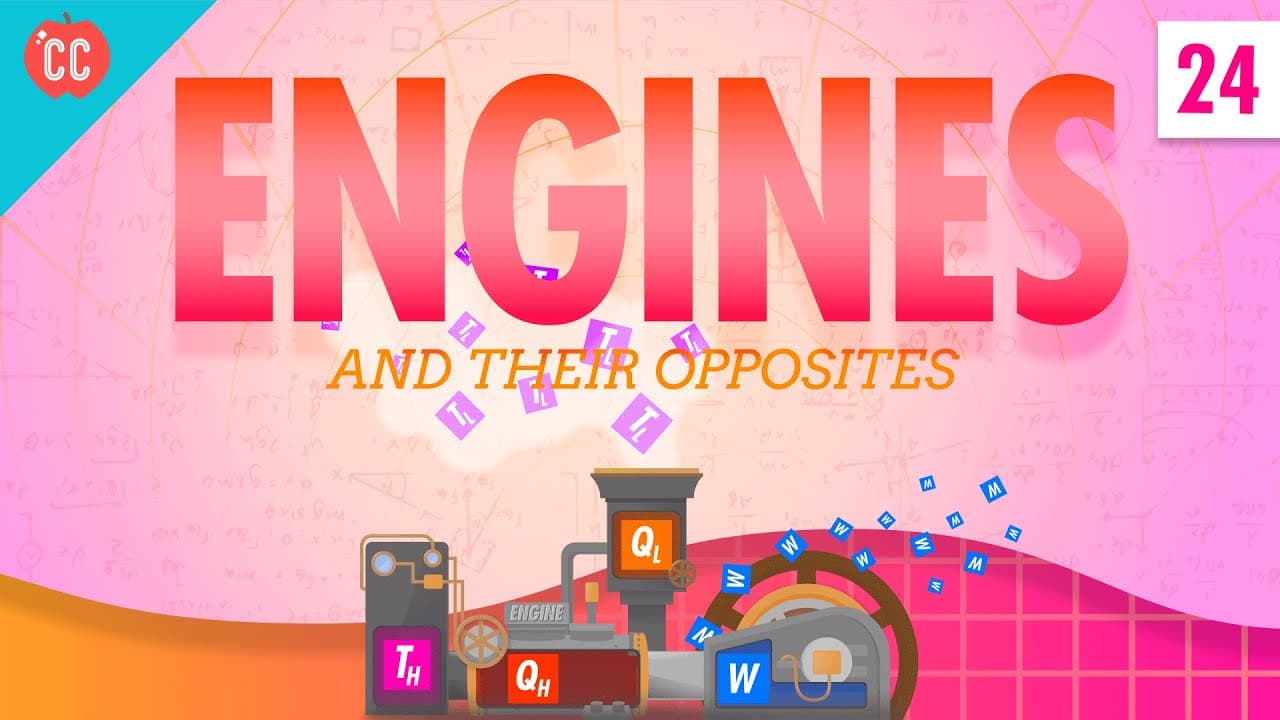
Steam engines convert thermal energy into mechanical work through a cycle of heating and cooling. The efficiency of an engine is determined by how much input heat is converted to work versus exhaust heat. The Carnot engine represents an ideal with maximum efficiency, though it's hypothetical. Real engines and cooling machines like refrigerators utilize these principles to function effectively.
Transcript
Think of all of the developments throughout history that led to the conveniences you enjoy today. If I had to pick the biggest game-changer in human technology, it would probably be the steam engine. During the industrial revolution, the steam engine powered machines in farms and factories. And, although it may not seem so, those advances eventuall... Read More
Key Insights
- Steam engines convert thermal energy into mechanical work through a repeating cycle of heating and cooling.
- The efficiency of an engine is determined by the ratio of work done to input heat, minus exhaust heat.
- A Carnot engine is a theoretical model that represents the maximum possible efficiency for heat engines.
- The Carnot cycle includes two adiabatic and two isothermal processes, maintaining constant temperature or heat.
- Real-life engines cannot exceed the efficiency of a Carnot engine due to practical limitations like friction.
- Refrigerators and air conditioners reverse the heat flow using work, moving heat from cooler to warmer areas.
- The coefficient of performance (COP) measures efficiency for cooling machines, similar to engine efficiency.
- Understanding steam engines led to the development of refrigerators, showcasing the application of thermodynamic principles.
Install to Summarize YouTube Videos and Get Transcripts
Explore YouTube Video Summarizer or Get YouTube Transcript Extractor
Questions & Answers
Q: How do steam engines convert heat into work?
Steam engines convert heat into work by using thermal energy to heat water, turning it into steam. The steam expands and moves pistons, performing mechanical work. The cycle involves heating, expansion, and the release of exhaust heat, allowing the engine to repeat the process. Efficiency depends on the balance between input heat and exhaust heat.
Q: What is the efficiency of a steam engine?
The efficiency of a steam engine is determined by the ratio of work done to input heat, minus the exhaust heat. It is calculated as 1 minus the ratio of exhaust heat to input heat. An engine's efficiency reflects how effectively it converts input heat into work, with less exhaust heat indicating higher efficiency.
Q: What is a Carnot engine?
A Carnot engine is a theoretical model representing the maximum possible efficiency for a heat engine. It operates on the Carnot cycle, which includes two adiabatic and two isothermal processes. The Carnot engine is idealized, with no friction or waste heat, serving as a benchmark for real engine efficiency, though it cannot be practically achieved.
Q: How does the Carnot cycle work?
The Carnot cycle consists of two adiabatic and two isothermal processes. In isothermal processes, the temperature is constant while heat is added or removed, causing volume and pressure changes. In adiabatic processes, the temperature changes without heat transfer. This cycle theoretically achieves maximum efficiency by avoiding heat flow between areas of different temperatures.
Q: Why can't real engines achieve Carnot efficiency?
Real engines cannot achieve Carnot efficiency due to practical limitations like friction, heat losses, and material constraints. The Carnot engine is an idealized model without these inefficiencies. Real engines must deal with unavoidable energy losses, making it impossible to reach the theoretical maximum efficiency represented by the Carnot cycle.
Q: How do refrigerators and air conditioners work?
Refrigerators and air conditioners work by reversing the natural flow of heat, using work to move heat from cooler to warmer areas. They circulate a refrigerant that absorbs heat inside, then expels it outside. This process, driven by a motor, is the reverse of a heat engine, and its efficiency is measured by the coefficient of performance (COP).
Q: What is the coefficient of performance (COP) in cooling machines?
The coefficient of performance (COP) measures the efficiency of cooling machines like refrigerators and air conditioners. It is the ratio of heat removed from the lower temperature zone to the work input. A higher COP indicates more efficient cooling, as more heat is removed for the same amount of work. It parallels engine efficiency but applies to cooling systems.
Q: How did steam engines influence the development of refrigerators?
Steam engines influenced the development of refrigerators by providing foundational knowledge of thermodynamics and heat transfer. The principles used in steam engines, such as converting heat to work and understanding efficiency, were applied to reverse the heat flow in cooling machines. This led to innovations in refrigeration and air conditioning technology, showcasing the broader impact of steam engine advancements.
Summary & Key Takeaways
-
Steam engines operate by converting thermal energy into mechanical work, using a cycle of heating water into steam, expanding it to move pistons, and releasing exhaust heat. Efficiency is a key focus, calculated by the ratio of work done to input heat. An ideal engine, the Carnot engine, serves as a theoretical model for maximum efficiency.
-
The Carnot cycle, comprising adiabatic and isothermal processes, illustrates the ideal efficiency of heat engines, though no real engine can achieve this due to practical factors like friction. Refrigerators and air conditioners apply similar principles, using work to move heat from cooler to warmer areas, with efficiency measured by the coefficient of performance.
-
The development of steam engines paved the way for advances in cooling technology, demonstrating the broader impact of understanding thermodynamics. Both engines and refrigerators rely on the conversion and transfer of heat, highlighting the importance of efficiency in energy use and technological innovation.
Read in Other Languages (beta)
Share This Summary 📚
Summarize YouTube Videos and Get Video Transcripts with 1-Click
Try YouTube Summary with ChatGPT & Claude or YouTube Transcript Generator
Explore More Summaries from CrashCourse 📚






Summarize YouTube Videos and Get Video Transcripts with 1-Click
Try YouTube Summary with ChatGPT & Claude or YouTube Transcript Generator