What Were Isaac Newton's Major Contributions to Science?
TL;DR
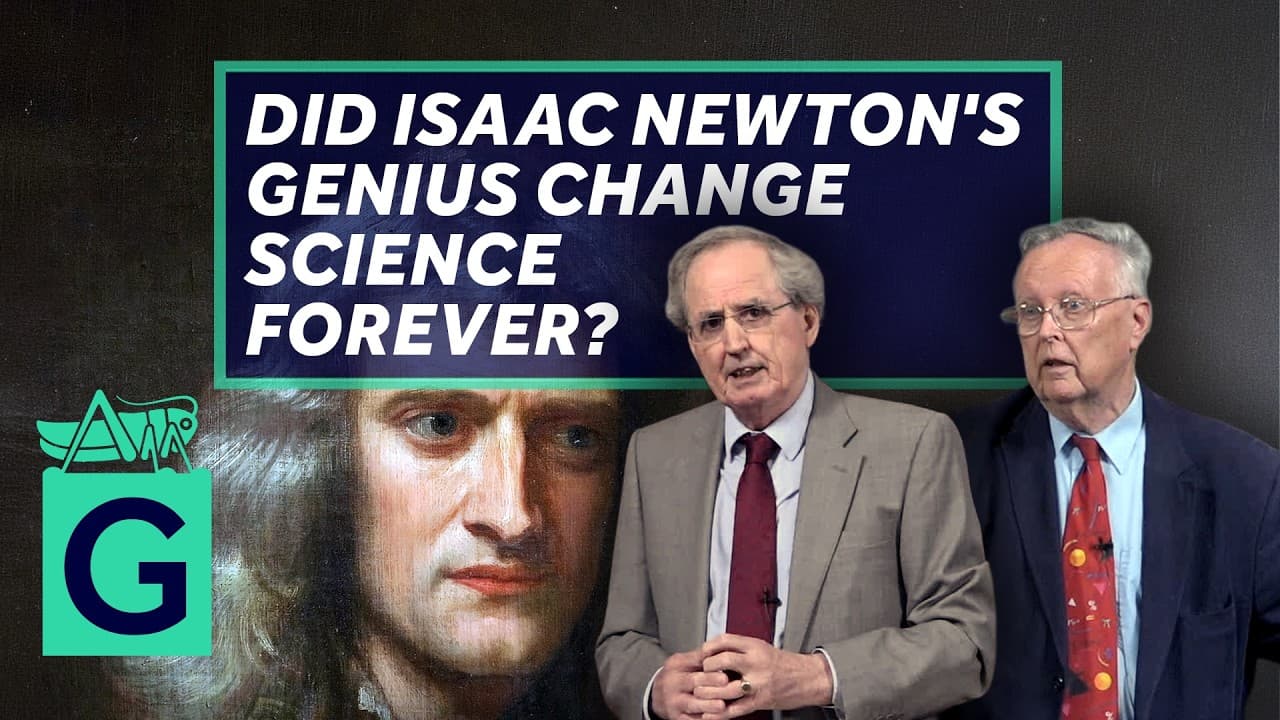
Isaac Newton made groundbreaking contributions to mathematics, physics, and astronomy, including the laws of motion and universal gravitation, which laid the foundation for classical mechanics. His work in optics led to the invention of the reflecting telescope and an understanding of light's composition. Newton's multidisciplinary approach also included alchemy and religious studies, solidifying his legacy as one of history's greatest scientific minds.
Transcript
- Before we begin this lecture Raymond Floods, and I was sad to learn of the death, two days ago, of Professor John Barrow. John was one of only two people in history to have held to Gresham chairs in astronomy and geometry. The other person being back in the 17th century. John was my successor as Gresham professor of geometry and Raymond's predece... Read More
Key Insights
- 👖 Isaac Newton's contributions spanned various scientific disciplines, including mathematics, physics, astronomy, and optics.
- 💦 Newton's groundbreaking work on gravitation and the laws of motion laid the foundation for classical mechanics.
- 🙂 His study of light and color led to the development of the Newtonian telescope and a deeper understanding of optics.
- ❓ Newton's interest in alchemy and his exploration of religious texts demonstrated his multidisciplinary approach to knowledge.
- 🌍 His legacy as a scientific genius has been recognized through statues, banknotes, coins, and postage stamps around the world.
- 🤔 Newton's impact on scientific thinking extended beyond his lifetime, with his ideas continuing to shape our understanding of the physical world.
- 🎙️ More videos with Isaac Newton:
Install to Summarize YouTube Videos and Get Transcripts
Explore YouTube Video Summarizer or Get YouTube Transcript Extractor
Questions & Answers
Q: What are some of the topics covered in this comprehensive analysis of Sir Isaac Newton?
This analysis covers Newton's early years during the English Civil War, his education in Grantham and Cambridge, his major works such as the Principia and Optics, as well as his involvement in alchemy and divinity.
Q: How did Newton's contributions to mathematics and optics impact the scientific community?
Newton's work in mathematics included his development of calculus, which laid the groundwork for many branches of modern mathematics. His study of optics led to the discovery that white light is composed of different colors, and he invented the reflecting telescope.
Q: What were some of Newton's achievements during his time at the Royal Mint in London?
Newton, as the Warden and later the Master of the Mint, resolved monetary crises and reduced counterfeiting. He also designed medals to commemorate significant events, such as Queen Anne's coronation.
Q: How did Newton's views on religion and alchemy influence his work?
Newton had unconventional religious views, rejecting the doctrine of the Trinity. His exploration of alchemy influenced his understanding of chemistry and led to advancements in experimental science.
Summary & Key Takeaways
-
Sir Isaac Newton, England's greatest scientist and mathematician, lived from 1642 to 1727. He made significant contributions in various fields, such as gravitation, optics, mathematics, alchemy, and divinity.
-
Newton's early years were marked by turmoil, including the English Civil War and the execution of King Charles I. He grew up in Lincolnshire and displayed early interest in making things and performing experiments.
-
After attending school in Grantham, Newton returned to Cambridge University and eventually became the Lucasian Professor of Mathematics. He published his groundbreaking work, "Mathematical Principles of Natural Philosophy," or the Principia, in 1687.
Read in Other Languages (beta)
Share This Summary 📚
Summarize YouTube Videos and Get Video Transcripts with 1-Click
Try YouTube Summary with ChatGPT & Claude or YouTube Transcript Generator
Explore More Summaries from Gresham College 📚

Summarize YouTube Videos and Get Video Transcripts with 1-Click
Try YouTube Summary with ChatGPT & Claude or YouTube Transcript Generator