Products
Features
YouTube Video Summarizer
Summarize YouTube videos
Web & PDF Highlighter
Highlight web pages & PDFs
Chat with PDF
Ask any PDF questions with AI
Ask AI Clone
Chat with your highlights & memories
Audio Transcriber
Transcribe audio files to text
Glasp Reader
Read and highlight articles
Kindle Highlight Export
Export your Kindle highlights
Idea Hatch
Hatch ideas from your highlights
Integrations
Obsidian Plugin
Notion Integration
Pocket Integration
Instapaper Integration
Medium Integration
Readwise Integration
Snipd Integration
Hypothesis Integration
Apps & Extensions
Chrome Extension
Safari Extension
Edge Add-ons
Firefox Add-ons
iOS App
Android App
Discover
Discover
Ideas
Discover new ideas and insights
Articles
Curated articles and insights
Books
Book recommendations by great minds
Posts
Essays and notes from readers
Quotes
Inspiring quotes collection
Videos
Curated videos and summaries
Explore Glasp
Glasp Newsletter
Weekly insights and updates
Glasp Talk
Interview series with great minds
Glasp Blog
Latest news and articles
Glasp Use Cases
Learn how others use Glasp
Build & Support
Glasp API
Access Glasp's API for developers
MCP Connector
Connect Glasp to Claude & ChatGPT
Community
Glasp Reddit Community
Students
Student discount and benefits
FAQs
Frequently Asked Questions
AboutPricing
DashboardLog inSign up

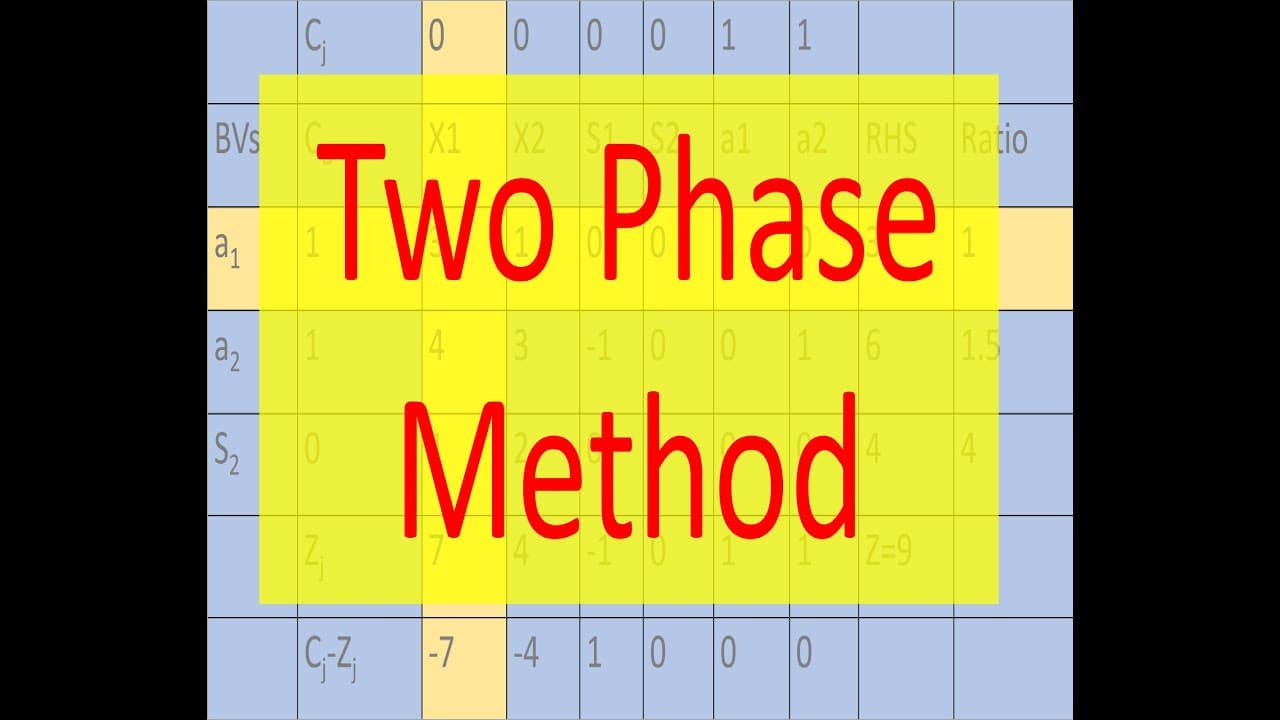
Operation Research 11: Linear Programming Solution: Two phase method

2.0K views
•
December 29, 2021
by
Solomon Getachew
YouTube video player
Operation Research 11: Linear Programming Solution: Two phase method

TL;DR

This lesson explains how to solve linear programming problems involving greater than or equal to and equal to constraints using the two-phase method.

Transcript

hello everybody and welcome to lesson 9 linear programming solution using two-phase method the objective of this lesson is to solve the linear programming problem using two-phase method as we know the simplex method algorithm requires an initial basis feasible solution initial basic visible solution is the slack variables put on the columns of the ... Read More

Key Insights

  • 🟰 The two-phase method is used to solve linear programming problems with constraints involving greater than or equal to and equal to inequalities.
  • 🛰️ In phase one, the objective is to minimize the artificial variables until they become zero.
  • ➖ Optimal solutions are achieved when the cj minus zj values are greater than or equal to zero.
  • 🤨 The two-phase method involves standardizing the constraints, introducing artificial variables, and conducting row operations to obtain the optimal solution.
  • ↗️ The pivot column is determined based on the maximum negative value in the cj minus zj row, while the pivot row is determined by the least positive ratio of the right-hand side with the values in the pivot column.
  • 🛰️ After phase one, the artificial variables are eliminated, and the original problem is solved in phase two.
  • ➖ The optimality of the solution in phase two is checked using the cj minus zj values, with negative or zero values indicating optimality.

Install to Summarize YouTube Videos and Get Transcripts

Explore YouTube Video Summarizer or Get YouTube Transcript Extractor

Summary & Key Takeaways

  • The two-phase method is used to solve linear programming problems with greater than or equal to and equal to constraints.

  • The first step is to bring the constraints into equality form and introduce artificial variables.

  • In phase one, the goal is to minimize the sum of the artificial variables until they become zero. In phase two, the original problem is solved starting from the basic feasible solution found in phase one.


Read in Other Languages (beta)

English

Share This Summary 📚

Summarize YouTube Videos and Get Video Transcripts with 1-Click

Download browser extensions on:

Try YouTube Summary with ChatGPT & Claude or YouTube Transcript Generator

Explore More Summaries from Solomon Getachew 📚
Adopting | Adapting | Developing Measuring Instrument thumbnail
Adopting | Adapting | Developing Measuring Instrument
Solomon Getachew
Chapter 1: Operation Management Overview thumbnail
Chapter 1: Operation Management Overview
Solomon Getachew
Inferential Statistics: T Test ANOVA, Correlation, Chi Square, Simple Multiple & Logistic Regression thumbnail
Inferential Statistics: T Test ANOVA, Correlation, Chi Square, Simple Multiple & Logistic Regression
Solomon Getachew
How Does the Big M Method Solve Linear Programming? thumbnail
How Does the Big M Method Solve Linear Programming?
Solomon Getachew
How to Determine Sample Size for Research thumbnail
How to Determine Sample Size for Research
Solomon Getachew
Chapter 1: 2-Economic agents and Circular flow of Economic Activities thumbnail
Chapter 1: 2-Economic agents and Circular flow of Economic Activities
Solomon Getachew

Summarize YouTube Videos and Get Video Transcripts with 1-Click

Download browser extensions on:

Try YouTube Summary with ChatGPT & Claude or YouTube Transcript Generator

Apps & Extensions

  • Chrome Extension
  • Safari Extension
  • Edge Add-ons
  • Firefox Add-ons
  • iOS App
  • Android App

Key Features

  • YouTube Video Summarizer
  • Web & PDF Summarizer
  • Web & PDF Highlighter
  • Chat with PDF
  • Ask AI Clone
  • Audio Transcriber
  • Glasp Reader
  • Kindle Highlight Export
  • Idea Hatch

Integrations

  • Obsidian Plugin
  • Notion Integration
  • Pocket Integration
  • Instapaper Integration
  • Medium Integration
  • Readwise Integration
  • Snipd Integration
  • Hypothesis Integration

More Features

  • APIs
  • MCP Connector
  • Blog & Post
  • Embed Links
  • Image Highlight
  • Personality Test
  • Quote Shots

Company

  • About us
  • Blog
  • Community
  • FAQs
  • Job Board
  • Newsletter
  • Pricing
Terms

•

Privacy

•

Guidelines

© 2026 Glasp Inc. All rights reserved.