Products
Features
YouTube Video Summarizer
Summarize YouTube videos
Web & PDF Highlighter
Highlight web pages & PDFs
Chat with PDF
Ask any PDF questions with AI
Ask AI Clone
Chat with your highlights & memories
Audio Transcriber
Transcribe audio files to text
Glasp Reader
Read and highlight articles
Kindle Highlight Export
Export your Kindle highlights
Idea Hatch
Hatch ideas from your highlights
Integrations
Obsidian Plugin
Notion Integration
Pocket Integration
Instapaper Integration
Medium Integration
Readwise Integration
Snipd Integration
Hypothesis Integration
Apps & Extensions
Chrome Extension
Safari Extension
Edge Add-ons
Firefox Add-ons
iOS App
Android App
Discover
Discover
Ideas
Discover new ideas and insights
Articles
Curated articles and insights
Books
Book recommendations by great minds
Posts
Essays and notes from readers
Quotes
Inspiring quotes collection
Videos
Curated videos and summaries
Explore Glasp
Glasp Story
How we grew from 0 to 3 million users
Glasp Newsletter
Weekly insights and updates
Glasp Talk
Interview series with great minds
Glasp Blog
Latest news and articles
Glasp Use Cases
Learn how others use Glasp
Build & Support
Glasp API
Access Glasp's API for developers
MCP Connector
Connect Glasp to Claude & ChatGPT
Community
Glasp Reddit Community
Students
Student discount and benefits
FAQs
Frequently Asked Questions
AboutPricing
DashboardLog inSign up

What Are M0, M1, and M2 in Money Supply?
March 23, 2012
by
Khan Academy
YouTube video player
What Are M0, M1, and M2 in Money Supply?

TL;DR

M0 represents base money, the physical currency and reserves held by central banks. M1 includes M0 plus checkable deposits like checking accounts, while M2 encompasses M1 along with easily convertible assets like savings accounts. Understanding these measures is key to grasping economic activity and the role of monetary policy.

Transcript

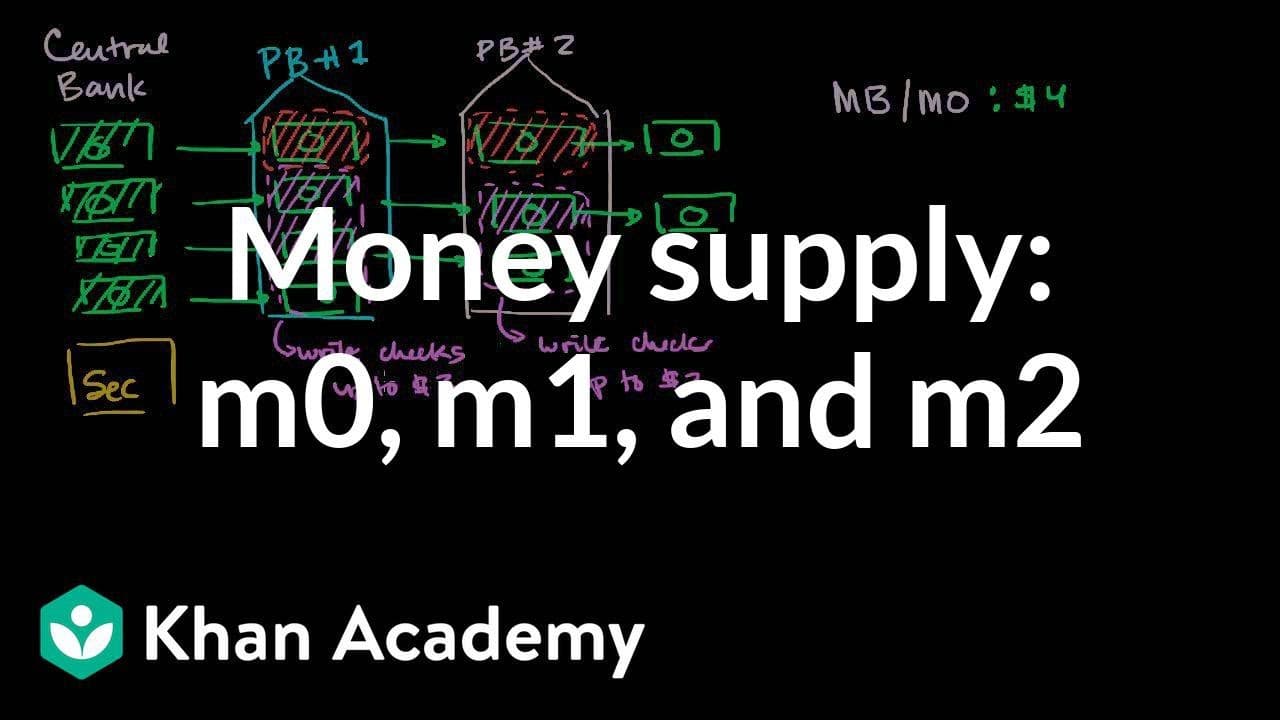
What I want to explore in this video is the different ways of measuring the amount of money we have in circulation. So we're going to start things with our Central Bank in the US. This would be the US Federal Reserve. And let's say that they print $4. And we're going to focus, just for visualization purposes, on that they're doing it physically. Th... Read More

Key Insights

  • 🤑 The money supply can be measured in different ways, including base money (M0), narrow money (M1), and broad money (M2).
  • 🤑 Physical currency and checkable deposits are part of narrow money (M1), representing easily usable forms of money.
  • 🤑 Savings accounts and other assets that can be converted to M1 are included in broad money (M2).
  • 💵 The money supply affects economic activity and is influenced by the actions of central banks and commercial banks.
  • 💵 The fractional reserve system allows banks to lend out a portion of the deposits they receive, increasing the overall money supply.
  • 🤑 Different countries may have variations in their definitions and measurements of the money supply.
  • 🤑 The money supply is an important factor considered by policymakers in managing inflation and stabilizing the economy.

Install to Summarize YouTube Videos and Get Transcripts

Explore YouTube Video Summarizer or Get YouTube Transcript Extractor

Summary & Key Takeaways

  • The US Federal Reserve prints $4 in physical currency and buys safe and liquid securities in the open market.

  • The purchased securities are deposited in a private bank, where $3 is kept in a checking account and $1 is placed in a savings account.

  • The private bank can lend out $2, which is deposited in another private bank, and the process repeats, with money being transferred between banks and individuals.


Read in Other Languages (beta)

English

Share This Summary 📚

Summarize YouTube Videos and Get Video Transcripts with 1-Click

Download browser extensions on:

Try YouTube Summary with ChatGPT & Claude or YouTube Transcript Generator

Explore More Summaries from Khan Academy 📚
Producer surplus | Consumer and producer surplus | Microeconomics | Khan Academy thumbnail
Producer surplus | Consumer and producer surplus | Microeconomics | Khan Academy
Khan Academy
Synthetic division | Polynomial and rational functions | Algebra II | Khan Academy thumbnail
Synthetic division | Polynomial and rational functions | Algebra II | Khan Academy
Khan Academy
2015 AP Calculus BC 5a | AP Calculus BC solved exams | AP Calculus BC | Khan Academy thumbnail
2015 AP Calculus BC 5a | AP Calculus BC solved exams | AP Calculus BC | Khan Academy
Khan Academy
Examples establishing conditions for MVT thumbnail
Examples establishing conditions for MVT
Khan Academy
How to Measure the Energy Content of Foods with Calorimetry thumbnail
How to Measure the Energy Content of Foods with Calorimetry
Khan Academy
Mistakes when finding inflection points: not checking candidates | AP Calculus AB | Khan Academy thumbnail
Mistakes when finding inflection points: not checking candidates | AP Calculus AB | Khan Academy
Khan Academy

Summarize YouTube Videos and Get Video Transcripts with 1-Click

Download browser extensions on:

Try YouTube Summary with ChatGPT & Claude or YouTube Transcript Generator

Apps & Extensions

  • Chrome Extension
  • Safari Extension
  • Edge Add-ons
  • Firefox Add-ons
  • iOS App
  • Android App

Key Features

  • YouTube Video Summarizer
  • Web & PDF Summarizer
  • Web & PDF Highlighter
  • Chat with PDF
  • Ask AI Clone
  • Audio Transcriber
  • Glasp Reader
  • Kindle Highlight Export
  • Idea Hatch

Integrations

  • Obsidian Plugin
  • Notion Integration
  • Pocket Integration
  • Instapaper Integration
  • Medium Integration
  • Readwise Integration
  • Snipd Integration
  • Hypothesis Integration

More Features

  • APIs
  • MCP Connector
  • Blog & Post
  • Embed Links
  • Image Highlight
  • Personality Test
  • Quote Shots
  • Open Graph Checker

Company

  • About us
  • Our Story
  • Blog
  • Community
  • FAQs
  • Job Board
  • Newsletter
  • Pricing
Terms

•

Privacy

•

Guidelines

© 2026 Glasp Inc. All rights reserved.