Examples establishing conditions for MVT
TL;DR
The mean value theorem allows us to find a number within an interval where the derivative of a function is equal to the average rate of change.
Transcript
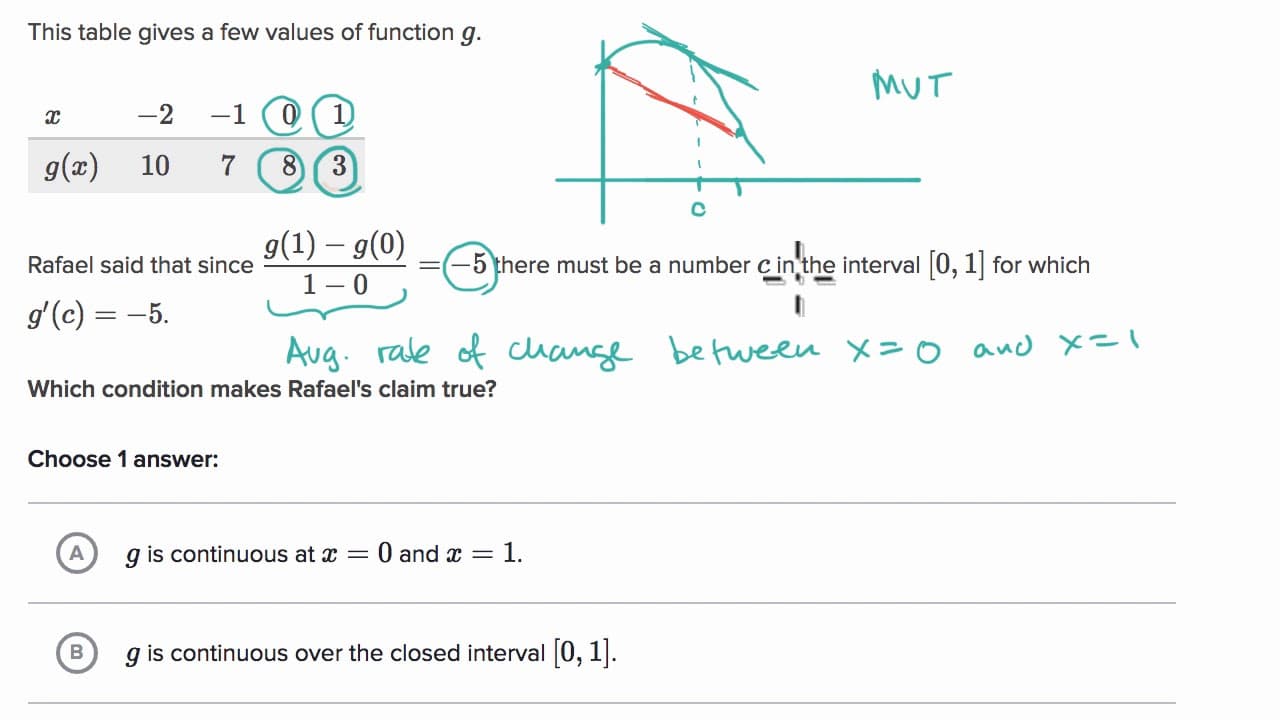
- [Instructor] This table gives us a few values of the function g. So we know what g of x is equal to with these values right over here. X is equal to negative two, negative one, zero, and one. It says Rafael said that since g of one minus g of zero over one minus zero is equal to negative five, there must be a number c in the interval in the close... Read More
Key Insights
- 😥 Rafael is using the average rate of change between two points to make a claim about the derivative of the function within an interval.
- ☠️ The mean value theorem guarantees the existence of a number within an interval where the derivative is equal to the average rate of change.
- 😚 To apply the mean value theorem, the function must be continuous over the closed interval and differentiable over the open interval.
Install to Summarize YouTube Videos and Get Transcripts
Explore YouTube Video Summarizer or Get YouTube Transcript Extractor
Questions & Answers
Q: What is the mean value theorem?
The mean value theorem states that if a function is continuous over a closed interval and differentiable over an open interval, then there must be a number within the closed interval where the derivative of the function is equal to the average rate of change.
Q: What conditions need to be met to apply the mean value theorem?
The function must be continuous over the closed interval and differentiable over the open interval.
Q: Why is it important to meet the conditions of the mean value theorem?
Meeting the conditions ensures that the conclusion drawn from applying the mean value theorem is valid. Without meeting the conditions, the theorem cannot guarantee the existence of a number where the derivative is equal to the average rate of change.
Q: Which choice satisfies the conditions for applying the mean value theorem in this case?
The choice that states "g is differentiable over the open interval from -1 to 1" satisfies the conditions of the theorem, as it covers the open interval [0, 1] that we are interested in.
Summary & Key Takeaways
-
Rafael claims that there must be a number within the interval [0, 1] where the derivative of the function g is equal to -5, based on the average rate of change between x = 0 and x = 1.
-
To apply the mean value theorem, we need to meet the conditions of the theorem, which include the function being continuous over the closed interval and differentiable over the open interval.
-
Of the given choices, the condition that makes Rafael's claim true is that g is differentiable over the open interval from -1 to 1.
Read in Other Languages (beta)
Share This Summary 📚
Summarize YouTube Videos and Get Video Transcripts with 1-Click
Try YouTube Summary with ChatGPT & Claude or YouTube Transcript Generator
Explore More Summaries from Khan Academy 📚



Summarize YouTube Videos and Get Video Transcripts with 1-Click
Try YouTube Summary with ChatGPT & Claude or YouTube Transcript Generator